Best technique for high water spring steelhead fishing
Spring in British Columbia, with its melting snowpacks and sudden downpours, often turns our beloved steelhead rivers into roaring, turbid beasts. It can be incredibly frustrating to hit your favourite run only to find it a raging torrent, making your usual fishing spots and techniques seem completely useless. But don't despair! This comprehensive guide will walk you through the precise strategies, gear adjustments, and river-reading skills you need to successfully target steelhead even when the water is high and fast, helping you turn those challenging conditions into rewarding opportunities.
Navigating the Challenge of High Water Spring Steelhead Fishing
High water conditions are a double-edged sword for steelhead anglers in British Columbia. On one hand, the increased flow and often murkier water can push steelhead closer to the banks, offering new holding lies and making them feel more secure. On the other hand, the sheer power of the current makes it incredibly difficult to get your presentation down to the fish, and visibility for both you and the fish can be severely limited. Understanding why the river behaves this way and how steelhead react is the first step toward adapting your approach.
The Impact of Snowmelt and Spring Rains
The spring season in BC is characterized by significant hydrological changes. As temperatures rise, the immense snowpack in our mountains begins to melt rapidly, swelling countless rivers. This natural phenomenon is often compounded by heavy spring rains, further increasing water levels and flow rates. This influx of water doesn't just raise the river; it changes its character entirely. The water often becomes colder, heavier, and frequently laden with sediment, reducing clarity to just a few inches. This combination of speed, depth, and murkiness creates a formidable challenge for anglers used to clear, moderate flows.
For the steelhead themselves, these changes are critical. They are powerful fish, but they are also energy conservers. They won't fight the main current more than they absolutely have to. Instead, they'll seek out predictable holding lies that offer refuge from the relentless flow, often where they can expend minimal energy while still having access to potential food sources. Recognizing these zones becomes paramount to successful fishing in high water.
Prioritizing Safety in Swift Currents
Before you even think about casting, safety has to be your absolute top priority when fishing high water in BC. Swift currents can be incredibly dangerous, even in seemingly benign spots. What looks like a gentle eddy from the bank can have powerful undertows, and unstable banks can give way without warning. Always tell someone where you are going and when you expect to return. Never fish alone if possible, especially when wading in high water.
Always wear a personal flotation device (PFD), even if you're not planning to wade deep. A sudden slip or unexpected depth change can put you in a perilous situation quickly. A wading staff is not optional; it's a critical tool for maintaining balance and probing the bottom for stability. Be aware of your surroundings: submerged logs, shifting gravel, and debris being carried downstream all pose significant hazards. Your gear can be replaced; your life cannot. For more crucial insights into staying safe on the water, you might want to read our guide on How to wade a BC steelhead river safely.
Adapting Your Gear for Raging Rivers and Turbid Waters
Fishing in high, fast water demands a fundamental shift in your gear setup. Your standard low-water tackle simply won't cut it. The goal is to gain maximum control over your presentation, get your bait or lure down to the fish quickly, and have the backbone to fight a powerful steelhead in strong currents. This means thinking about heavier, more robust components from rod tip to hook point.
Heavy-Duty Rods and Reels for Power and Control
When the river is raging, you need a rod with serious backbone. Forget your light-action nymphing rod; you'll want something in the 10-12 foot range, rated for at least 10-20 lb line, often even heavier. A longer rod provides better line control, allowing you to mend your line effectively and keep your float or lure drifting naturally in the target zone. It also gives you leverage to turn a strong steelhead that might try to dive into heavy current or snags. Many anglers opt for specialized float rods designed for these very conditions.
Your reel should match the rod's power. A high-quality centrepin reel is a favourite among float fishing enthusiasts for its smooth drag-free drifts, but a robust spinning reel or baitcasting reel with a reliable drag system will also work. Ensure your reel has ample line capacity, as a hot steelhead in heavy current can peel off line at an alarming rate. When selecting these critical components, many anglers find a wide selection of suitable heavy-duty rods and reels available on Amazon, often with reviews that can guide your choice.
Line Selection and Weighting Strategies
Choosing the right line is crucial in high water. For float fishing, a high-visibility monofilament mainline is often preferred, typically in the 12-20 lb test range. The bright colour helps you track your float and line, which is essential for detecting subtle bites in turbulent water. Underneath your float, a fluorocarbon leader is excellent for its abrasion resistance and low visibility, usually in the 10-15 lb range. For detailed information on different lines and their applications, consider checking out BC Freshwater vs Tidal Waters License, Explained for broader licensing contexts, though this specific article focuses on gear.
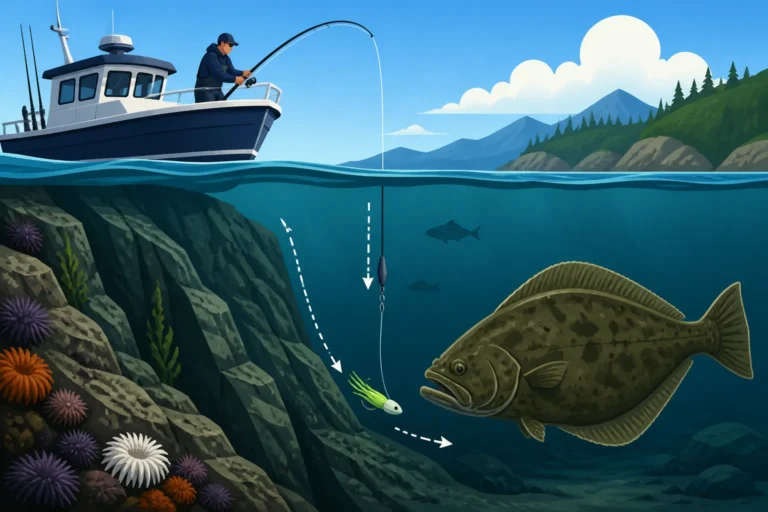
Getting your bait or lure down through strong currents to where the steelhead are holding is the biggest challenge. This means using significantly more weight than you would in lower water. A combination of pencil lead, slinky weights, or large split shot is usually employed. The key is to use just enough weight to tick the bottom occasionally without dragging excessively. Experimentation is vital here. You might need to adjust your weight as you move from one run to another, or even within the same run as the current changes. The goal is a controlled, natural drift right in the fish's face.
Mastering High-Water Steelhead Techniques for Success
Once your gear is dialed in, it's time to focus on the techniques that truly shine when BC rivers are running high. These methods are designed to effectively present your bait or lure in challenging conditions, maximizing your chances of connecting with a spring steelhead.
Float Fishing: The Undisputed High-Water Champion
When the water is high and fast, float fishing (often called 'drift fishing' when done without a float, directly on the bottom) is arguably the most effective technique for steelhead. It allows you to present your offering naturally, at the right depth, and often for a significant distance downstream. The principle is simple: use a buoyant float to suspend your bait or lure just above the bottom, allowing it to drift with the current into prime steelhead holding water. For a deeper dive into this technique, check out our guide on Drift Fishing for Steelhead in BC Rivers.
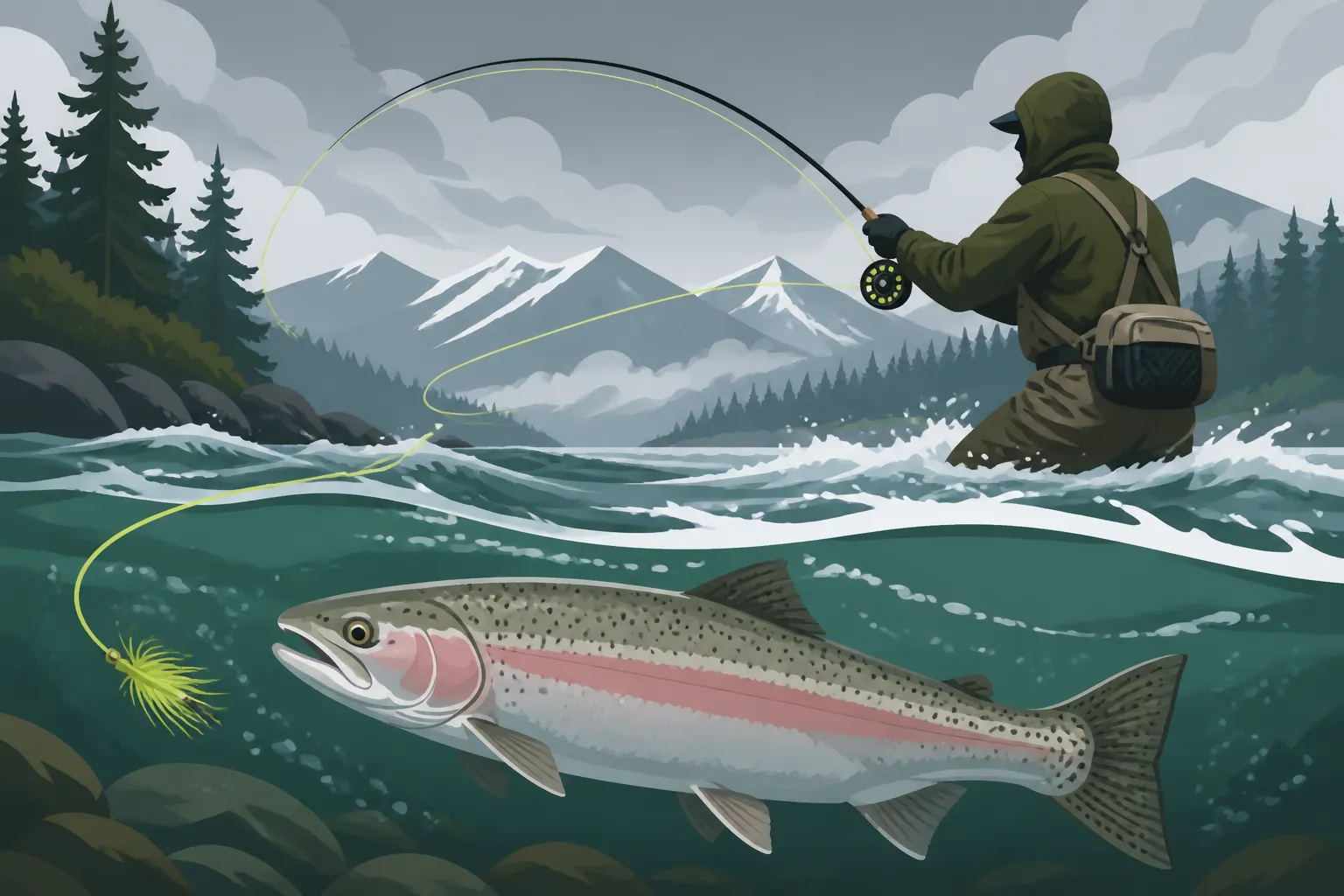
The setup for high-water float fishing involves a long rod, a large fixed or sliding float, heavy mainline, substantial pencil lead or slinky weight, and a fluorocarbon leader. Baits like roe bags, gooey bobs, or even brightly coloured artificial worms and jigs are often threaded onto a robust hook. The trick is to ensure your weight is heavy enough to get your bait down quickly, but not so heavy that it constantly snags the bottom. You want a controlled drift, just a hair slower than the surface current, indicating your weight is occasionally tapping the riverbed. Mending your line frequently to keep it free from drag is absolutely essential to achieving a natural presentation.
Bottom Bouncing and Indicator Nymphing
While float fishing reigns supreme, other techniques can also be highly effective depending on the specific conditions. Bottom bouncing involves a similar weighting strategy to float fishing, but without the float. Instead, you're relying on the feel of your line and the rod tip to detect strikes as your weight bounces along the riverbed. This is particularly effective in very turbid water where fish are holding tight to the bottom and visual cues from a float might be impossible to detect. This technique allows you to cover seams and pockets that might be too shallow or too turbulent for a float rig.
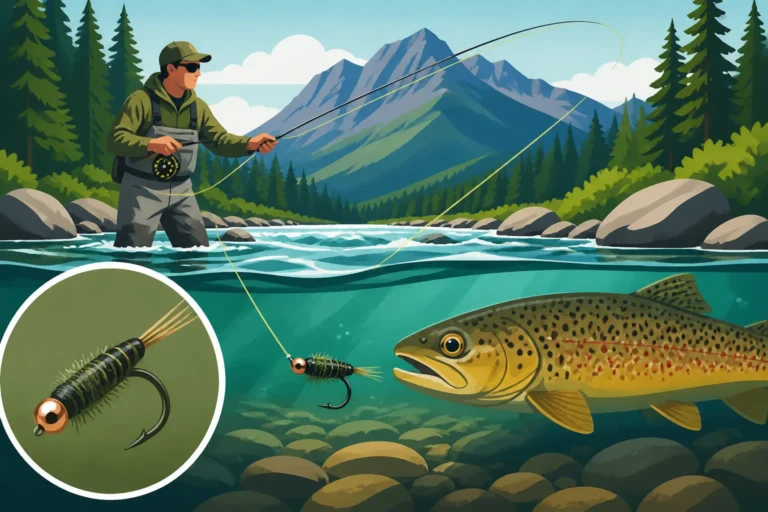
Indicator nymphing, a favourite for trout and often used for steelhead in clearer conditions, can still work in high water if the clarity isn't too compromised and the current isn't overwhelming. The key is to use larger, heavier nymphs, sometimes with added split shot, and a more buoyant indicator to hold it all up. This method is often employed in smaller, more manageable side channels or eddies rather than the main heavy current. Experiment with fly patterns that create a strong silhouette or vibration, as visual cues are limited. You can find robust indicators and weighted nymphs for these conditions on Amazon, perfect for a quick resupply.
Spoons, Spinners, and Swinging Flies
For more aggressive steelhead in slightly clearer (or at least less opaque) high water, spoons and spinners can be incredibly effective. The vibration and flash they produce can attract fish even in low visibility. Opt for larger, heavier spoons like the Koho or Croc, in bright, contrasting colours such as chartreuse, orange, or metallic patterns. Cast them slightly upstream and across, letting them swing and wobble through likely holding water. Ensure your reel has a strong enough retrieve to handle the current pulling on your lure.
Swinging flies, a classic steelhead technique, can also work in high water, but often requires specialized gear and patience. You'll need heavier spey or switch rods, aggressive sinking tips, and larger, bulkier flies that push a lot of water. The idea is to cast across and downstream, letting the fly swing through the steelhead's holding lie. While less common in the absolute highest, murkiest conditions, it can be deadly in rivers that retain some clarity, especially if the water is merely high, not completely blown out. Our article on Fly Patterns for BC Steelhead Rivers offers more on pattern selection.
Finding the Elusive Steelhead in Swift, Swollen Flows
When the river is high and fast, steelhead aren't spread out evenly. They become incredibly concentrated in specific types of water where they can find respite from the powerful current. Learning to "read the water" in these conditions is perhaps the most critical skill for consistent success. Forget the textbook runs; you're looking for subtle anomalies in the flow.
Seeking Out Slower Water and Current Breaks
The golden rule for high-water steelhead fishing is to target the slowest water you can find. Steelhead will expend as little energy as possible, so they will gravitate towards areas where the current is significantly reduced. This includes:
- Inside Bends: As the river turns, the fastest current is on the outside bend. The inside curve often has a slower, shallower shelf where fish can hold.
- Eddies: These are pockets of reverse or swirling current, often found downstream of large obstructions like fallen trees, boulders, or points of land. The fish will sit at the "head" of the eddy, where the main current meets the slower water, or deeper within the eddy itself.
- Current Seams: These are the visible lines where fast water meets slow water. Steelhead will often hold directly in the slower water, just off the seam, waiting for food to drift by in the faster flow. These can be particularly productive.
- Back Channels and Sloughs: If the river has side channels or flooded sloughs that are somewhat protected from the main current, these can be prime holding areas, especially if they have some depth.
Don't be afraid to experiment with your casting angles and drifts. Often, the most productive lies are surprisingly close to the bank, even within a few feet of shore.
Closer to the Banks and Deeper Holding Lies
In high water, steelhead frequently hug the banks. The water velocity is slowest closest to the shore due to friction, and often, the banks offer additional cover from overhead predators and strong currents. Look for any structure that breaks the current: overhanging branches, undercut banks, root wads, or large rocks. These provide ideal ambush points where a steelhead can sit comfortably and dart out for a passing meal. Your goal is to get your float, lure, or fly drifting naturally right along these banks, often within inches of the shore.
Furthermore, fish often hold deeper in high water. The increased flow provides more overhead cover, and the deeper water can offer a more stable environment. This means you need to be diligent about ensuring your presentation is getting down to the fish. Whether you're float fishing or bottom bouncing, always err on the side of slightly more weight to ensure your offering is ticking the bottom or just off it. Sometimes, adjusting your depth by just six inches can make all the difference between an empty swing and a screaming reel. Remember, the fish aren't going to move far to find your bait, so you need to put it right in their face. Understanding Best water temperature for steelhead fishing can also provide clues about their preferred holding depths.
A Comparative Look at High-Water Steelhead Techniques
Here's a quick overview of the most effective techniques for high-water conditions, along with their key advantages and challenges:
| Technique | Best For | Key Advantages | Challenges | Essential Gear |
|---|---|---|---|---|
| Float Fishing | Most high-water scenarios, varying clarity | Natural drift, excellent depth control, visible bite | Requires active line mending, snagging potential | Long rod, large float, heavy weight, high-vis mono, roe/jigs |
| Bottom Bouncing | Very turbid water, deep holding lies | Direct bottom contact, good feel for structure | Harder to detect subtle bites, frequent snagging | Robust rod, heavy weight (slinky), sensitive line, roe/jigs |
| Spoons/Spinners | Aggressive fish, moderate turbidity, active bite | Flash & vibration attracts, covers water quickly | Less effective in extreme turbidity/current, tiring | Medium-heavy rod, heavy spoons/spinners (bright colors), strong retrieve reel |
| Swinging Flies | Moderate high water, slightly clearer streams | Classic presentation, highly effective if fish are active | Limited by extreme turbidity/current, specialized gear | Spey/Switch rod, heavy sinking tips, bulky flies (intruder style) |
No matter which technique you choose, the patience to adjust and the willingness to learn from each drift are your greatest assets. Sometimes the smallest adjustment to your lead, your leader length, or your cast can unlock a day's worth of action. Don't be afraid to experiment, and remember that even in challenging conditions, British Columbia's steelhead are out there, waiting for a well-presented offering. If you're looking for prime locations to test these techniques, our guide on Best Steelhead Rivers in BC can point you in the right direction. Or, if you prefer guided trips, explore Best Guided Steelhead Trips on the Skeena for expert assistance.
Disclaimer
The information provided in this guide is for general informational purposes only and is not intended as legal, safety, or professional fishing advice. Always consult current British Columbia fishing regulations and local conditions before heading out, and prioritize your safety above all else. Fishing regulations, conditions, and best practices can change rapidly.