Best rig for bottom fishing for sturgeon
British Columbia's rivers, especially the mighty Fraser, are legendary for their colossal white sturgeon. But targeting these prehistoric giants with their immense power and incredible fighting spirit isn't like your average trout fishing trip. Many anglers get frustrated because their standard gear just can't stand up to the challenge of heavy currents, snaggy bottoms, and a fish that can weigh hundreds of pounds. This guide is all about setting you up for success, detailing the best rig for bottom fishing for sturgeon, so you can confidently tackle these incredible creatures.
The Unique Demands of Sturgeon Bottom Fishing
Sturgeon fishing is a whole different ballgame. You're not just casting a lure and reeling it in; you're setting up a robust system designed to hold bait perfectly still in raging currents and then withstand the incredible power of a fish that can peel line off your reel faster than you thought possible. It requires specialized gear and an understanding of how these magnificent fish operate.
Understanding Sturgeon Behavior and Habitat
White sturgeon are fascinating creatures, primarily bottom feeders and scavengers, using their sensitive barbels to detect food along the riverbed. They tend to hang out in deeper holes, troughs, and current seams where food naturally washes down and collects. On a river like the Fraser River Fishing Guide, you'll find them in areas with slower currents adjacent to faster-moving water, or near drop-offs and significant underwater structure where they can ambush prey or scavenge.
Their diet largely consists of whatever dead or dying fish and invertebrates are available, which is why fresh, oily bait is so effective. Given their preferred habitat and feeding style, your rig needs to be designed to keep your bait stationary right on the bottom, in the strike zone, without getting swept away or hopelessly snagged. This means your components must be incredibly strong and abrasion-resistant, as the riverbed is often littered with rocks, logs, and other debris.
Why a Specialized Rig is Crucial
You might think a heavy-duty salmon rig would suffice, but sturgeon are on another level. A standard rig simply won't cut it. Firstly, the sheer size and power of a sturgeon mean any weak link in your setup will be exploited. A 200-pound sturgeon can snap lines, bend hooks, and bust swivels that aren't specifically designed for its force. Secondly, the environments they inhabit, particularly the swift, murky waters of the Lower Fraser River Sturgeon Fishing, are incredibly harsh on tackle. Strong currents demand heavy weights to keep your bait in place, and these weights need to be securely attached to avoid losing your entire setup.
Lastly, effective bait presentation is key. Sturgeon rely heavily on scent and feel. Your rig needs to present the bait naturally on the bottom, allowing the sturgeon to pick it up without feeling undue resistance from your mainline or weight. This requires a specific configuration that balances strength with sensitivity, giving you the best chance to detect a bite and land one of these impressive fish.
Anatomy of the Ultimate Sturgeon Bottom Fishing Rig
Building a robust sturgeon rig isn't about complexity; it's about selecting the right, heavy-duty components and assembling them correctly. Each piece plays a critical role in ensuring your bait stays put and your line holds true against these powerful fish.
Heavy-Duty Main Line and Leader
Your mainline is the foundation of your entire setup. For sturgeon, especially on large rivers with strong currents, braided line is almost universally preferred. It offers incredible strength-to-diameter ratio, has virtually no stretch (which improves bite detection), and casts heavy weights remarkably well. You'll want a braid in the 80 to 150 lb test range, depending on the average size of fish in your target area and the strength of the current. Brands like PowerPro or Izorline are popular choices for their durability and knot strength. When looking to upgrade your setup, check out "Best line for sturgeon fishing in heavy current" for more in-depth advice.
Your leader is arguably the most critical component, as it's the section directly exposed to the fish's mouth, sharp fins, and the abrasive riverbed. A heavy monofilament or fluorocarbon leader, typically 100 to 200 lb test, is essential. Monofilament offers a bit more stretch and abrasion resistance than braid in this application, and its thicker diameter can be more forgiving against rough surfaces. Fluorocarbon offers even better abrasion resistance and is less visible underwater, though it can be pricier. The leader should be at least 3-6 feet long, sometimes even longer in very clear or calm water, allowing for a more natural presentation of the bait. Many anglers buy large spools of leader material, which you can often find readily available on Amazon.
Swivels, Snaps, and Beads for Security
These small but mighty components ensure your rig functions smoothly and securely.
- Swivels: You'll want heavy-duty barrel swivels or ball-bearing swivels rated for at least 200-300 lb test. The swivel acts as a critical connection point between your mainline and your leader, preventing line twist, especially when dealing with heavy currents or a fighting fish that rolls. A good quality swivel is non-negotiable.
- Snaps (for weights): For attaching your weight, a heavy-duty snap swivel is often used. This allows for quick changes of sinker size depending on current conditions. Again, look for ratings that exceed the maximum expected pull from a sturgeon, typically 200 lb test or more.
- Beads: A bead is a small, hard plastic or ceramic piece that sits between your sliding sinker and your swivel. Its purpose is twofold: to protect the knot on your swivel from being constantly chafed by the heavy sinker, and to prevent the sinker from sliding over the swivel and jamming. Choose robust, durable beads that won't crack under pressure.
The Right Hooks for Big Fish
Hook choice is paramount for sturgeon fishing, not just for catching them, but for their safety, as well. In British Columbia, particularly on the Fraser River, circle hooks are often mandated for sturgeon fishing due to their high conservation value. These hooks are designed to hook the fish in the corner of the mouth, minimizing gut-hooking and improving the chances of a successful catch and release. To ensure a healthy release, it's also important to follow all the "BC Fraser River Sturgeon Catch and Release Requirement" rules.
- Circle Hooks: Look for strong, heavy-gauge circle hooks, typically in sizes from 10/0 to 16/0. The size will depend on your bait and the average size of the sturgeon you're targeting. Gamakatsu, Owner, and Mustad all make excellent, sharp, and durable circle hooks suitable for sturgeon. Ensure they are razor-sharp right out of the package.
- J-Hooks (if allowed): In areas where J-hooks are permitted, you'd still opt for heavy-duty, strong hooks in similar large sizes. However, always prioritize circle hooks for conservation when possible, and always check local regulations before you go. Remember to review "Sturgeon catch and release survival tips" to ensure the fish's well-being.
Weighting Your Rig for Immovability
This is where many anglers struggle. Keeping your bait stationary in strong current requires serious weight.
- Weight Types:
- Pyramid Sinkers: Their flat sides and pyramid shape help them dig into the bottom, making them excellent for strong currents.
- Flat Bank Sinkers: Similar to pyramid sinkers, their flat profile helps them hold bottom.
- Cannonball/Bell Sinkers: While effective, their round shape can make them roll more in very strong currents.
- Homemade Weights: Some anglers pour their own weights using rebar or other scrap metal, often in heavy, flat shapes to maximize bottom-holding power.
- Weight Sizes: You might need anywhere from 8 ounces to a whopping 32 ounces (2 pounds) or even more in extreme currents. The key is to use enough weight so that your rig stays absolutely stationary. If your line is dragging or pulsing with the current, you need more weight. It's always a good idea to carry a variety of sizes, which you can often find in bulk packs on Amazon, so you can adapt to changing conditions.
Step-by-Step Rigging Techniques for Fraser River Sturgeon
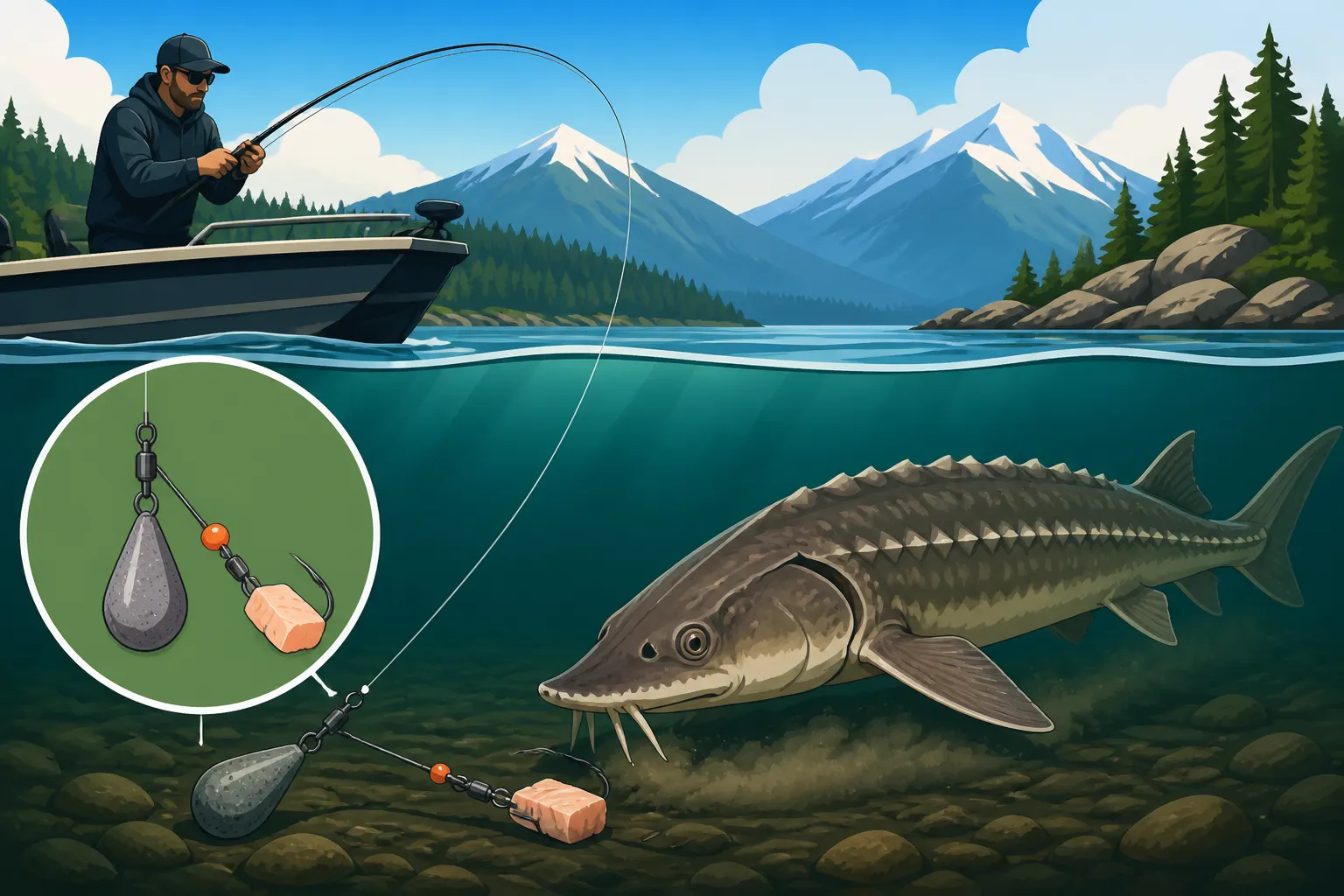
While there are variations, the most common and effective rig for bottom fishing for sturgeon is a modified Carolina rig, often referred to simply as a "sliding sinker rig." This design allows the sturgeon to pick up the bait without feeling the heavy sinker, giving them time to commit before you set the hook.
The Basic Sliding Sinker Rig (Carolina Rig Variant)
This rig is the workhorse for sturgeon anglers on the Fraser and similar rivers. It’s effective because it provides a direct connection to the fish while allowing the heavy sinker to remain stationary on the riverbed.
- Step 1: Mainline Preparation. Start with your heavy braided mainline coming off your reel.
- Step 2: Add the Sinker. Thread your chosen heavy sinker (pyramid or flat bank sinker) directly onto your braided mainline. Make sure the line passes smoothly through the eye of the sinker.
- Step 3: Add the Bead. Slide a durable bead onto the mainline after the sinker. This bead acts as a buffer, protecting your knot from the constant banging of the heavy sinker. Without it, the sinker could easily weaken or fray your knot over time, leading to a break-off when you least expect it.
- Step 4: Tie on the Swivel. Tie your heavy-duty barrel swivel to the end of your mainline using a strong knot like a Palomar knot or a uni-knot. Ensure the knot is cinched down tightly and trim any excess tag end.
- Step 5: Attach the Leader. Tie your heavy monofilament or fluorocarbon leader (typically 100-200 lb test, 3-6 feet long) to the other end of the barrel swivel. Use the same strong knots here. The length of the leader can be adjusted based on water clarity and current speed; longer leaders offer a more natural bait presentation but can be harder to cast and manage.
- Step 6: Tie on the Hook. Finally, tie your large, heavy-gauge circle hook (10/0 to 16/0) to the end of your leader. Again, a Palomar knot or an improved clinch knot works well. Double-check all your knots for integrity.
- Step 7: Baiting Up. Thread your chosen bait (e.g., fresh eulachon, salmon roe, lamprey, or even a combination) onto the circle hook. Ensure the hook point is exposed and the bait is securely fastened so it doesn't wash off in the current. Remember, fresh bait, like what's discussed in "Best bait for sturgeon on the Fraser River", is almost always superior.
The Fixed Sinker Rig for Specific Conditions
While less common for active fishing in strong currents, a fixed sinker rig can have its place, particularly in areas with less current or when targeting a very specific small zone. In this setup, the sinker is tied directly to the end of the leader, and a dropper line (a shorter leader) with the hook is tied above it.
- Construction: Start with your mainline, tie on a heavy-duty three-way swivel. To one eye, tie a short (6-12 inch) dropper line with your heavy sinker attached. To another eye, tie a longer (1-3 foot) leader with your hook. The main line attaches to the third eye.
- Advantages: This rig can prevent tangles in very mild currents and keeps the bait slightly off the bottom, which can be useful if the bottom is extremely snaggy. It’s also often used in "bar fishing" scenarios where multiple rigs are deployed from an anchored boat or shore.
- Disadvantages: The sturgeon will feel the weight immediately when it takes the bait, which can lead to dropped bites. It's also more prone to snagging the mainline in strong, rocky currents. For the powerful flows of the Fraser, the sliding sinker rig is almost always preferred.
Bait Presentation and Preservation
The best rig in the world won't work without enticing bait. Sturgeon are scavengers, drawn to strong scents.
- Fresh is Best: Eulachon (candlefish), salmon roe, lamprey, and even chunks of fresh salmon or other oily fish are top choices. The fresher, the better, as the natural oils and scents are what attract sturgeon from downstream. You might want to consider the "Best time to fish the Fraser River in summer" for optimal bait freshness.
- Scent Enhancement: Some anglers will "milk" their bait by gently squeezing it to release more oils, or add commercial scent attractants to give it an extra kick.
- Secure the Bait: When using circle hooks, you'll typically thread the bait on so the hook point is exposed. For larger baits, you might need to use a bait loop or thread a small zip tie through the bait and around the hook shank to keep it from tearing off in the current or from small fish nibbling. Make sure your hook is well-presented within the bait so that when a sturgeon mouths it, the hook can properly rotate and set in the corner of its jaw.
Deploying and Managing Your Sturgeon Rig in BC Waters
Once your rig is perfectly tied, the real work begins: getting it into the water effectively and managing it for a bite. This is where local knowledge and patience truly pay off.
Reading the Water and Choosing Your Spot
Sturgeon love structure and current breaks. Look for:
- Deep Holes: These are prime resting and feeding areas where food settles.
- Current Seams: The transition zone between fast and slow water often holds fish.
- Drop-offs and Ledges: These underwater features provide ambush points and cover.
- Confluences: Where two rivers meet, the mixing currents can concentrate baitfish and therefore sturgeon.
- Inside Bends: Often deeper and with slower currents, these can be hotspots.
Understanding "How to read structure for sturgeon on the Fraser" will dramatically increase your chances. Using a good fishfinder or depth sounder on your boat is invaluable for identifying these key areas. Scan the bottom for humps, depressions, and schools of baitfish, which often indicate the presence of larger predators. Remember, sturgeon are rarely in the fastest current; they prefer to sit just out of it, expending minimal energy while waiting for food.
Casting and Anchoring for Optimal Placement
Given the heavy weights involved, casting for sturgeon can be demanding.
- Casting Technique: Use a long, powerful rod (like those recommended in "Best rod setup for Fraser River sturgeon") and a smooth, deliberate casting motion. Overhand casts are usually best. Aim to cast slightly upstream from your target spot, allowing the current to carry your rig down and settle into the desired zone.
- Anchoring: If fishing from a boat, proper anchoring is crucial. You'll need a heavy anchor system (often a sturdy river anchor with plenty of chain and rope) to hold your boat firmly in the current. Anchor well upstream of your intended fishing spot and let out enough rope to allow your boat to settle perfectly over or just upstream of the area you want to fish. Many experienced guides use two anchors—one off the bow and one off the stern—to keep the boat perfectly stationary, preventing it from swinging in the current and dragging your rigs. Being well-anchored not only keeps your bait in the strike zone but also makes fighting a large sturgeon much safer and easier.
The Waiting Game and Hooksetting Strategy
Sturgeon fishing is often a game of patience. These fish aren't always aggressive biters.
- Detecting Bites: A sturgeon bite can range from a series of gentle taps or nibbles on your rod tip to a sudden, powerful pull that bends your rod over dramatically. Sometimes, the line will simply go slack as the fish picks up the bait and swims upstream. Keep a close eye on your rod tip for any unusual movement.
- The Circle Hook Advantage: With circle hooks, you generally don't "strike" to set the hook in the traditional sense. When you feel a definite bite, simply pick up your rod, reel down until you feel the weight of the fish, and apply steady pressure. As the fish swims away, the circle hook is designed to slide into the corner of its mouth and set itself. A hard, sweeping hookset can actually pull the circle hook out of the fish's mouth.
- Staying Vigilant: Even with the best setup, small fish can sometimes peck at your bait. Be patient and wait for a truly solid indication that a sturgeon has taken the bait. When that rod doubles over, be ready for the fight of your life!
| Component | Recommended Specification (Minimum) | Purpose | Where to Find |
|---|---|---|---|
| Mainline (Braid) | 80-150 lb Test | Strength, no stretch, good casting for heavy weights | Local tackle shop, Amazon, Outdoor stores |
| Leader (Mono/Fluoro) | 100-200 lb Test, 3-6 ft length | Abrasion resistance, knot protection, bait presentation | Local tackle shop, Amazon, Fishing specialty stores |
| Swivel (Main) | 200-300 lb Test Barrel/Ball Bearing | Prevents line twist, connects mainline to leader | Local tackle shop, Amazon, Marine suppliers |
| Swivel (Weight) | 200 lb Test Snap Swivel | Attaches sinker for quick changes | Local tackle shop, Amazon |
| Beads | Heavy Duty, Hard Plastic/Ceramic | Protects mainline knot from sinker abrasion | Local tackle shop, Amazon |
| Hooks | 10/0 – 16/0 Heavy Gauge Circle Hooks | Safe, effective hooking; often mandatory for sturgeon | Local tackle shop, Amazon, Major fishing brands |
| Sinkers | 8 oz – 32 oz+ Pyramid/Flat Bank | Holds bait stationary in strong currents | Local tackle shop, Amazon, Hardware stores |
Disclaimer
Fishing regulations, license requirements, and catch limits for British Columbia waters can change frequently. It is the angler's responsibility to review and understand the most current regulations published by Fisheries and Oceans Canada (DFO) and the BC Freshwater Fishing Regulations Synopsis before heading out. This guide is for informational purposes only and should not replace official sources. Always prioritize safety, responsible angling practices, and conservation.