Sturgeon Growth Rate to Trophy Size
Many anglers dream of landing a true behemoth, especially when it comes to the legendary white sturgeon of British Columbia. There’s a natural curiosity that comes with these ancient giants: just how long does it take for them to reach those incredible, record-breaking sizes? It's a question that echoes among fishing enthusiasts, often accompanied by a tinge of frustration when the biggest fish seem to elude us year after year. This guide is here to unravel the mysteries of sturgeon growth, helping you understand the remarkable journey these fish undertake from tiny fry to colossal trophy.
Understanding the White Sturgeon: A BC Icon
The white sturgeon (Acipenser transmontanus) is North America's largest freshwater fish, a living fossil that has roamed the waters of British Columbia for millions of years. For anglers, particularly those drawn to the mighty Fraser River, the white sturgeon represents the pinnacle of freshwater sport fishing. They aren't just big; they are a vital part of our ecosystem and hold immense cultural significance. Their sheer size and longevity make them a species of incredible interest, and understanding their biology, especially their growth patterns, is crucial for anyone hoping to truly appreciate these magnificent creatures.
The Life Cycle of a Fraser River Giant
The life cycle of a white sturgeon is a marathon, not a sprint, which is precisely why they can attain such extraordinary sizes. It all begins with tiny, adhesive eggs, typically spawned in spring or early summer in turbulent, rocky stretches of rivers. These eggs hatch into larvae, which quickly develop into fry, no bigger than your pinky finger. From there, they enter a juvenile stage, where they grow relatively quickly in the rich, food-abundant waters of rivers like the Fraser.
As they mature, they become sub-adults, still growing, but at a more measured pace. What makes them truly unique is their incredible lifespan, often exceeding 100 years, with some individuals estimated to be even older. Imagine a fish that has witnessed over a century of changes on the Fraser! This extended lifespan allows them to accumulate mass over decades, eventually reaching the awe-inspiring dimensions that define a trophy sturgeon. Their journey from a minuscule egg to a multi-hundred-pound giant is a testament to their resilience and the health of their habitat.
Why Growth Rate Matters to Anglers and Conservationists
For anglers, the growth rate of sturgeon is intimately tied to the dream of a trophy catch. We all want to know if that 6-foot fish we just released has the potential to become an 8-foot monster in a few more decades. Understanding how quickly these fish grow helps us appreciate the age and history behind each catch, making the experience even more profound. It's not just about the fight; it's about connecting with a living legend.
From a conservation standpoint, knowing the growth rate is absolutely critical. It helps scientists and fisheries managers understand population dynamics, assess the impact of fishing pressure, and implement effective regulations. For instance, if a species grows very slowly, it means that losing even a few large, old breeding individuals can have a disproportionately large impact on future generations. This knowledge underpins the rigorous BC Fraser River Sturgeon Catch and Release Requirement and other protective measures, ensuring these ancient fish continue to thrive for future generations of anglers and nature lovers. It allows us to fish responsibly, knowing that the giants we release have a chance to grow even larger and contribute to the population.
Factors Influencing Sturgeon Growth Rate
It’s not just about time; a multitude of factors play into how quickly a sturgeon will pack on the pounds and length. Think of it like a carefully calibrated ecological equation, where every variable can tip the scales, quite literally. Understanding these factors is key to appreciating why some areas produce bigger fish, and why individual growth can vary so wildly.
Diet and Food Availability
Perhaps the most obvious factor influencing growth is food. Sturgeon are opportunistic bottom feeders, and their diet consists of whatever they can find on the riverbed. This includes a smorgasbord of invertebrates, fish eggs, and smaller fish. On the mighty Fraser River, the abundance of salmon during their migrations provides a crucial, nutrient-rich feast. When millions of salmon enter the river system to spawn, they bring with them an incredible influx of protein and fat, both through their carcasses after spawning and the eggs they lay.
A sturgeon living in a system with consistent, rich food sources, like the Fraser River Fishing Guide outlines, will generally grow faster and larger than one in a less bountiful environment. Consider two hypothetical sturgeon, both born the same year. One grows up in the lower Fraser, where salmon runs are plentiful and marine influences bring in a diverse diet. The other might be in a more isolated tributary with scarcer food. The Fraser sturgeon will almost certainly outgrow its cousin significantly over their lifetime. A well-fed sturgeon is a fast-growing sturgeon, and the sheer volume of biomass available in the lower Fraser is a huge reason How big white sturgeon get in the Fraser River is so impressive. Anglers often use the Best bait for sturgeon on the Fraser River, like eulachon or salmon parts, to appeal to their natural scavenging instincts, further testament to their diet.
Water Temperature and Habitat
Water temperature plays a subtle but significant role in a sturgeon's metabolic rate and, consequently, its growth. Like all cold-blooded creatures, sturgeon are more active and digest food more efficiently in warmer water, up to a certain point. Prolonged periods of optimal temperatures, coupled with abundant food, can accelerate growth. Conversely, colder waters or extreme temperature fluctuations can slow down their metabolism and growth.
Habitat also plays a critical role. Sturgeon prefer large, deep river systems with good current, rocky substrates for spawning, and plenty of deep pools and eddies for resting and foraging. The vastness and ecological diversity of the Fraser River provide an ideal habitat that supports healthy growth. Rivers with less diverse habitats, fewer deep pockets, or more constricted flows might not offer the same opportunities for foraging and shelter, potentially impacting growth rates. The ability to find prime Best sturgeon spots on the Lower Fraser River often means finding areas with optimal depth, current, and food concentrations, which are exactly the conditions conducive to substantial growth.
Genetics and Individual Variation
Just like people, not all sturgeon are destined to be giants, even under perfect conditions. Genetics play a substantial role. Some individual sturgeon are simply predisposed to grow larger and faster than others, inheriting genes that favor rapid development and massive size. This is why, even within the same age class and habitat, you'll see a range of sizes.
Beyond genetics, individual variation can also stem from early life experiences. A sturgeon that had a particularly successful first few years, finding ample food and avoiding predators, might get a head start that it maintains throughout its life. Conversely, an individual that faced early challenges might always be a bit smaller for its age. This natural variability means that while we can discuss general growth trends, the specific journey of any one sturgeon is unique. It's part of the mystique that makes encountering these fish so special – you never know if you've hooked a particularly fast grower or an ancient, slow-and-steady giant. For those curious about the truly exceptional, learning about the BC record white sturgeon weight and length often reveals these genetic lottery winners.
The Journey to Trophy Size: Timelines and Milestones
Understanding the factors that influence sturgeon growth is one thing, but what does that actually look like over the course of their incredibly long lives? It's a journey marked by distinct phases, each contributing to the eventual grandeur of a trophy-sized fish.
Early Life: From Fry to Juvenile
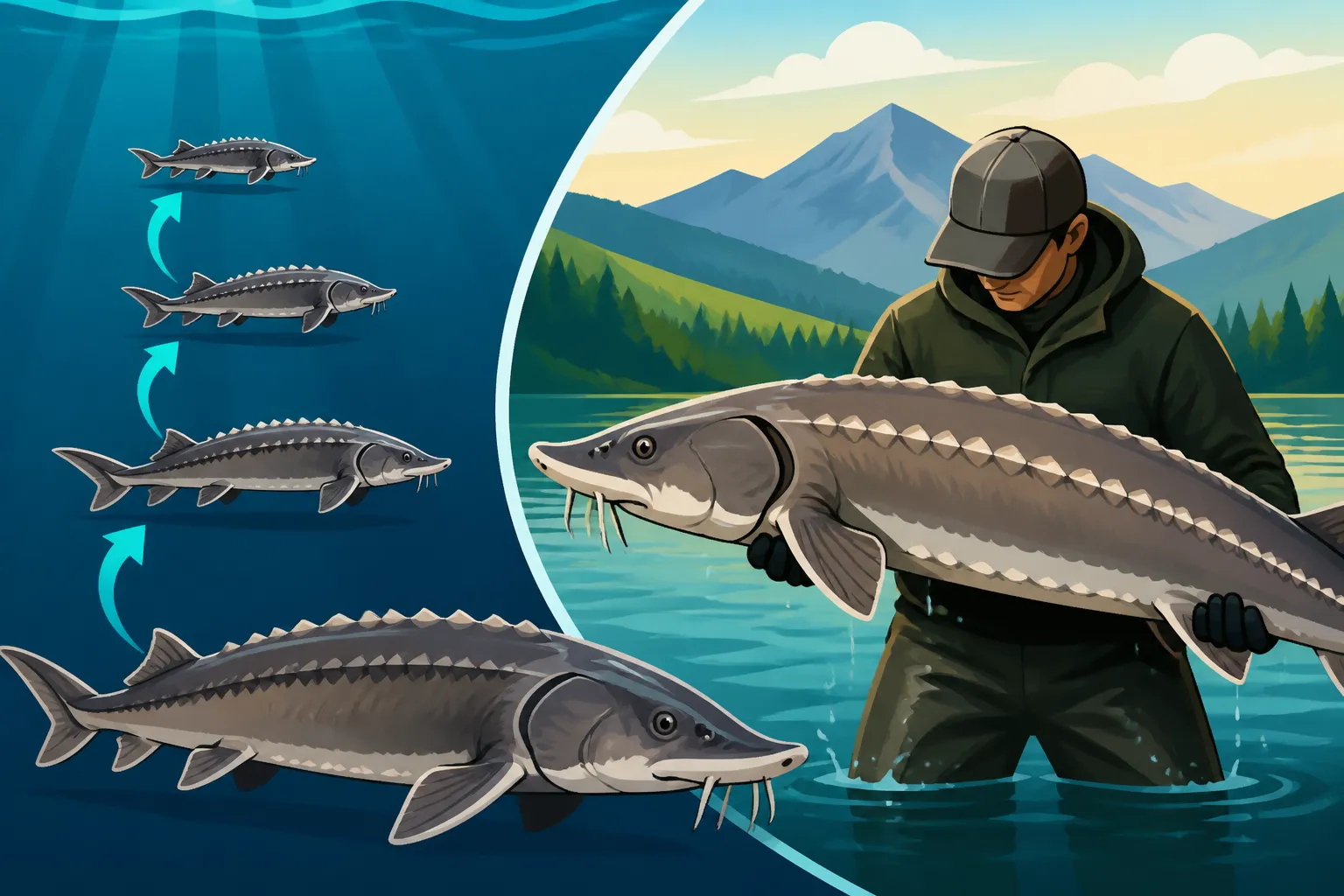
The initial years of a white sturgeon's life are characterized by rapid, almost explosive growth. From a tiny, vulnerable fry, they quickly grow into robust juveniles. In their first year, they might reach lengths of 10-20 centimeters (4-8 inches). By the time they are 3 to 5 years old, they could be over a meter (3 feet) long. This early rapid growth is crucial for survival, allowing them to quickly outgrow many potential predators. During this phase, access to rich feeding grounds and safe nursery habitats is paramount. Think of them as aquatic teenagers, eating constantly to fuel their development. Anglers exploring rivers like the Fraser will often encounter these younger fish, offering a glimpse into the future giants. For example, looking into White Sturgeon Habits on the Fraser River will show how crucial these early years are for establishing their long-term growth trajectory.
Adolescent Years: Steady Growth to Sub-Adult
As sturgeon move past their juvenile stage and into their adolescent and sub-adult years (roughly from 5 to 20-30 years old), their growth rate tends to stabilize. It's still significant, but not quite as dramatic as those initial bursts. During these decades, they continue to add length and girth, becoming substantial fish. A sturgeon in its teens might be 1.5 to 2.5 meters (5-8 feet) long, weighing hundreds of pounds. This is the stage where many anglers start to encounter truly impressive fish, often referred to as "medium" or "large" sturgeon, but not yet the "trophy" giants. These are the fish that represent the bulk of the catch for many Best Sturgeon Guides on the Fraser River.
Mature Adults: The Pursuit of the True Giant
It's in their mature adult years, often spanning from 30-40 years old and beyond, that white sturgeon truly begin to embody the term "trophy size." Growth continues, but it becomes even slower and more gradual, mainly adding girth rather than significant length. A sturgeon that is 60 or 70 years old might only be a few feet longer than one that is 30, but it will be considerably heavier and more powerful. These are the truly ancient, massive individuals that command respect, some reaching over 3-4 meters (10-13 feet) and weighing well over 1,000 pounds. These are the fish that have survived decades, perhaps even a century, of challenges, floods, and human activity. Catching and releasing such a fish is a profound experience, a connection to deep time. The pursuit of these fish is why many anglers travel far and wide, often equipping themselves with specialized gear found on platforms like Amazon to handle such immense power.
Estimating Age from Size
Estimating the age of a white sturgeon from its size is an art, not an exact science, but fisheries biologists have developed methods to do so. Unlike trees with rings, you can't just cut a sturgeon open. Instead, scientists often use the pectoral fin ray, which contains annual growth rings, similar to tree rings. By taking a small, non-lethal sample, they can section the fin ray and count these rings under a microscope.
While anglers won't be performing scientific age assessments on the water, understanding the general relationship between size and age helps contextualize your catch. A 6-foot sturgeon might be anywhere from 15 to 30 years old, depending on its specific growth history and environmental factors. An 8-foot sturgeon is very likely to be over 40-50 years old, and a truly monumental 10-foot-plus fish could easily be 80-100 years old, or even more. This incredible longevity is a key reason why conservation efforts are so vital, ensuring these ancient creatures continue their slow, steady journey to monumental sizes.
Here’s a general guide for white sturgeon size and estimated age, though remember, individual variation is significant:
| Sturgeon Length (Approx.) | Estimated Age Range (Years) | Notes |
|---|---|---|
| Up to 1 meter (3.3 ft) | 1 – 10 | Rapid growth in early life, juveniles. |
| 1 – 2 meters (3.3 – 6.6 ft) | 10 – 30 | Adolescent to sub-adults, steady growth. |
| 2 – 3 meters (6.6 – 9.8 ft) | 30 – 60 | Mature adults, significant weight gain, slower length increase. |
| 3+ meters (9.8+ ft) | 60 – 150+ | True trophy giants, very slow growth, ancient individuals. |
This table illustrates the long commitment it takes for a sturgeon to become a true river monster. When you're considering How long white sturgeon live, it truly puts into perspective the incredible journey these fish undertake.
Conservation and Sustainable Sturgeon Fishing
Given their incredible longevity and the slow pace at which they reach trophy sizes, white sturgeon are particularly vulnerable to overfishing. This is why conservation efforts in British Columbia are so robust and why every angler plays a critical role in their continued survival. We want future generations to experience the thrill of connecting with these magnificent fish, just as we do.
Catch and Release Practices
For white sturgeon in BC, catch and release is not just a suggestion; it's a mandatory regulation. Every single sturgeon caught in freshwater is required to be released alive and unharmed. This is arguably the most important conservation measure in place for these fish, especially when dealing with those prized trophy specimens that have taken decades, if not a century, to grow so large. Proper catch and release techniques are paramount. This means minimizing fight time, keeping the fish in the water as much as possible, using appropriate gear to avoid prolonged stress, and handling them with extreme care, particularly around their sensitive gills and belly. Anglers can find excellent resources, often including specialized tools and guides on Amazon, to help them practice responsible catch and release. Learning Sturgeon catch and release survival tips is absolutely vital for every sturgeon angler.
The Role of Regulations in Protecting Large Sturgeon
Beyond mandatory catch and release, a comprehensive suite of regulations is in place to protect white sturgeon. These regulations dictate everything from specific fishing seasons and locations to gear restrictions (like single, barbless hooks). The goal is to minimize stress on the fish and ensure that populations, especially of large, reproductively mature individuals, remain healthy. Large sturgeon, having survived for so long, are crucial breeders, contributing significantly to the genetic diversity and strength of the population.
These rules aren't designed to make fishing harder; they're designed to make it sustainable. By adhering to guidelines like BC Fishing Regulations Explained and understanding Special Regulation Waters in BC, anglers become part of the solution, actively contributing to the long-term health of the sturgeon fishery. Fishery managers are constantly monitoring populations and adjusting rules as needed, ensuring a delicate balance between recreational opportunity and species protection.
What You Can Do to Support Sturgeon Conservation
As an angler, you are on the front lines of conservation. Beyond following all regulations, there are several ways you can contribute:
- Educate Yourself and Others: Share your knowledge of proper catch and release techniques and the importance of conservation with fellow anglers. Many great books and educational videos are available, easily accessible through platforms like Amazon, offering in-depth insights into sturgeon biology and responsible angling.
- Report Poaching or Illegal Activity: If you witness any illegal fishing practices or habitat degradation, report it to the provincial authorities. Protecting sturgeon populations often relies on vigilant eyes on the water.
- Support Research and Monitoring: Organizations dedicated to sturgeon research often rely on public support and citizen science initiatives. Participating in or donating to these efforts helps scientists gather critical data on population health and growth.
- Choose Reputable Guides: If you opt for a guided trip, choose guides who demonstrate a strong commitment to ethical fishing practices and sturgeon welfare. Best guide services for the Fraser River's sturgeon reach will often highlight their conservation efforts. These professionals are often the best advocates for the species.
By understanding the incredible growth journey of the white sturgeon and actively participating in their conservation, we ensure that these majestic living fossils continue to thrive in British Columbia's waters for generations to come.
Disclaimer
This article is for general informational purposes only and does not constitute professional advice. Laws, prices and regulations vary by location and change over time. Consult a qualified professional for guidance on your specific situation.