How to fish a run and pool steelhead river
Many anglers arrive at a British Columbia steelhead river with high hopes, only to be confronted by the intricate puzzle of its water. The constantly shifting flows, from fast, turbulent runs to deep, quiet pools, can feel incredibly intimidating, leaving you wondering where to even begin. It's a common frustration to feel like you're missing the prime spots or using the wrong technique. This comprehensive guide is designed to equip you with the knowledge and strategies to confidently dissect and effectively fish a run and pool steelhead river, transforming your approach from guesswork to intentional angling.
Understanding Run and Pool Dynamics
Steelhead rivers across British Columbia, from the iconic Skeena system in the north to the more accessible coastal rivers near Vancouver, are complex environments. They're not just a continuous flow of water; instead, they’re composed of distinct sections, each with unique characteristics that influence how steelhead behave and where they choose to hold. Recognizing and understanding these dynamics is the absolute first step towards consistent success. It’s about more than just identifying a "good spot"; it’s about comprehending the underlying reasons why a steelhead would be there.
What Defines a Run?
A "run" is essentially a stretch of river where the current maintains a relatively consistent speed and depth, typically faster than a pool but not as chaotic as a rapids. Imagine a long, smooth conveyor belt of moving water, often with a gravel or small rock bottom. Steelhead frequently use runs for two main purposes: actively migrating upstream and opportunistically feeding. As they push against the current, they'll often pause in slightly slower seams or behind submerged structure within a run to conserve energy or to intercept dislodged food items.
Fishing a run demands an understanding of current seams and subtle holding lies. These fish are often on the move or actively searching for food, making them more susceptible to a well-presented offering that drifts naturally. A common mistake is to simply cast and let your gear get swept away. Instead, focus on mending your line to achieve a drag-free drift, allowing your bait or fly to mimic natural debris or prey. The edges of the main current, the areas behind larger rocks, or slight depressions in the riverbed are all prime real estate within a run. Covering water effectively while maintaining a natural presentation is the key here.
What Defines a Pool?
In contrast to runs, "pools" are deeper, slower-moving sections of the river. They usually form downstream from runs or rapids, or in significant bends where the water has scoured out a deep basin. Think of a pool as a sanctuary or a rest stop for migrating steelhead. After expending significant energy battling currents, steelhead seek refuge in these calmer, deeper waters to recover, hold, and conserve strength before continuing their arduous journey upstream. The surface water might appear almost still, but don't be fooled; there can still be subtle currents and deep holding lies below.
Steelhead in pools are often less active and may not be as inclined to chase a fast-moving presentation. They might be nestled tight against cut banks, under log jams, behind large boulders, or simply in the deepest, most protected parts of the pool. Your strategy for pools must shift dramatically. It's less about rapid coverage and more about systematic, methodical probing of specific features. The challenge is getting your offering down to their depth and keeping it there for a tempting duration, enticing a strike from a less aggressive fish. Understanding the nuances of these deeper sections is crucial for How to Catch Steelhead in BC.
Transitional Zones: The Often-Missed Spots
Beyond the obvious runs and pools, some of the most overlooked—and often most productive—areas are the "transitional zones" where these distinct water types meet. These are the dynamic interfaces where a fast run eases into a slow pool, or where water accelerates out of a pool into a new run. These zones create complex current patterns, seams, and eddies that provide steelhead with ideal resting and feeding lies. Many anglers rush through these areas, focusing only on the "meat" of the run or pool, missing out on prime opportunities.
Consider the "tailout" of a pool, which is the shallower, faster-moving water where the pool gradually transitions back into a run. This is a classic feeding lane where steelhead will often position themselves to intercept food swept out of the slower water. Similarly, the "head" of a pool, where the main current from an upstream run first enters the deeper, slower water, can be a fantastic holding spot. Fish will often sit just out of the main current, enjoying a reprieve but still close enough to grab an easy meal. These areas are fantastic for presentations that swing or drift slowly through the current, mimicking vulnerable prey. Don't underestimate the power of these nuanced areas; some of the biggest steelhead are taken from these strategic positions.
Essential Gear for Run and Pool Steelhead Fishing
Having the right equipment is critical for successfully navigating the diverse challenges of a run and pool steelhead river. It's not necessarily about owning the most expensive gear, but rather investing in versatile, durable tools that allow you to adapt your approach as water conditions and fish behaviour change. Your gear should feel like a natural extension of your fishing strategy, enabling effective presentation and giving you the power to land these often-powerful fish.
Rods and Reels: Matching the Water
For British Columbia steelhead, especially when fishing varied run and pool environments, versatility in your rod and reel setup is paramount. Many experienced anglers favour longer rods, typically ranging from 10 to 13 feet in length, with a medium-heavy action. These longer rods offer distinct advantages: superior line control for mending in complex currents, the ability to achieve longer, drag-free drifts with floats, and added leverage for steering powerful steelhead away from snags and obstructions once hooked. For drift and float fishing, a 10'6" or 11'3" rod can provide an excellent balance of sensitivity and backbone. Spey or switch rods are also popular choices for fly anglers looking to swing flies across wide runs.
Your reel needs to be robust and equipped with a smooth, consistent drag system. Whether you prefer the precise line control of a centrepin reel for float fishing, or a high-quality spinning or baitcasting reel, ensure it can handle the intense, often blistering runs of a fresh steelhead. Look for reels with ample line capacity and a drag that engages without hesitation or stickiness. Many anglers find durable, corrosion-resistant reels built to withstand harsh river conditions by browsing options on Amazon. A reliable reel is not just about bringing in the fish; it's about protecting lighter leaders and absorbing the shock of a powerful strike.
Line, Leaders, and Terminal Tackle
The right line setup is foundational for effective presentations in varied river conditions. For float fishing, a high-visibility monofilament mainline is often preferred, as it floats well and makes it easier to track your float and detect subtle takes. For spinning or baitcasting, braided mainline paired with a fluorocarbon leader is a popular choice, offering excellent sensitivity and casting distance. Your mainline should be strong enough to handle a steelhead's fight, typically ranging from 10 to 20 lb test, depending on the river's size and the target species.
When it comes to leaders, fluorocarbon is almost universally favoured due to its superior abrasion resistance and near invisibility underwater. The breaking strength of your leader will vary; opt for 8-10 lb for very clear water and spooky fish, or step up to 12-15 lb for larger fish or when fishing around heavy cover. The length of your leader is also crucial, often extending several feet to create a natural, uninhibited presentation. For hooks, always use razor-sharp, high-quality single or treble hooks (where regulations permit), sized appropriately for your bait or fly. Never compromise on hook quality; a dull hook is a lost fish. Stocking up on swivels, various sizes of split shot, and different weights (such as pencil lead or slinky weights) will allow you to quickly adapt to changing depths and current speeds. These essential terminal tackle items are readily available on Amazon for convenient purchase.
Wading Gear and Safety Essentials
Steelhead fishing in British Columbia inevitably involves getting into the water, often in cold and challenging conditions. High-quality, breathable waders are an absolute must to keep you dry and comfortable. Pair these with sturdy wading boots that provide excellent grip on slippery rocks and uneven riverbeds. Many anglers prefer felt soles for maximum traction, while others opt for rubber soles with studs for durability and versatility.
Beyond comfort, safety should always be your top priority. Always wear a wading belt cinched snugly around your waders; this significantly reduces the amount of water that can enter your waders if you fall, making it much easier to regain your footing or swim to safety. A wading staff is an invaluable tool for probing unknown depths, maintaining balance in strong currents, and testing your footing on slick rocks. Don't leave home without it. Polarized sunglasses are also non-negotiable, not just for eye protection from UV rays and stray hooks, but also for cutting glare and allowing you to spot subtle underwater structure and even cruising fish. Lastly, always carry a small first-aid kit and ensure you have a reliable way to communicate, such as a fully charged cell phone in a waterproof case or a satellite messenger if you're venturing into remote areas. For more details on staying safe, review comprehensive guides on Wading Techniques for BC Steelhead Rivers.
Strategic Approaches to Fishing Runs
When you're faced with a dynamic run, your primary objective is to present your offering in a way that appears completely natural to a steelhead. Fish in runs are often either migrating or actively feeding, making them more likely to react to a well-presented bait or fly that mimics a dislodged food item. The critical challenge lies in precisely managing your line and depth in varying current speeds to achieve that perfect, tempting drift.
Float Fishing Techniques for Runs
Float fishing, also known as "centrepinning" or simply "drift fishing with a float," is an exceptionally effective method for targeting steelhead in runs. The float suspends your bait or fly at a consistent depth, allowing it to drift naturally with the current, just above the riverbed. This technique particularly shines in runs with uneven depths, or where you need to keep your offering just clear of bottom snags. The ultimate goal is to achieve a "dead drift," where your float moves at precisely the same speed as the current, without any drag created by your mainline.
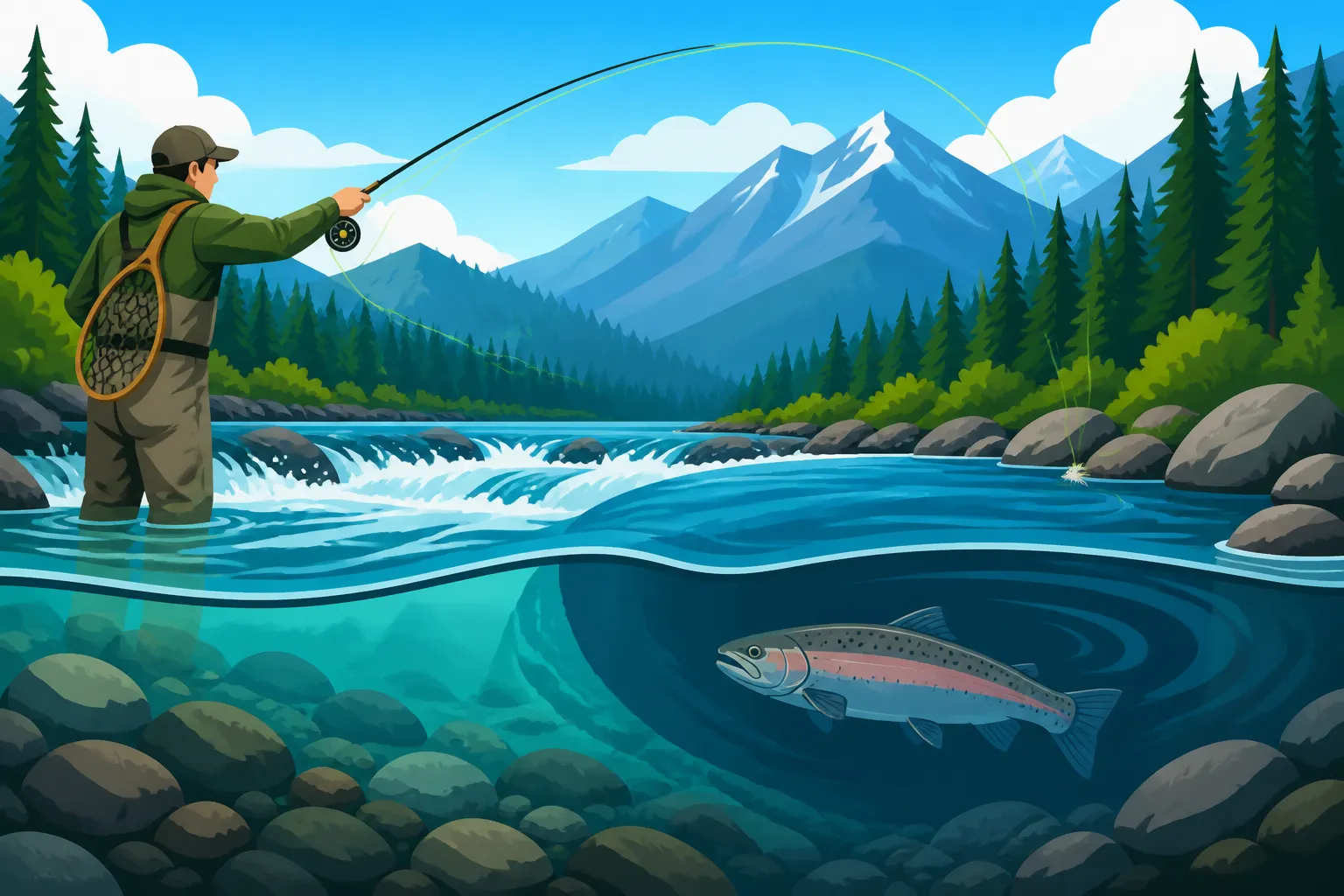
To execute this, cast your float slightly upstream and across the run. As your float begins its downstream journey, continuously "mend" your line. This involves lifting your rod tip and flipping slack line upstream to reposition it, preventing the main current from catching your line and pulling your float unnaturally fast. Constant mending ensures your float, and more importantly your bait or fly, remains perfectly in sync with the current, creating the most natural presentation possible. Focus on current seams where faster and slower waters meet, or where the current washes over submerged structure. For a deeper dive into this technique, especially on specific rivers, check out our guide on Float Fishing the Bulkley River.
Drift Fishing Runs with Bottom Contact
Drift fishing without a float is another incredibly potent technique for runs, especially when steelhead are holding tight to the bottom in faster water, or when the riverbed is relatively clean and snag-free. This method involves using just enough weight to allow your bait or lure to occasionally "tick" or bounce off the riverbed as it drifts downstream. The aim isn't to drag bottom constantly, but to feel those subtle taps, confirming your offering is in the critical "strike zone."
Utilizing a bottom-bouncing rig, such as a slinky weight or pencil lead setup, allows your bait—be it roe, a worm, or a small Spin-N-Glo—to tumble naturally along the riverbed. Cast upstream and across, allowing your weight to sink. As it drifts, maintain a slight amount of tension on your line—just enough to feel the weight intermittently tap the bottom, but not so much that you impede its natural drift. This technique demands a sensitive rod to detect not only the bottom contact but also the often incredibly subtle "thump" or slackening of the line that indicates a steelhead has taken your offering. When you feel a strike, set the hook swiftly and decisively! Our comprehensive article on Drift Fishing for Steelhead in BC Rivers offers more detailed insights into perfecting this approach.
Swinging Flies Through Runs
For the dedicated fly angler, swinging flies through runs is both an art form and an exceptionally productive method for steelhead. This technique involves casting a weighted fly, typically a streamer or an intruder pattern, across and slightly downstream, then allowing the current to swing it in an arc across the river. This broadside presentation, combined with the subtle movement of the fly, often triggers an aggressive, territorial strike from steelhead.
This method excels in runs with consistent current, which allows for a smooth, uninterrupted swing of the fly. As the fly completes its arc, maintain a tight line to feel any takes. The strike on a swung fly is often exhilarating – a sudden, hard pull that will send a jolt through your rod. Experiment with various sink tips and fly weights to ensure your fly is getting down to the fish's holding depth without constantly snagging the bottom. Spey or switch rods are perfectly suited for this technique, enabling effortless casting across wide runs and efficient line management. Familiarizing yourself with effective Fly Patterns for BC Steelhead Rivers can significantly boost your success with this captivating method.
Mastering the Pools for Steelhead Success
Fishing pools demands a distinctly different approach than runs. Here, patience, methodical coverage, and a focus on subtle, tantalizing presentations are paramount. Steelhead in pools are typically resting or conserving energy, and while they may not be actively chasing, a well-placed, slow, and tempting offering can often coax a powerful strike. The deeper, often darker water of pools can hide fish incredibly well, requiring you to be systematic and thorough in your exploration.
Systematic Coverage of Deep Pools
Deep pools can harbour an astonishing number of steelhead, but locating them requires a systematic strategy rather than random, hopeful casts. Before making your first cast, take a moment to visualize the pool's topography. Where are the deepest sections? Are there any visible or suspected submerged logs, boulders, or cut banks that could offer prime cover? Begin your fishing efforts by targeting the shallower edges of the pool first, gradually working your way towards the deeper central or downstream sections. This methodical approach helps ensure you don't inadvertently spook any fish that might be holding closer to the bank before you've had a chance to present to them.
Mentally divide the pool into imaginary grids or lanes. Cast into the upper reaches of a lane, allow your chosen presentation to sink to the desired depth, and then drift or retrieve it through that section. Once you've thoroughly covered that lane, move a few feet downstream and repeat the process. Continue this systematic coverage until you've explored the entire pool. For float fishing, ensure your leader length is precisely set to keep your bait or fly just above the bottom. For drift fishing, adjust your weight as necessary to maintain intermittent bottom contact. Fly anglers might employ deep nymphing rigs or slowly stripped streamers. The objective is to methodically present your offering to every plausible holding lie within the pool's depths.
Targeting Pool Seams and Eddies
Even within the seemingly placid waters of a deep pool, currents are rarely entirely uniform. Pay close attention to subtle "seams" where faster water from the upstream run gradually bleeds into the slower pool water, or where the main current gently brushes against a submerged rock, log, or bank. These seams frequently create nuanced current breaks where steelhead can comfortably hold, conserving energy while remaining poised to intercept any food items drifting by. Eddies, formed by obstructions or pronounced bends in the river, are also classic holding spots, providing a quiet refuge out of the main flow.
Fishing these specific features demands precision in your casting and presentation. For seams, position yourself to cast slightly upstream of the seam itself, allowing your bait or fly to drift directly down that critical current line. For eddies, present your offering so it washes naturally into the eddy and then slowly drifts or swings through it. Steelhead holding in these prime areas are often opportunistic; a well-placed, enticing presentation can frequently elicit a strike even from a seemingly inactive fish. This is where a keen eye for subtle water nuances, much like the detailed observation required for How to read structure for sturgeon on the Fraser, directly translates to heightened steelhead success.
Adjusting Tactics for Different Pool Depths
The reality is that not all pools are identical; some might have a relatively uniform deep bottom, while others feature dramatic shelves, abrupt drop-offs, or significant depressions. Your tactics must adapt to these variations. In pools with a consistent depth, your focus should remain on thoroughly covering the entire bottom layer with your chosen technique. If float fishing, meticulously adjust your leader length to maintain that consistent depth. If drift fishing, ensure your weight is calibrated to provide consistent bottom contact across the pool.
For pools that exhibit significant changes in depth, such as a sudden deep hole following a shallow shelf, you'll need to be nimble and adjust your approach rapidly. Consider making multiple passes, varying your leader length or the amount of weight you're using on each pass, or even switching between techniques. For instance, you might effectively float fish the shallower entrance to a pool and then transition to a heavier deep nymphing rig or a more substantial drift setup for the deeper holes. Sometimes, the simplest tactic—allowing your offering to "soak" in a prime, deep lie for an extended period—can be the key to triggering a strike from a wary fish. Don't hesitate to experiment with your presentation depth until you consistently find where the steelhead are holding.
Reading the Water Beyond the Obvious
Becoming a truly proficient steelhead angler transcends merely casting and retrieving. It involves cultivating an intuitive, almost instinctual understanding of the river itself – a skill often referred to as "reading the water." This advanced ability allows you to anticipate where fish will likely be positioned, predict how they might react to your presentation, and dynamically adjust your strategy in response to changing conditions. It’s a continuous learning curve, but one that offers profound rewards on every single fishing trip.
The Subtle Signs of Steelhead Lies
Steelhead, as migratory fish, are constantly on the move, but they don't simply stop anywhere. They meticulously select "lies" that provide an optimal balance of safety, a comfortable current break, and convenient access to passing food. Learning to spot these subtle indicators is crucial. Look for slight changes in the surface current speed, a deeper seam running parallel to the bank, or even a persistent line of foam or bubbles that might signify a significant subsurface obstruction. Any deviation or anomaly in the water's flow or the riverbed's contour can be a potential prime lie.
Consider what a steelhead instinctively needs: protection from aerial and aquatic predators, a place to rest comfortably out of the strongest current, and proximity to a food conveyor belt. These fundamental needs often translate to lies situated near submerged rocks, behind large log jams, under eroded cut banks, within depressions or troughs in the riverbed, or simply behind subtle current breaks caused by unseen structure. Occasionally, a barely perceptible ripple on the surface might be the only clue to a hidden boulder below, creating that perfect current buffer for a holding steelhead. Keep your polarized sunglasses on and actively scan the water as you move; the more you consciously observe, the more adept you’ll become at discerning these critical, subtle clues. For a general overview of steelhead habits, our guide on Steelhead Fishing in BC provides further context.
Adjusting to Water Conditions
British Columbia's steelhead rivers are remarkably dynamic environments, with conditions that can fluctuate hourly, let alone daily or seasonally. Key factors such as water levels, clarity, and temperature are paramount in dictating where steelhead will hold and how readily they'll respond to your offerings. During periods of high, murky water, steelhead often move closer to the banks and seek refuge in slower, less turbulent areas. In these conditions, brighter, larger flies or baits with a strong scent might be more effective, and fish might be less wary of heavier gear.
Conversely, periods of low, gin-clear water will render steelhead extremely wary and spooky. They will likely retreat to deeper, darker water or seek heavy cover, demanding an exceedingly subtle and natural presentation. This necessitates the use of lighter leaders, smaller and more natural-coloured flies or baits, and longer, more stealthy casts. Water temperature also plays a significant role; frigid water often makes fish lethargic, requiring slower, deeper presentations, while slightly warmer temperatures can make them more active and willing to chase. Always consult BC Fishery Notices and local river reports before heading out, and be prepared to adapt your gear and techniques dynamically on the river. Understanding the BC Steelhead Season Dates can also provide valuable insight into typical conditions.
Patience and Persistence
Steelhead fishing is, almost universally, not about instant gratification. It’s often lovingly referred to as "the sport of a thousand casts," and for very good reason. There will undoubtedly be days when the fish simply aren't biting, or when despite your best efforts, you feel like you're doing everything right yet still coming up empty-handed. This is precisely where patience and unwavering persistence become your most invaluable assets. Do not allow discouragement to set in. Instead, use these moments to re-evaluate your approach. Consider changing your depth, switching your fly or bait, moving to an entirely different section of the river, or simply taking a moment to observe the water.
Sometimes, merely waiting for a subtle shift in light—perhaps a passing cloud cover—or a slight fluctuation in the current can suddenly trigger a bite. The pursuit of steelhead is an enduring journey, far more than just a destination. Each meticulously planned cast is a fresh opportunity, and every blank day is a profound lesson learned, adding to your growing understanding of these magnificent fish and their intricate environment. Embrace the inherent challenge, savour the stunning natural beauty of the BC wilderness, and trust that your dedicated persistence will ultimately be rewarded with the electric, unforgettable pull of a chrome-bright steelhead at the end of your line.
| Technique | Best for Water Type | Ideal Conditions | Key Advantages | Considerations |
|---|---|---|---|---|
| Float Fishing | Runs, Medium-Depth Pools | Moderate current, varying depths, some subsurface snags | Natural drift, precise depth control, high visibility | Requires constant line mending, susceptible to wind |
| Drift Fishing | Runs, Deep Pools (clean bottom) | Stronger current, clean gravel bottom, deep holding lies | Direct bottom contact, covers water effectively | Higher risk of snagging, requires a sensitive rod |
| Swinging Flies | Runs, Pool Tailouts | Consistent current, open water, active fish | Triggers aggressive territorial strikes, covers wide areas | Less effective in very slow or very deep, still water |
| Deep Nymphing/Indicator | Pools, Slower Sections of Runs | Deep, slow water, wary fish, precise depth needed | Subtle presentation, excellent depth control | Slower coverage, often harder to detect subtle strikes |
| Casting & Retrieving Lures | Runs, Pool Heads, Turbid Water | Active fish, covering water quickly, off-colour conditions | Aggressive presentation, covers significant water | Can spook wary fish in clear, low water; less natural drift |
Disclaimer
This article is for general informational purposes only and does not constitute professional advice. Laws, prices and regulations vary by location and change over time. Consult a qualified professional for guidance on your specific situation.