Best Techniques for Deep Water Halibut
You run forty kilometres offshore, find the bank on the sounder, drop a bait into 300 feet of water and then spend the next hour reeling up empty hooks, snarled spreader bars and the odd dogfish. Deep water halibut fishing in BC can feel like guesswork. This guide breaks down the techniques, gear and timing that actually put big flatfish in the boat.
How Halibut Behave in Deep Water
Before you choose a rig, it helps to understand what a halibut is doing down there. Pacific halibut are ambush feeders built for life on the bottom. They lie flat on sand, gravel and mud, often at the edge of a slope or a change in bottom type, and they wait for food to come to them. When something interesting drifts by, they lift off the bottom and engulf it.
Where Halibut Hold on BC Banks
The classic halibut grounds off British Columbia are offshore banks and plateaus: Swiftsure Bank and La Perouse Bank off the southwest coast of Vancouver Island, the banks off Ucluelet and Tofino, the waters around Haida Gwaii and Langara Island, and the edges of Hecate Strait and Queen Charlotte Sound. On all of these, the fish relate to structure that is subtle on a chart but obvious on a good sounder.
Look for edges where a flat plateau drops into deeper water, saddles between two humps, and transitions from hard bottom to sand or gravel. Halibut like spots where current pushes food across the bottom, so the up-current side of a bump or the lip of a slope often produces better than the middle of a flat. For a deeper look at why fish use these features, see Halibut Habits off the BC Coast.
Depth Ranges Through the Season
Halibut move seasonally. In winter, many fish are deep, often in several hundred feet of water on the outer shelf where they spawn. As the water warms in spring, they push onto the banks and into shallower water to feed, and by summer you can find fish anywhere from 100 feet to well past 400 feet depending on the area and the food.
That means “deep water” is a moving target. In May, your best water off Ucluelet might be 180 to 250 feet. In August, after the bait has moved, you might find the bigger fish sitting deeper, along the outer edges of the same bank. A typical depth range by season is summarized below, and you can dig into the numbers further in How deep halibut live off the BC coast.
| Season | Typical Depth Range | What the Fish Are Doing |
|---|---|---|
| Late winter | 300 to 600 feet and deeper | Spawning and holding on the outer shelf |
| Spring | 150 to 300 feet | Moving onto banks to feed |
| Summer | 100 to 400 feet | Spread out, following bait and current |
| Early fall | 200 to 400 feet | Feeding hard before moving deeper |
Why Tide and Current Matter So Much
In deep water, current controls everything. On a big tide, a strong current can push your line at a steep angle, making it impossible to hold bottom with a reasonable weight and causing tangles. On a small tide or around slack water, your gear sits straight down where the fish are and your scent trail spreads in a predictable way.
Many experienced BC halibut anglers plan their whole trip around tide tables, fishing the hours either side of slack and choosing days near the neap tides when the current is gentler. If you have a choice of days, pick the one with the smallest tidal exchange. That single decision can be worth more than any lure in your tackle box.
Bait Fishing Techniques for Deep Halibut
Bait remains the most consistent way to catch halibut in deep water, especially when the current is moving and the fish are scattered. A good bait rig puts a lot of scent in the water and holds bottom without tangling.
The Spreader Bar Rig
The spreader bar is the workhorse of BC halibut fishing. It is a stiff wire arm with a heavy weight hanging from one end or the middle and a leader to a big circle hook on the other. The bar keeps the bait away from the main line and the weight, which reduces tangles and lets the bait move naturally in the current.
Most anglers use sinkers in the 16 to 48 ounce range, depending on depth and current, and leaders of 3 to 5 feet in 150 to 300 pound mono. Circle hooks from 12/0 to 16/0 are standard. The idea is simple: drop to bottom, lift a foot or two, and keep the weight just touching every so often so you know you are in the strike zone.
Choosing Bait
Halibut are not fussy eaters, but some baits are better than others in deep water. Whole or plug-cut herring is the go-to. It is oily, smells strong and is easy to find in tackle shops along the coast. Octopus is tougher and stays on the hook through multiple bites from small fish, while salmon bellies and heads are prized for their oil and smell.
A common approach is a combination bait: a herring for scent, wrapped or tipped with a strip of octopus or squid for durability. When the smaller bottom fish are picking you apart, a tough bait buys you time for a halibut to find it. Change baits often in deep water; once a bait washes out, it is just a hook.
Keep your bait cold and firm until it goes on the hook. Soft, sun-warmed herring tears off on the drop and never reaches the bottom intact, which is a waste of a long trip down. A small cooler with ice packs for the bait, separate from the fish box, makes a noticeable difference over a full day offshore.
Anchoring and Chumming
On known halibut holes, anchoring can be deadly. When you anchor up-current of a productive edge, your scent trail spreads down the slope and draws fish to you. Many charter boats on the west coast of Vancouver Island anchor on banks and drop a chum bag or a mesh bag of herring and fish carcasses to the bottom on a separate line.
Anchoring in deep water takes the right gear: a large anchor, plenty of chain and rode, and an anchor ball retrieval system. If you have never anchored in 250 feet of water in a swell, start in more modest depths and learn from someone who has done it. The rewards can be huge, but so can the risks.
Drifting With Bait
When the current is moderate and the fish are spread across a big flat, drifting covers more ground. You set up up-current of a structure, shut down and drift over it with baits bouncing along the bottom. This is often the best approach for searching new water. For a full walkthrough of the method, see How to catch halibut on the drift.
The trick when drifting is managing line angle. If your line drifts out at a steep angle, you need more weight or a slower drift. A drift sock can slow the boat in wind, and some anglers use a bow-mounted electric motor to hold the drift line steady.
Jigging Techniques for Deep Halibut
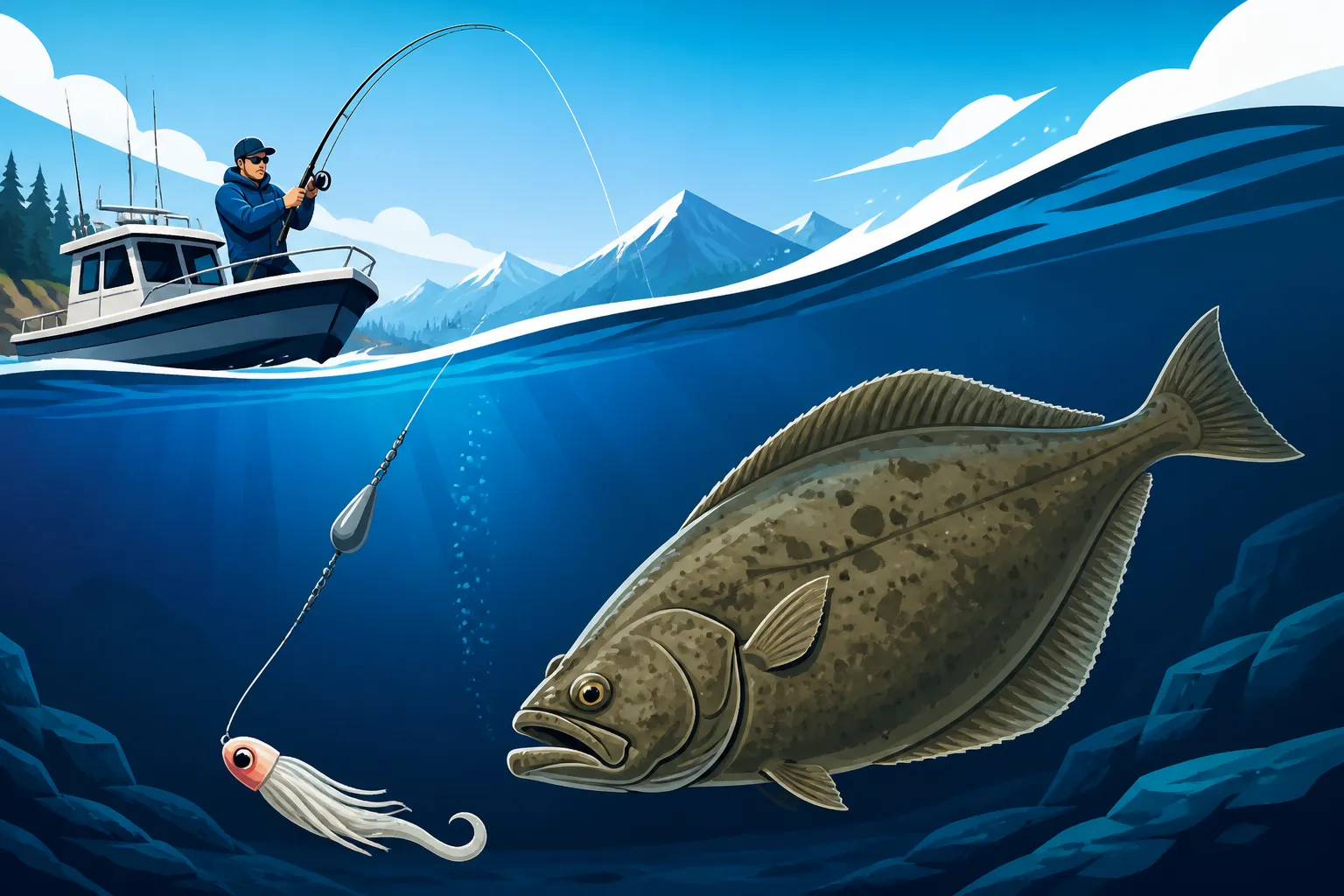
Jigging is the active angler’s answer to halibut. It covers water quickly, triggers reaction bites and often catches bigger fish. In deep water it takes more effort and better gear, but the payoff can be worth it.
Vertical Jigging Basics
The basic idea is to drop a heavy jig straight down to the bottom, then lift it a few feet and let it fall back. Halibut usually hit on the drop. Keep your line as vertical as possible by matching the jig weight to the depth and current, and stay in contact with the bottom so you know where the strike zone is.
In deep water, that means jigs in the 16 to 32 ounce range, heavier on stronger tides. Pipe jigs, butterfly jigs and large leadheads with swimbaits are popular. The motion should be steady and rhythmic rather than frantic; a halibut needs a moment to lock on to a falling target. The full method is broken down in Best technique for vertical jigging halibut.
Swimbaits and Leadheads
Large soft plastic swimbaits on heavy leadheads have become a favourite for BC halibut. They mimic herring, sand lance and other baitfish, and the tail action draws fish from a distance. White, pearl, glow and chartreuse are good colours for deep water, and many anglers add a strip of herring or a scent product for extra appeal.
A swimbait can be fished like a jig, bounced along the bottom on the drift, or slowly lifted and dropped near structure. Glow paint on the head and tail can help in the dark at depth. Expect to lose a few soft tails to dogfish and smaller fish.
Combining Jigging and Bait
Many anglers run a mixed program: a bait rig in the rod holder, and a jig worked by hand. The bait spreads scent and attracts fish, while the jig triggers them. On anchor, you might have two bait rods out and one angler working a jig. On the drift, the jig angler can cover the most likely structure.
For more Vancouver Island specific advice on jigging depths and setups, see Jigging for Halibut off Vancouver Island. If you want to compare depth targets through the season, How deep to jig for halibut off Vancouver Island has charts of typical ranges.
| Technique | Best Conditions | Strengths | Weaknesses |
|---|---|---|---|
| Spreader bar with bait | Moderate current, known holes | Strong scent trail, consistent | Bait gets stripped by small fish |
| Anchoring with chum | Slack tides, productive edges | Draws fish to you, good for groups | Requires big anchor and skill |
| Drifting with bait | Large flats, searching new water | Covers ground | Tangles in strong current |
| Vertical jigging | Light current, defined structure | Triggers reaction bites, bigger fish | Physically demanding in deep water |
| Swimbaits on leadheads | Clear water, active fish | Lifelike action, versatile | Lost tails, slower in strong current |
Gear That Handles Deep Water Halibut
Deep water halibut fishing punishes weak gear. A 100 pound fish in 300 feet of water, with a heavy sinker and strong current, will find any weak link in your setup.
Rods and Reels
A stout conventional rod in the 50 to 80 pound class, 5 to 6 feet long, is standard. Short rods give you leverage to lift heavy fish and weights from depth. Pair it with a two-speed lever drag reel with enough capacity for 400 to 600 yards of braid. The low gear is a lifesaver when you are cranking a big fish up from the bottom.
Electric reels are becoming more popular for deep halibut, especially for anglers with shoulder or back problems or for very deep water. They take the drudgery out of retrieving heavy weights from 400 feet. Many anglers order these setups and related accessories from Amazon, but check that reels are rated for saltwater and compare reviews carefully before you buy.
Line and Terminal Tackle
Braided line in the 65 to 100 pound range is the standard. It has almost no stretch, which helps you feel bites at depth, and it has a small diameter, which reduces drag in the current. Add a top shot of mono or a shock leader to absorb sudden runs at the boat.
Terminal tackle includes heavy swivels, crimps, sleeves and circle hooks. Many of these items are easier to source in bulk online. Amazon carries spreader bars, circle hooks and crimping kits from various brands, but always test hardware for strength before trusting it with a big fish. For hooks, look for forged circle hooks from reputable makers.
Electronics and Safety Gear
A good sounder with a powerful transducer is essential. You need to see the bottom clearly at 400 feet and pick out changes in hardness and structure. GPS and chartplotters help you return to productive spots and stay out of rockfish conservation areas.
Offshore halibut grounds are remote, so safety gear is non-negotiable: a VHF radio, life jackets for everyone, flares, an EPIRB or personal locator beacon, and a reliable second means of propulsion. Weather can turn quickly on the west coast. If you need a refresher on boat safety requirements, BC required boat safety equipment checklist covers the basics.
Landing, Handling and Staying Legal
Hooking a big halibut is only half the battle. Landing it safely and legally takes planning, and doing it badly can be dangerous.
Bringing Big Fish Aboard
Big halibut can thrash violently when brought aboard, breaking gear and injuring people. Many BC anglers use a harpoon with a float or a large gaff to control the fish at the side of the boat before bringing it in. Others prefer to secure the fish with a tail rope before lifting.
Once the fish is aboard, dispatch it quickly and humanely, then bleed it by cutting the gills. Bleeding improves the quality of the meat and calms the boat down. Keep the fish cool on ice or in a fish bag as soon as possible.
Size Limits and Bag Limits
Halibut regulations in BC are set by the federal government and can change from year to year, including daily limits, possession limits, annual limits and maximum size limits. Some seasons have had slot limits that require you to release fish above or below a certain length.
Measure fish carefully before keeping them, and record your catch on your licence as required. For details on the current rules, check BC Halibut Bag Limit Rules and any fishery notices for your area before you go.
Rockfish and Bycatch
Deep water halibut grounds are also home to rockfish, lingcod and other bottom species. Many rockfish suffer barotrauma when brought up from depth, and releasing them at the surface often means they die. Carry a descending device to return rockfish to depth, and follow the rules for release.
Rockfish conservation areas are closed to bottom fishing, including halibut fishing. Check your chartplotter for boundaries and stay out of them. The details are in BC rockfish conservation area rules.
Common Deep Water Mistakes and How to Fix Them
Most frustrating halibut days come down to a handful of repeat mistakes. The good news is that each one has a simple fix once you recognize it.
Fishing Off the Bottom
The single most common mistake is drifting too high. In 300 feet of water with current, it is easy to lose track of the bottom and end up fishing 20 or 30 feet above it. Halibut will rise for food, but most bites come within a few feet of the bottom.
Picture a typical scenario: you drop to bottom, lock the reel, and settle in. Ten minutes later the boat has drifted over a deeper part of the bank, and your bait is now hanging well above the fish. The fix is to touch bottom regularly. Every minute or two, free-spool until you feel the weight hit, then lift a foot or two and lock up again. On anchor, check that your weight is still on bottom after every tide change.
Using Too Little Weight
New anglers often try to get away with lighter sinkers because heavy weights are tiring to crank. The result is a line that streams out behind the boat at a steep angle, tangles with other lines and never holds bottom. In deep water with current, the line itself creates drag, and a light weight simply cannot overcome it.
Carry a range of weights and do not be shy about going heavier. If your line angle is more than about 30 degrees from vertical, add weight. When everyone on the boat uses the same weight, lines tend to drift at the same angle and tangle less, which matters on a crowded charter.
Setting the Hook Wrong With Circle Hooks
Circle hooks are designed to slide to the corner of the jaw and turn into the fish as it swims away. A hard, sweeping hook set, the instinctive reaction for many anglers, often pulls the hook straight out of the fish’s mouth.
When you feel the heavy, thumping weight of a halibut taking the bait, resist the urge to strike. Instead, reel steadily and let the rod load up. Once the rod is bent and the fish is pulling, keep steady pressure. This takes discipline, especially after a long wait, but it dramatically improves hook-up rates.
Giving Up Too Soon on a Spot
Halibut move in and out of an area with the tide and the food. A spot that is dead at the start of the slack can turn on suddenly as fish move up the slope. Many anglers move too soon and miss the bite.
Give a proven spot at least one full tide window before you move. If you are getting small fish and dogfish, that is often a sign that your scent trail is working; the bigger fish may be on their way. Use the time to re-bait, check your gear and stay patient.
Planning a Productive Deep Water Trip
Putting it all together means planning around weather, tides and the fish’s seasonal patterns. A good trip starts days before you leave the dock.
Picking Your Window
Choose a day with a calm forecast and a small tidal exchange, ideally with slack tides during daylight. Spring and summer offer the most reliable conditions for offshore banks. Plan to arrive at your first spot before the slack so you can set up and fish the best window.
If you are booking a charter, ask about their typical season and which months produce the best deep water fishing. For more on timing, Best Season to Book a Halibut Charter lays out what to expect month by month.
Building a Game Plan
Have a primary and a backup spot. Start on the most productive edge you know, fish it through the slack, and move if it is not producing. Mark every bite on your GPS. Over a few trips, you will build a map of where the fish hold in different tides and seasons.
Pack more weights and leaders than you think you need. Deep water eats tackle. Some anglers keep a standing order of sinkers, swivels and pre-tied leaders through Amazon or a local tackle shop so they never leave the dock short; whichever route you take, check current prices and stock yourself before the season starts rather than the night before. Bring a variety of baits and jigs, and be prepared to switch techniques if the fish are not responding.
Learning From Each Trip
Keep a log. Record date, tide, depth, bottom type, bait or jig, and fish caught. Patterns emerge quickly when you write things down. Over time you will learn which edges produce on which tides and which baits work best on which banks.
If you are new to the coast, spend a day or two with a good charter or a friend who knows the grounds. Learning the basics in person will save you a lot of lost tackle and frustration. For a broader overview of where to start, see Best Halibut Fishing Spots in BC and Halibut Fishing Techniques for BC’s Coast.
Disclaimer
This article is for general informational purposes only and does not constitute professional advice. Laws, prices and regulations vary by location and change over time. Consult a qualified professional for guidance on your specific situation.