How to tell a bull trout from a Dolly Varden
It's a question that has puzzled even the most seasoned anglers heading out onto British Columbia's pristine waters: "Is that a Bull Trout or a Dolly Varden?" It’s an honest frustration, because let's face it, these two species look incredibly similar, often found in similar habitats, and misidentification can lead to inadvertently breaking regulations or simply missing out on the joy of correctly naming your catch. This guide is here to untangle that confusion, providing clear, actionable ways to tell these two magnificent fish apart, ensuring you're confident in your identification every time.
The Confounding Cousins: Why Telling Them Apart is So Tricky
For years, even the scientific community struggled to differentiate between Bull Trout and Dolly Varden. It wasn't until more recent genetic studies that many of the fish previously identified as "Dolly Varden" in certain regions of BC were, in fact, Bull Trout. This historical confusion is why so many anglers still scratch their heads today. They are both members of the char family (genus Salvelinus), closely related to Arctic Char and Lake Trout, and share many physical characteristics typical of chars, such as light spots on a darker body.
A Shared Ancestry and Overlapping Habitats
Think of them like very close cousins who happen to live next door and even share a school. Both Bull Trout and Dolly Varden prefer cold, clear, pristine waters – the kind of wild, untamed rivers and lakes that British Columbia is famous for. They are often found lurking in deep pools, under cut banks, or behind large boulders, ambushing smaller fish or insects. This habitat overlap, especially in coastal drainages where their ranges meet, is a primary reason for the mix-up. An angler casting into a beautiful BC river might genuinely have both species present, making a positive identification critical not just for curiosity, but for adherence to BC Fishing Regulations Explained.
Many folks I've talked to over the years recount stories of catching what they thought was a Dolly Varden, only to have a more experienced angler or guide gently correct them. It’s not about being wrong; it’s about how genuinely subtle the differences can be. This shared heritage and preferred environment mean you can't just rely on "where" you caught it in a general sense. You need to look closer, a lot closer.
The Historical Haze and Modern Clarity
For a long time, the prevailing wisdom was that Dolly Varden were found in coastal streams and rivers, while Bull Trout were more of an interior species. And while this still largely holds true, especially for the larger, more distinct populations, there are zones where their ranges converge and overlap. The genetic work helped define the true extent of these ranges. It turned out that many of the "Dolly Varden" found in the Fraser River system and its tributaries, for instance, were genetically Bull Trout. This is a huge piece of information for anglers, as understanding these distinctions ensures we can better contribute to conservation efforts and correctly apply BC Bag and Possession Limits by Species. It’s a classic case of science catching up with what nature had already sorted out, and now we, as anglers, need to adapt our understanding.
Key Physical Characteristics for Identification
While they are tricky, there are distinct physical characteristics that, once you know what to look for, can help you confidently identify a Bull Trout versus a Dolly Varden. It's often a combination of these features rather than a single definitive trait.
Spotting the Difference: Body Spots
This is often the first thing people look at, and for good reason, but it can also be misleading if you don't know the nuances. Both fish have light spots on a darker background, a classic char trait.
Bull Trout Spotting Pattern
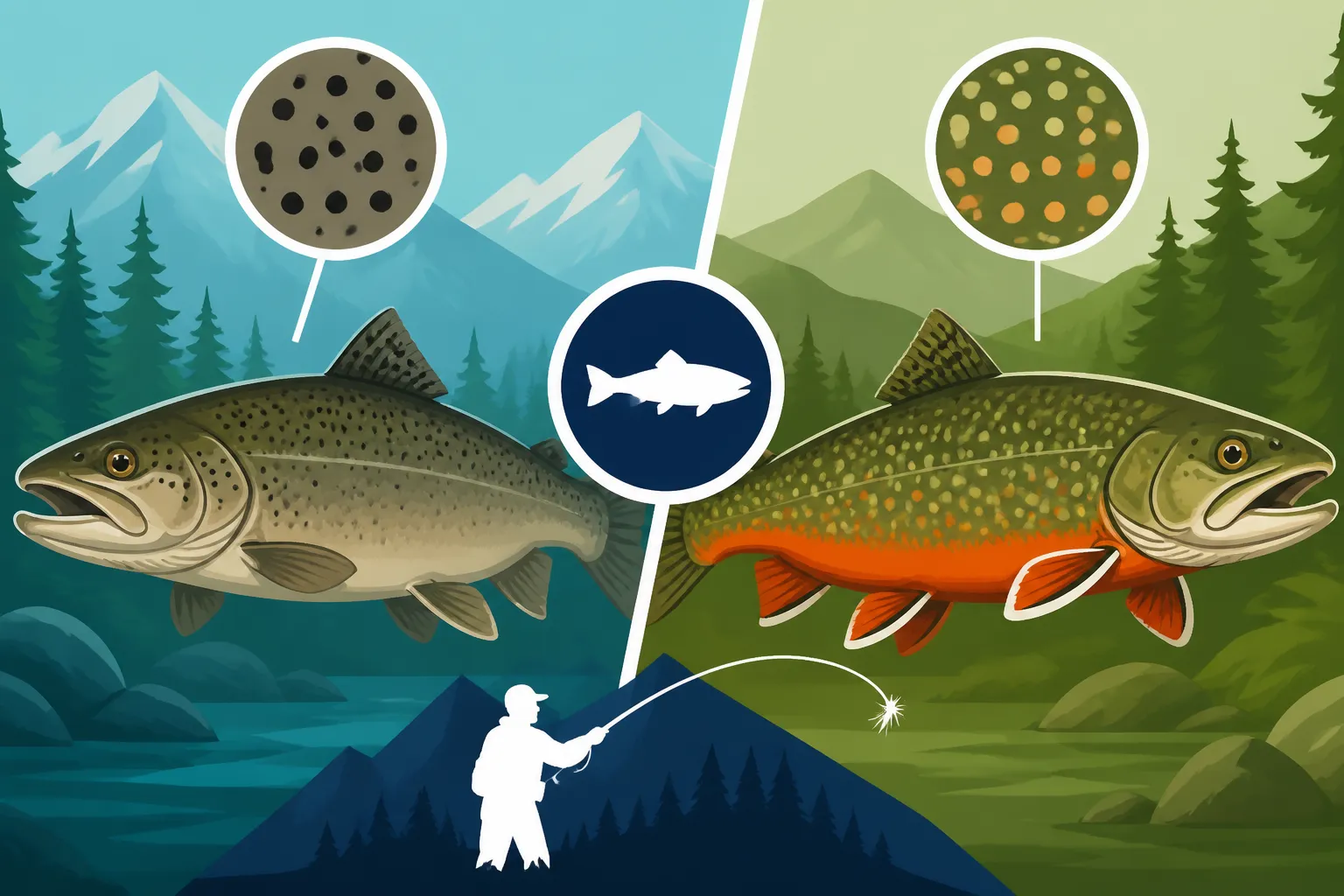
Bull Trout typically have smaller, more numerous, and often yellow, orange, or reddish-orange spots. These spots are usually evenly distributed across their back and sides, but crucially, they rarely extend onto their dorsal fin (the fin on their back). The spots on a Bull Trout can sometimes appear more faded or less vibrant than those on a Dolly Varden, especially on older fish. Their overall body colour tends to be olive green to brown on the back, fading to white or cream on the belly, often with a hint of red or orange along the lateral line during spawning season.
Imagine catching a beautiful fish in a deep pool in the Best Fishing Rivers in British Columbia with a greenish-brown back and a smattering of yellowish spots. If those spots seem to stop abruptly before reaching the dorsal fin, you're likely looking at a Bull Trout.
Dolly Varden Spotting Pattern
Dolly Varden, on the other hand, tend to have larger, fewer, and often brighter spots. These spots are typically pink, red, or even reddish-orange, and they almost always extend onto the dorsal fin. Their background colour is usually a darker olive to green, sometimes almost purplish, with a creamy white belly. The spots can appear quite prominent, like bright jewels against the darker skin.
If you reel in a fish from a coastal stream and its dorsal fin is peppered with vibrant pink or red spots, that’s a strong indicator it’s a Dolly Varden. Think of the spots on a Dolly Varden as bolder and more encompassing.
Jaw and Mouth Structure: The Crucial Clue
This is perhaps the most reliable physical differentiator, especially for larger fish. The jaw structure, particularly how far the upper jaw extends, is a tell-tale sign.
Bull Trout Jaw Extension
Bull Trout have a distinctly long, strong upper jaw that extends well past the rear margin of the eye. This gives them a more elongated, almost predatory, appearance to their head. When you hold a Bull Trout, you'll notice how far back that upper jaw goes, reaching back significantly. This adaptation helps them feed on larger prey, including other fish.
Picture an apex predator; the Bull Trout's jaw reflects that. You can even gently open the mouth and see how far back the jawbone reaches relative to the eye socket.
Dolly Varden Jaw Extension
Dolly Varden have a shorter upper jaw that does not extend past the rear margin of the eye, or at most, only slightly. Their head appears more proportionate to their body, without the exaggerated jawline of a Bull Trout.
This difference can be subtle on smaller fish, but on larger individuals, it becomes quite obvious. If the jaw seems to stop more or less even with the back of the eye, you're looking at a Dolly Varden. You might find a good field guide on Amazon that has detailed illustrations comparing these jaw structures.
Tail Shape and Body Proportions
While less definitive, the overall body shape and tail can offer supporting evidence.
Bull Trout Body and Tail
Bull Trout tend to have a more streamlined, torpedo-like body, built for power and speed in currents. Their caudal (tail) fin is often noticeably more forked, especially in larger specimens. This deeper fork aids in propulsion in swift rivers.
Dolly Varden Body and Tail
Dolly Varden can be a bit more stout in body shape, though still very muscular. Their tail fin is typically less forked than a Bull Trout's, appearing more square or slightly emarginate (shallowly notched).
Here's a quick comparison table to keep handy:
| Feature | Bull Trout | Dolly Varden |
|---|---|---|
| Body Spots | Smaller, numerous, yellow/orange; rarely on dorsal fin | Larger, fewer, pink/red/reddish-orange; almost always on dorsal fin |
| Upper Jaw | Extends well past rear margin of the eye | Does not extend past rear margin of the eye (or only slightly) |
| Overall Colour | Olive green to brown, lighter belly; sometimes reddish flanks | Darker olive to green, sometimes purplish; creamy belly |
| Tail Fin | More deeply forked | Less forked, often square or slightly emarginate |
| Pectoral Fins | Relatively shorter | Relatively longer (can be subtle) |
Habitat, Range, and Behavioural Clues
Beyond physical appearance, understanding where these fish typically live and how they behave can provide crucial context for identification. Geography plays a huge role in Bull Trout vs Dolly Varden Identification.
Geographical Distribution in British Columbia
This is arguably one of the most important clues for anglers in BC. While there's overlap, their strongholds are generally distinct.
Bull Trout Strongholds
Bull Trout are predominantly found in interior drainages of British Columbia. Think of the mighty Fraser River system, the Columbia River basin, the Peace River, and numerous smaller streams and lakes in the Cariboo and Kootenay regions. They are widespread throughout these areas. They thrive in large, cold river systems and deep, cold lakes. If you're fishing in regions like the Kootenays, the odds are very high that a char with spots is a Bull Trout.
There are also anadromous (sea-run) populations of Bull Trout that move from interior rivers out to the ocean and return to spawn, adding another layer to their complex life history. These can sometimes be mistaken for sea-run Dolly Varden.
Dolly Varden Strongholds
Dolly Varden, particularly the true genetic Dolly Varden, are primarily coastal fish. Their range extends along the Pacific Northwest, and in BC, they are found in coastal rivers, streams, and lakes that drain directly into the Pacific Ocean, or into very short, direct tributaries of larger coastal systems. Think of rivers on Vancouver Island, the Sunshine Coast, and the northern coastal regions. They often don't venture far inland.
If you're fishing a stream on Vancouver Island or a small river near Prince Rupert, you're much more likely to encounter a Dolly Varden. However, remember the overlap: some coastal drainages, especially larger ones, can have both. This is where the physical cues become paramount. Knowing the specific drainage you're in can sometimes be the first big hint. For example, if you're fishing the Campbell River Fishing Guide area, you're more likely to encounter Dolly Varden than Bull Trout.
Habitat Preferences and Water Conditions
Both species demand high-quality, cold water, but there are subtle preferences.
Bull Trout Preferences
Bull Trout are often associated with larger, wilder river systems and deep, cold lakes. They require complex habitats with plenty of cover, such as large woody debris, undercut banks, and deep pools. Spawning habitat for Bull Trout is particularly sensitive, requiring very cold, clear, clean gravel beds, often in small, undisturbed tributaries. They are highly migratory, moving significant distances within river systems or between lakes and rivers for spawning and feeding.
Dolly Varden Preferences
Dolly Varden also require cold, clear water but are often found in smaller coastal streams and rivers, as well as estuaries where they might spend time in brackish water. Like Bull Trout, they need clean gravel for spawning, but their migratory patterns might be shorter, often staying within a single river system or moving only short distances to the sea. They are also highly opportunistic feeders, and you might find them in more diverse riverine habitats than their Bull Trout counterparts.
Dietary Habits and Behaviour
Both are predatory char, but their diets can vary slightly based on their size and environment.
Bull Trout Diet and Behaviour
Bull Trout are voracious predators, especially as they grow larger. Their diet consists primarily of other fish, including sculpins, whitefish, and juvenile salmon and trout. This piscivorous (fish-eating) diet contributes to their larger size and aggressive feeding behaviour. They are ambush predators, often holding in current breaks and darting out to strike prey. Their larger mouth is perfectly suited for swallowing substantial meals.
Dolly Varden Diet and Behaviour
Dolly Varden also feed on fish, but often have a more varied diet, especially when smaller, including aquatic insects, crustaceans, and salmon eggs. Larger Dolly Varden will certainly predate on smaller fish. Their feeding behaviour is similar to Bull Trout, utilizing cover to ambush prey, but they might be encountered more frequently in areas with abundant insect life or salmon spawning activity.
Tools and Tips for Positive Identification in the Field
Making a positive identification in the field, especially when you're excited about a catch, takes practice and a systematic approach. It's not always easy, but with the right tools and a little patience, you can get it right.
The Power of Observation: Slow Down and Look Closely
The biggest mistake anglers make is rushing the identification process. Before you release that beautiful fish, take a moment. Gently cradle it in the water, or in a net if necessary, and observe these features:
- Spot Check: Is the dorsal fin spotted? This is a huge clue. Count the spots, note their size and colour.
- Jaw Lineup: Carefully look at the mouth. Does the upper jaw extend beyond the eye? This requires a good, clear view.
- Overall Impression: What's the dominant colour? How is the body shaped?
- Location, Location, Location: Remind yourself where you are. Are you in a known Bull Trout or Dolly Varden zone? While not definitive on its own, it helps contextualize the physical traits.
A good pair of polarized sunglasses, available readily on Amazon, can help you spot these subtle differences underwater or in shaded areas, reducing glare and allowing clearer observation.
Photography for Later Review and Citizen Science
Snapping a clear photo is an excellent way to aid in identification. Get a good side-on shot that clearly shows the head, body, and dorsal fin. Even if you're not sure in the moment, you can review the photo later, compare it to field guides, or even share it with knowledgeable anglers or local fisheries biologists for an expert opinion. This is also invaluable for catch-and-release reporting or simply documenting your fishing adventures.
Many local fishing communities have online forums or social media groups where experienced anglers are happy to help with identification. Just make sure your photos are clear and respectful of the fish.
Field Guides and Apps: Your Portable Experts
Carrying a good, waterproof field guide specifically for BC fish species is a fantastic idea. These guides often have detailed illustrations or photographs highlighting the key differences between look-alike species. You might even grab a specialized fishing app or a waterproof field guide off Amazon that includes detailed descriptions and range maps for both Bull Trout and Dolly Varden. Having this information readily accessible can make all the difference when you're standing river-side.
Some apps even allow you to mark your location, which, when combined with your identification notes, can help you learn the distribution patterns over time. Understanding Trout Species Identification Guide for BC in general can also deepen your understanding of these specific char.
Conservation and Regulations: Why Correct ID Matters
Beyond satisfying your curiosity, accurate identification is crucial for conservation. Both Bull Trout and Dolly Varden are native species that face pressures from habitat loss and other environmental factors. Regulations regarding retention, size limits, and even whether you can use bait often differ between the two species, or in specific management units. For example, some waters might be BC Catch and Release Only Waters for one species but allow retention for another.
Misidentifying a Bull Trout as a Dolly Varden (or vice-versa) could lead to accidentally violating regulations, which nobody wants. Always consult the most current Reading the BC Freshwater Fishing Regulations Synopsis before heading out, and if in doubt, practice catch and release. This ensures the health of the population for future generations. Knowing these details also impacts the Best Time of Year to Fish in BC for each specific species.
Disclaimer
This article is for general informational purposes only and does not constitute professional advice. Laws, prices and regulations vary by location and change over time. Consult a qualified professional for guidance on your specific situation.