Trolling Techniques for BC Lake Trout
Trying to dial in those elusive deep-water dwellers like lake trout in British Columbia's vast, cold lakes can feel like searching for a needle in a haystack. Their habits change with the seasons, and getting your lure down to their preferred depth with the right presentation is a constant challenge. This comprehensive guide will walk you through everything you need to know about effective trolling techniques for BC lake trout, helping you understand their behaviour, master the right gear, and implement proven strategies to put more fish in your boat.
Understanding BC Lake Trout and Their Habits
Lake trout, often called "Lakers" by seasoned anglers, are a fascinating and formidable adversary. Unlike their river-dwelling cousins, these fish prefer the deep, cold, and often crystal-clear waters of large lakes. Their behaviour is heavily influenced by water temperature, available forage, and light conditions, making a solid understanding of their habits crucial for successful trolling.
Lake Trout Biology and Preferred Habitats
Lake trout ( Salvelinus namaycush ) are actually a type of char, closely related to Dolly Varden and bull trout. They are native to many large, deep, oligotrophic (nutrient-poor) lakes across North America, and British Columbia is blessed with some incredible lake trout fisheries. These fish are characterized by their sleek, powerful bodies, often marked with light spots on a darker background, and a deeply forked tail. They are built for power and endurance, perfectly adapted to their deep-water existence.
Their preferred habitat is defined by cold water, typically below 55°F (13°C), and often much colder. This means they'll spend the majority of the year in the deeper reaches of lakes, sometimes hundreds of feet down, particularly during the warmer summer months. They seek out areas with abundant oxygen and access to their primary food sources. Think about lakes like Quesnel Lake Fishing Guide or Williston Lake Fishing Guide, where vast expanses of deep water provide ideal conditions. These deep lakes often feature dramatic underwater structures like shelves, drop-offs, humps, and submerged islands, which provide ambush points and cover for both the lake trout and their prey.
Seasonal Movements and Feeding Patterns
Lake trout exhibit distinct seasonal movements that dictate where and how you should target them. Understanding these patterns is key to adjusting your trolling strategy throughout the year.
- Spring (Ice-out to early Summer): As the ice recedes and surface waters begin to warm, lake trout often move into shallower water, sometimes as little as 10-30 feet deep. This is a fantastic time for anglers, as they are more accessible and actively feeding on baitfish that are also moving into the shallows. They're still looking for that comfortable cold water, but the entire water column is often within their preferred temperature range. They might be found cruising rocky points, shoals, and even near creek mouths where fresh water introduces nutrients and prey.
- Summer: This is when lake trout truly go deep. As surface temperatures climb, the lake stratifies, forming distinct layers of water at different temperatures. Lake trout will seek out the thermocline – the layer where the temperature changes most rapidly – or below it, where the water remains consistently cold and oxygenated. This can mean fishing anywhere from 50 to 200 feet deep, or even more, depending on the lake and its depth profile. They become pelagic, often suspended over very deep water, following schools of kokanee or other baitfish, or hugging deep structure.
- Fall (Late Summer to Ice-on): As the lake water cools in the fall, lake trout once again begin to move shallower. They become incredibly active, preparing for their spawn, which typically occurs in late fall or early winter on rocky shoals. During this period, they can be found at varying depths, often shallower than in summer, but not quite as shallow as in spring. This is a prime time for targeting larger, more aggressive fish.
- Winter (Ice Fishing Season): While this guide focuses on trolling, it’s worth noting that through the ice, lake trout can still be found in deeper areas, though they might suspend or cruise more actively than in summer, as the entire water column again becomes uniformly cold.
Their feeding patterns also vary. In spring and fall, they might aggressively chase down baitfish in open water or ambush them near structure. In summer, their metabolism slows slightly in the colder depths, but they are still voracious predators, often keying in on specific forage like kokanee, whitefish, or even smaller lake trout. Matching your lure size and action to the prevalent forage is a critical component of successful trolling. For instance, if you're fishing a lake known for its kokanee population, imitating those silvery baitfish will be a smart move, much like how one might approach Okanagan Lake Kokanee Fishing.
Essential Gear for Successful Lake Trout Trolling
Trolling for lake trout, especially in BC's larger, deeper lakes, requires specialized gear that can get your lures down to where the fish are holding and handle the powerful runs of these impressive fish. Don't skimp on quality here; it makes a huge difference.
Rods, Reels, and Line Choices
When it comes to rods and reels, durability and power are paramount. You'll be dealing with heavy weights, long lines, and strong fish.
- Rods: For downrigger fishing, dedicated downrigger rods are ideal. These are typically 7.5 to 9 feet long, with a moderate action that allows the rod tip to load up when the downrigger clip releases, signaling a strike. The moderate action also provides a good cushion against the violent headshakes of a big lake trout. If you're using lead core or Dipsy Divers, a slightly stiffer, medium-heavy to heavy action trolling rod, 8 to 10 feet long, will handle the strain better. Look for reputable brands like Shimano, Daiwa, or Okuma, which offer excellent options for trolling.
- Reels: Level-wind baitcasting reels are the workhorses of lake trout trolling. They need robust drag systems and high line capacity. A reel in the 300 to 400 size class is generally sufficient, capable of holding hundreds of yards of line. You'll want a reliable gear ratio that allows for smooth retrieval and deployment. Again, brands like Daiwa, Shimano, and Penn offer excellent trolling reels built for this kind of abuse.
- Line: Your main line choice is crucial.
- Braided Line: For your main line on downriggers, 30-50 lb test braided line is a popular choice due to its zero stretch, allowing you to feel every bite, even at depth. It also has a thinner diameter than monofilament of equivalent strength, which helps with less water resistance.
- Monofilament Line: Some anglers prefer 20-30 lb monofilament for its stretch, which can act as a shock absorber. However, it's not ideal for direct downrigger connections due to stretch affecting bite detection.
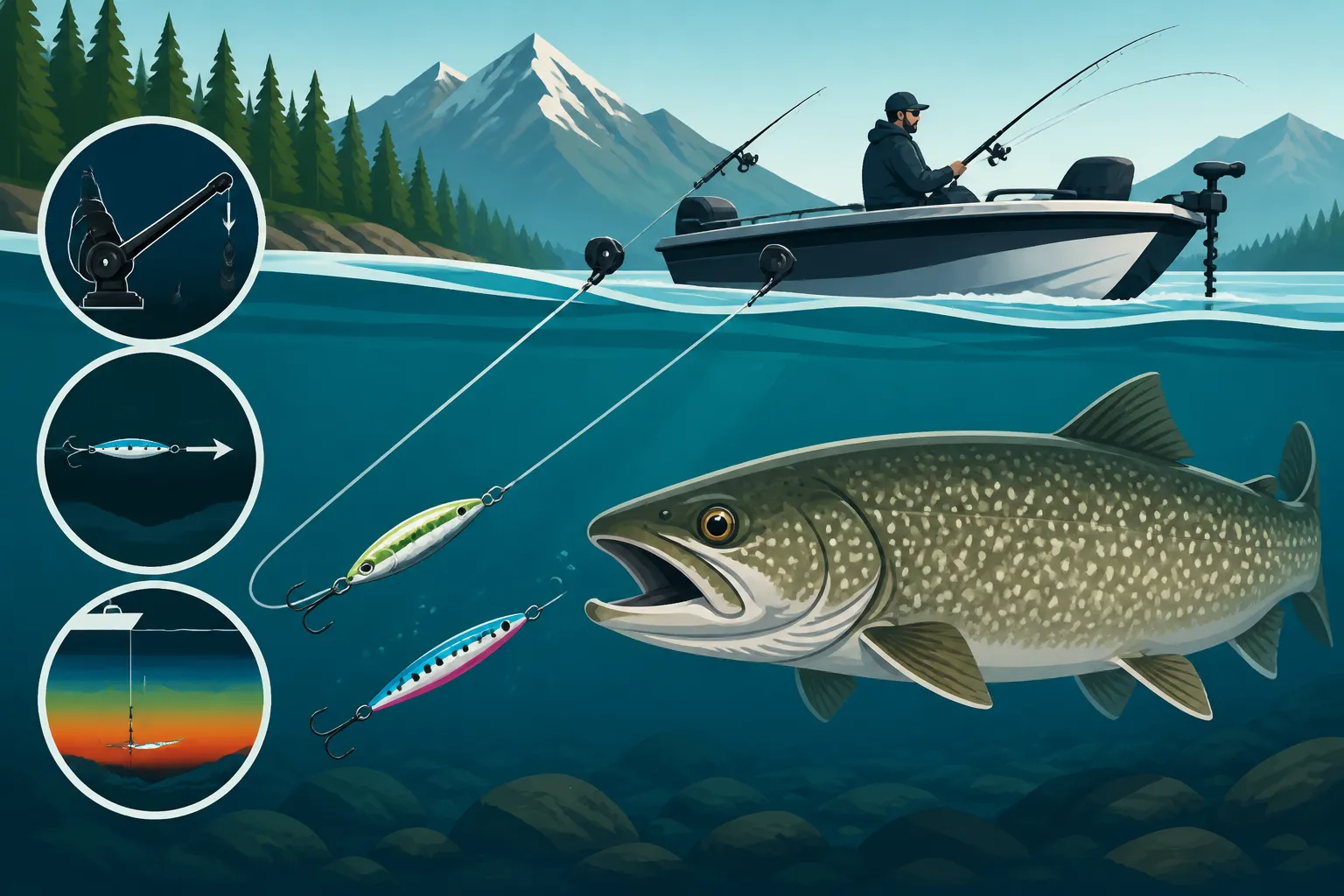
- Lead Core Line: This is a specialized line where a lead filament is woven into a braided sheath. Each colour typically represents 10 yards, and a full core (10 colours) can get a lure down 50-60 feet at a trolling speed of 2-3 mph without any additional weights. It's bulky, so you'll need a large capacity reel.
- Leaders: Regardless of your main line, always use a fluorocarbon leader (10-20 lb test, 6-12 feet long) attached with a swivel. Fluorocarbon is nearly invisible underwater and has excellent abrasion resistance, which is important when a lake trout is thrashing around rocky structure.
Trolling Motors and Depth Finders
Modern electronics have revolutionized lake trout trolling, allowing for unparalleled precision and efficiency.
- Trolling Motors: While your main outboard will handle long runs, an electric trolling motor (bow-mounted or transom-mounted, depending on your boat) is invaluable for maintaining precise speeds, especially in windy conditions or when making intricate turns. A strong GPS-enabled trolling motor with spot-lock functionality (like those from Minn Kota or Motorguide) can hold your boat perfectly over a deep hump or along a specific contour, freeing you up to focus on the rods. Variable speed control is also critical for fine-tuning your presentation.
- Depth Finders/Sonar: A high-quality fish finder is non-negotiable for lake trout trolling. You need to know the depth, identify structure, and most importantly, locate schools of baitfish and the lake trout themselves. Look for units with clear, high-resolution screens and advanced sonar capabilities like CHIRP, Side Imaging, and Down Imaging.
- CHIRP Sonar provides exceptional target separation and clarity, allowing you to distinguish individual fish.
- Side Imaging (or SideScan) is fantastic for scouting wide areas to identify submerged structure, bait schools, and potential fish holding areas off to the sides of your boat.
- Down Imaging (or DownScan) gives you a photographic-like view directly beneath your boat, making it easier to interpret bottom contours and identify suspended fish.
Learning to interpret your sonar effectively, including understanding how to use your Best sonar settings for finding structure on Kootenay Lake, will dramatically increase your success rate.
Downriggers, Dipsy Divers, and Lead Core Line
These are your primary tools for getting lures down to the depths where lake trout live. Each has its advantages and is suited for different situations.
- Downriggers: These are mechanical devices that use a heavy cannonball weight (8-15 lbs) to carry your fishing line down to a precise depth. Your fishing line is attached to the downrigger cable via a release clip. When a fish strikes, the clip releases, and you fight the fish directly on your rod. Downriggers offer the most precise depth control and allow you to fish light lines and lures, presenting them naturally. Electric downriggers (from brands like Scotty or Cannon) are especially convenient for rapid deployment and retrieval, which is a blessing when adjusting depths frequently.
- Dipsy Divers (or Jet Divers): These are disc-shaped or winged diving devices that attach directly to your main line, ahead of your leader and lure. They use water resistance to dive, and by adjusting a weight or setting on the diver, you can control its depth and even make it run off to the side of the boat, helping to spread out your presentation. Dipsy Divers are excellent for reaching moderate depths (up to 50-70 feet) and are often used in conjunction with downriggers to cover a wider area. They also have trip mechanisms that release tension when a fish strikes.
- Lead Core Line: As mentioned earlier, lead core line is an effective way to get lures down without additional weights or divers on your main line. It sinks at a relatively consistent rate (around 5-7 feet per colour/10 yards at typical trolling speeds). This method is stealthy and effective for covering a range of depths, though it can be less precise than downriggers. Many anglers use a combination of these methods to present multiple lures at different depths and distances from the boat. For instance, you might run two downriggers, a Dipsy Diver, and a lead core setup, especially if you have a larger boat and enough rod holders.
Top Lures and Baits for BC Lake Trout
Lake trout are opportunistic feeders, but they do have preferences. Having a diverse tackle box filled with proven lake trout lures and baits is essential for adapting to different conditions and fish moods.
Spoons and Plugs
These are arguably the most popular and effective lures for trolling lake trout.
- Spoons: Trolling spoons are designed to mimic injured baitfish with their wobbling, fluttering action. They come in a vast array of sizes, shapes, and colors.
- Common patterns: Silver, gold, blue/silver, green/silver, chartreuse, and sometimes vibrant multi-color patterns. Glow-in-the-dark spoons are incredibly effective in deeper, darker water.
- Popular Spoon Brands: Luhr-Jensen Kwikfish, Williams Wabler, Len Thompson, and Gibbs Delta are all excellent choices. For deeper water, larger, heavier spoons might be preferred, while smaller, lighter ones work well in shallower spring conditions. A good starting point for size is 3-5 inches.
- Action: Look for spoons with a good, consistent wobble at your target trolling speed. Sometimes, a subtle flutter is preferred, while other times a wide, aggressive kick will trigger strikes. Experimentation is key.
- Plugs/Stickbaits: Plugs are hard-bodied lures that dive when trolled and have an erratic, swimming action. They excel at imitating larger baitfish or even smaller trout.
- Common patterns: Silver, perch, rainbow trout, black/silver, firetiger.
- Popular Plug Brands: Rapala Deep Tail Dancer, Flat Rap, T-Rap, or other deep-diving crankbaits from Bomber or Storm.
- Depth: Many plugs are designed to dive to specific depths on their own, but when combined with downriggers or Dipsy Divers, their diving capability is amplified, allowing them to reach extreme depths. The larger lip on deep-diving plugs helps them get down quickly and produces an enticing wide wobble.
Flies and Tube Jigs
While not traditional trolling lures for all species, flies and tube jigs can be incredibly effective for lake trout, especially when presented correctly.
- Flies (Streamers/Bucktails): Large streamer or bucktail flies, especially those tied to imitate baitfish like smelt, kokanee, or sculpins, can be trolled successfully behind flashers or dodgers. The flasher/dodger provides attraction and imparts an enticing erratic action to the fly.
- Set-up: Typically, you'd run a 6-12 foot fluorocarbon leader from the flasher/dodger to your fly. The flashers create vibration and flash that draws attention in the deep, dark water.
- Patterns: Look for patterns like Clouser Minnows, Leech patterns, or larger bucktail streamers in silver, white, blue, or chartreuse. These can be particularly effective during the spring and fall when lake trout are more active and cruising.
- Tube Jigs: While often associated with vertical jigging, tube jigs can also be trolled effectively, especially if you're using a slower speed or want a different presentation.
- Presentation: A heavy tube jig (1-3 oz) in white, chartreuse, or even natural baitfish colors can be slowly trolled near the bottom or suspended in the water column. The soft plastic body and tentacles provide a subtle, lifelike action that can entice wary lake trout.
- Enhancement: Threading a small piece of natural bait (like a minnow strip) or adding a scent to the tube can further increase its effectiveness.
Natural Baits and Scent
Sometimes, nothing beats the real thing. Natural baits are incredibly potent for lake trout, especially when they're being finicky.
- Herring/Minnows: Trolling a whole or cut herring, or even large minnows, can be irresistible to lake trout. These are often rigged on a bait head or a "rotator" device that makes the bait spin, mimicking an injured fish.
- Presentation: Herring or minnows are typically fished behind a flasher or dodger, which adds attraction and ensures the bait has a consistent, enticing rotation. Fresh, brined bait is always best.
- Rigging: Ensure your bait is rigged straight to avoid line twist and to give it the most natural swimming action. Many anglers buy pre-rigged bait heads or learn to rig their own for optimal results.
- Scent Attractants: Adding scent to your artificial lures or even natural baits can make a significant difference. Lake trout rely heavily on their sense of smell, especially in deep, dark water where visibility is low.
- Types: Gels, sprays, and dips infused with a strong fish attractant like Anise, Garlic, or specific baitfish formulas (e.g., Krill, Smelt, Herring).
- Application: Apply scent liberally to your spoons, plugs, or tube jigs. Reapply every 30-60 minutes, or after catching a fish, to keep the scent trail strong. Products from brands like Pro-Cure or Mike's Fishing Scent are widely available, often through retailers on Amazon.
Mastering Trolling Techniques for BC Lake Trout
Once you have your gear and lures sorted, the real art of lake trout trolling comes down to technique. It's about combining precision, observation, and adaptability.
Speed, Depth, and Presentation
These three elements are the pillars of effective lake trout trolling. Get them right, and you're well on your way to success.
- Speed: This is one of the most critical factors. Lake trout often prefer relatively slow trolling speeds, typically between 1.5 to 3.0 mph. However, the ideal speed can vary depending on the lure type, water temperature, and the fish's mood.
- Slower Speeds (1.5-2.0 mph): Often best for tube jigs, live bait, or when fish are lethargic in very cold water. It allows lures with subtle actions to perform effectively.
- Moderate Speeds (2.0-2.5 mph): A good all-around speed for most spoons and plugs. This speed generates good wobble and flash without making the lure appear unnatural.
- Faster Speeds (2.5-3.0+ mph): Sometimes effective for covering water or when fish are highly aggressive. Some plugs and spoons are designed to work better at higher speeds.
- Testing: Watch your rod tips or transducer image to ensure your lures are running true and exhibiting their intended action at your chosen speed. A GPS speedometer is invaluable for maintaining consistent speed.
- Depth: Getting your lure to the exact depth where lake trout are feeding is paramount. This is where your downriggers, Dipsy Divers, and lead core lines come into play.
- Sonar is Your Best Friend: Continuously monitor your depth sounder. Look for fish arches, bait balls, and the thermocline. If you mark fish at 80 feet, get your lure to 80 feet, or slightly above or below, to see how they react.
- Adjustments: Be prepared to adjust your depth frequently. Lake trout can move vertically throughout the day, following bait or reacting to light conditions. Don't be afraid to raise or lower your downrigger balls by 5-10 feet to cover more of the water column.
- Presentation: This refers to how your lure behaves in the water and how attractive it is to the fish.
- Lure Action: Ensure your lure is swimming naturally. A bent spoon or a plug that's not running true will spook fish.
- Leader Length: Experiment with leader length. Sometimes a longer leader (10-15 feet) provides a more natural presentation, especially behind a flasher or Dipsy Diver. Other times, a shorter leader is preferred for a more direct connection to the lure's action.
- Staggering: If running multiple lines, stagger their depths and distances from the boat to avoid tangles and cover more of the water column. For example, one downrigger at 75 feet, another at 90 feet, and a Dipsy Diver running at 40 feet.
Reading Water and Structure
Effective lake trout trolling isn't just about speed and depth; it's about understanding the underwater landscape and predicting where fish will be.
- Interpreting Sonar: Your fish finder is your window into the underwater world. Learn to distinguish between hard and soft bottoms, identify rock piles, submerged timber, and most importantly, discern fish arches from debris.
- Fish Arches: A strong, distinct arch indicates a fish. The longer and thicker the arch, the bigger the fish. Pay attention to what depth these arches appear.
- Bait Balls: Dense clouds on your sonar usually indicate schools of baitfish. Where there's bait, there are usually predators.
- Thermocline: Your sonar might show a distinct line or band where the water temperature changes dramatically. Lake trout often congregate at or just below this layer in summer.
- Identifying Contours and Drop-offs: Lake trout often relate to underwater structure.
- Contour Maps: Use detailed bathymetric (contour) maps of the lake. Many modern fish finders come with pre-loaded maps or allow you to create your own. Look for underwater points, humps, ridges, and saddles. These are prime lake trout ambush points.
- Trolling Along Contours: Instead of just trolling in straight lines, try to follow specific depth contours. For example, if you find fish at 80 feet, try to troll your boat along the 80-foot contour line. This keeps your lure in the strike zone for longer.
- Drop-offs: The edges of deep drop-offs are fantastic spots. Lake trout will patrol these edges, moving up and down to feed. Trolling parallel to a sharp drop-off can be very productive.
Trolling Patterns and Strategies
Don't just drive in a straight line! Varying your trolling pattern can often trigger strikes from otherwise uninterested fish.
- S-Curves and Zigzags: Instead of a straight course, periodically make wide, sweeping S-turns or sharper zigzags. When your boat turns, the lures on the inside of the turn will slow down and drop slightly, while the lures on the outside will speed up and rise. This change in speed and depth can often trigger a reaction strike from following fish.
- Figure Eights: When you locate a particularly productive piece of structure, like a deep hump or a rock pile, troll in a figure-eight pattern over and around it. This allows you to repeatedly present your lures to fish holding in that area.
- Contour Trolling: As mentioned, following specific depth contours is a highly effective strategy. This keeps your lure in the "strike zone" longer if fish are holding at a particular depth along an underwater feature.
- Fan Casting (with Trolling): If you're fishing with multiple lines, spread them out using Dipsy Divers set to run at different angles, or use planner boards to take lines wide of the boat. This covers a broader swath of water.
- Trolling with the Wind/Current: In some lakes, there might be subtle currents, or wind can create surface currents. Experiment with trolling both with and against the wind/current. Sometimes fish prefer lures presented head-on, other times they like them coming from behind. This is similar to strategies used in Best Kokanee Trolling Techniques for Okanagan Lake, where current can play a role.
Advanced Tactics and Troubleshooting
Even with the right gear and basic techniques, lake trout can be challenging. Here's how to refine your approach and overcome common obstacles.
Targeting Specific Depths with Precision
Achieving and maintaining precise depth is a continuous battle when trolling deep.
- Downrigger Tracking: Ensure your downrigger cables are running straight down. Strong currents or fast trolling speeds can cause "blowback," where the cannonball doesn't stay directly beneath your boat, making your depth readings inaccurate. Using heavier cannonballs can help mitigate this. Some downriggers also have digital readouts that show the actual depth of the ball.
- Speed-to-Depth Ratios: Understand how different trolling speeds affect the diving depth of your lures, especially when using Dipsy Divers or lead core line. The faster you go, the shallower some lures will run, and vice versa. There are charts available (and apps) that can help you estimate lead core depth based on speed and the number of colours out.
- Combining Methods: Don't be afraid to combine different depth control methods. For example, run a downrigger at 100 feet with a spoon, and a Dipsy Diver set to run 50 feet out to the side, perhaps with a plug or a flasher and fly. This allows you to explore different depths and horizontal spreads simultaneously. Just be mindful of potential tangles!
- Using a "Cheater" Line: For downrigger fishing, some anglers attach a second lure to the main downrigger line using a short dropper leader and a separate release clip, allowing you to present two lures at different depths on one downrigger, increasing your chances.
Adjusting for Weather and Water Conditions
Lake trout, like all fish, are influenced by environmental factors. Being able to adapt is crucial.
- Wind and Waves: Windy conditions create chop on the surface, which can sometimes be good, breaking up light penetration and making fish less wary. However, too much wind makes boat control difficult.
- Compensation: Use your electric trolling motor's thrust or your main engine to maintain a consistent speed and course. When trolling into waves, your speed will fluctuate more, which can sometimes be beneficial as it imparts a natural "surging" action to your lures. When trolling with waves, your boat might surf, requiring more throttle control.
- Water Temperature: Keep an eye on your boat's temperature gauge, if equipped. While lake trout generally prefer cold water, extreme cold (like right after ice-out) can make them sluggish. Conversely, extremely warm surface water will push them deeper.
- Thermocline Fishing: In summer, locating and fishing the thermocline is often the most productive strategy. This is where cooler, oxygenated water meets warmer surface water, and baitfish often congregate there.
- Light Conditions: Overcast days or low-light periods (dawn and dusk) are often best for lake trout, as they tend to be more active. Bright sunny days can push them deeper or make them more lethargic.
- Lure Color: On bright days, natural or subdued lure colors (silver, blue, white) might be effective. On dark, overcast days or in deep water, brighter, contrasting colors (chartreuse, orange, glow-in-the-dark) often perform better. The flash from a dodger or flasher becomes even more important in low light.
Common Trolling Mistakes and How to Avoid Them
Even experienced anglers make mistakes. Recognizing and correcting them can make a huge difference.
- Incorrect Speed: Trolling too fast or too slow for the conditions and lures. Solution: Use a GPS speedometer, constantly monitor your rod tips, and experiment with small speed adjustments.
- Wrong Depth: Fishing above or below where the fish are holding. Solution: Trust your sonar! Continually adjust your downrigger or lead core to put your lures directly in the strike zone. If you're not marking fish, systematically explore different depths.
- Lack of Variation: Trolling in straight lines with the same lure at the same depth for hours. Solution: Incorporate S-turns, zigzags, change lures, adjust depths, and vary speeds until you find what works. Lake trout often respond to changes in presentation.
- Dull Hooks: A sharp hook is essential for penetrating the bony mouths of lake trout. Solution: Check your hook points frequently and sharpen them with a file or honing stone. Consider replacing dull or rusted hooks.
- Line Twist: Especially problematic with Dipsy Divers or certain lures. Solution: Use good quality swivels (ball bearing swivels are best) between your main line and leader, and between your leader and lure. Check for line twist regularly; if present, cut off the twisted section and re-tie.
- Ignoring the Sonar: Your fish finder isn't just for depth; it tells you where the fish and bait are. Solution: Pay close attention to your screen. Mark waypoints when you see fish or catch one to identify productive areas.
Best Practices for Catch and Release
Lake trout are slow-growing and long-lived, making them particularly vulnerable to overfishing. Practicing responsible catch and release, especially for larger breeding fish, is vital for maintaining healthy populations in BC's lakes. While specific regulations are always important, especially for species like Bull Trout in BC's Interior Rivers, the principles of careful handling apply universally.
Minimizing Stress and Injury
Every effort should be made to ensure the fish has the best chance of survival after release.
- Use Barbless Hooks: This is perhaps the easiest and most impactful step. Barbless hooks (or hooks with crimped barbs) come out cleanly and quickly, causing minimal tissue damage. Many BC Fishing Regulations Explained already mandate barbless hooks for certain species and waters, but it's a good practice for all lake trout.
- Keep the Fish in the Water: Whenever possible, unhook the fish while it's still in the water, especially if you don't intend to keep it. If you must bring it aboard, use a knotless, rubberized landing net to support its body. Avoid lifting large fish vertically by the jaw or gills, as this can damage internal organs and the spine.
- Minimize Handling Time: The less time the fish is out of the water, the better. Have your camera ready if you want a quick photo, then release immediately.
- Wet Hands: Always wet your hands before touching a fish. Dry hands can remove the protective slime layer, leaving the fish susceptible to disease.
- Proper Hook Removal: Use long-nosed pliers or a de-hooking tool to quickly and carefully remove the hook. If the hook is deeply embedded, it's sometimes better to cut the line as close to the hook as possible, as the hook will likely rust out over time, rather than causing excessive trauma during removal.
Deep Water Release Techniques
Lake trout caught from deep water (typically 30 feet or more) can suffer from barotrauma, where the rapid change in pressure causes their swim bladder to expand. This can make them unable to swim back down, leaving them floating on the surface to die.
- Signs of Barotrauma: Protruding eyes, stomach bulging out of the mouth, or inability to swim down.
- Descending Devices (Fizzing Not Recommended): The most effective way to release a deep-caught fish with barotrauma is using a descending device. These tools (like a SeaQualizer or similar weighted clip) attach to the fish's jaw, allowing you to lower it back down to its original depth, where the swim bladder can recompress. Once at depth, a release mechanism allows the fish to swim away.
- Fizzing: While "fizzing" (puncturing the swim bladder with a needle) was once a common practice, it's generally not recommended by fisheries biologists as it can introduce infection and often causes more harm than good.
- Rapid Descent: If a descending device isn't available, try to get the fish back down quickly. Hold the fish by the tail and push it headfirst into the water, helping it dive. Sometimes the natural reflex will kick in.
By following these best practices, you're not only increasing the survival rate of individual fish but also contributing to the long-term health and vitality of British Columbia's incredible lake trout fisheries for generations to come.
| Depth Control Method | Description | Ideal Depth Range | Pros | Cons |
|---|---|---|---|---|
| Downriggers | Heavy weight carries line to precise depth, clip releases. | 30 – 200+ feet | Most precise depth control, stealthy lure presentation, allows light line. | Requires specialized equipment, can be cumbersome, risk of tangles if not managed. |
| Dipsy Divers | Disc-shaped diver attaches to main line, dives with boat motion. | 15 – 70 feet | Reaches good depths without extra weight on rod, spreads lines horizontally. | Less precise depth control than downriggers, adds drag to line, can cause line twist if not paired with good swivels. |
| Lead Core Line | Main line with lead core woven in, sinks naturally. | 10 – 60 feet (per 10 colors) | Very stealthy, no weights or divers on line, covers varying depths. | Bulky, requires large capacity reel, less precise depth control than downriggers, takes time to deploy/retrieve full core, difficult to estimate depth. |
Disclaimer
The information provided in this guide is for general informational purposes only and is not intended as legal advice regarding fishing regulations. Fishing regulations in British Columbia can change frequently. Always consult the most current British Columbia Fishing License Guide for 2026, BC Fishing Regulations Explained, and relevant BC Fishery Notices and In-Season Closures, Explained published by the provincial and federal governments before heading out on the water. It is your responsibility to understand and comply with all applicable rules and regulations.