BC fishing license reciprocity with Alberta boundary waters
It's a common dilemma for anglers who love exploring new waters, especially when those waters straddle provincial lines. You're standing on the bank, gear ready, wondering if that British Columbia fishing license you diligently purchased is still valid if your cast drifts a few feet east into Alberta. The truth is, inter-provincial fishing regulations can be a real headache, and getting it wrong can lead to a frustrating encounter with enforcement officials, not to mention a hefty fine. This guide aims to clear up the confusion surrounding BC fishing license reciprocity with Alberta boundary waters, ensuring you're properly licensed and informed for your next angling adventure.
The Reality of Fishing Licenses on the BC-Alberta Border
Many anglers hope for a straightforward "one license fits all" situation when fishing near provincial borders, but the reality is often more complex. It's a natural assumption, especially when a river flows seamlessly from one jurisdiction to another, or a lake is bisected by an invisible line on a map. However, assuming reciprocity without confirmation can lead to significant problems.
No Blanket Reciprocity for Recreational Licenses
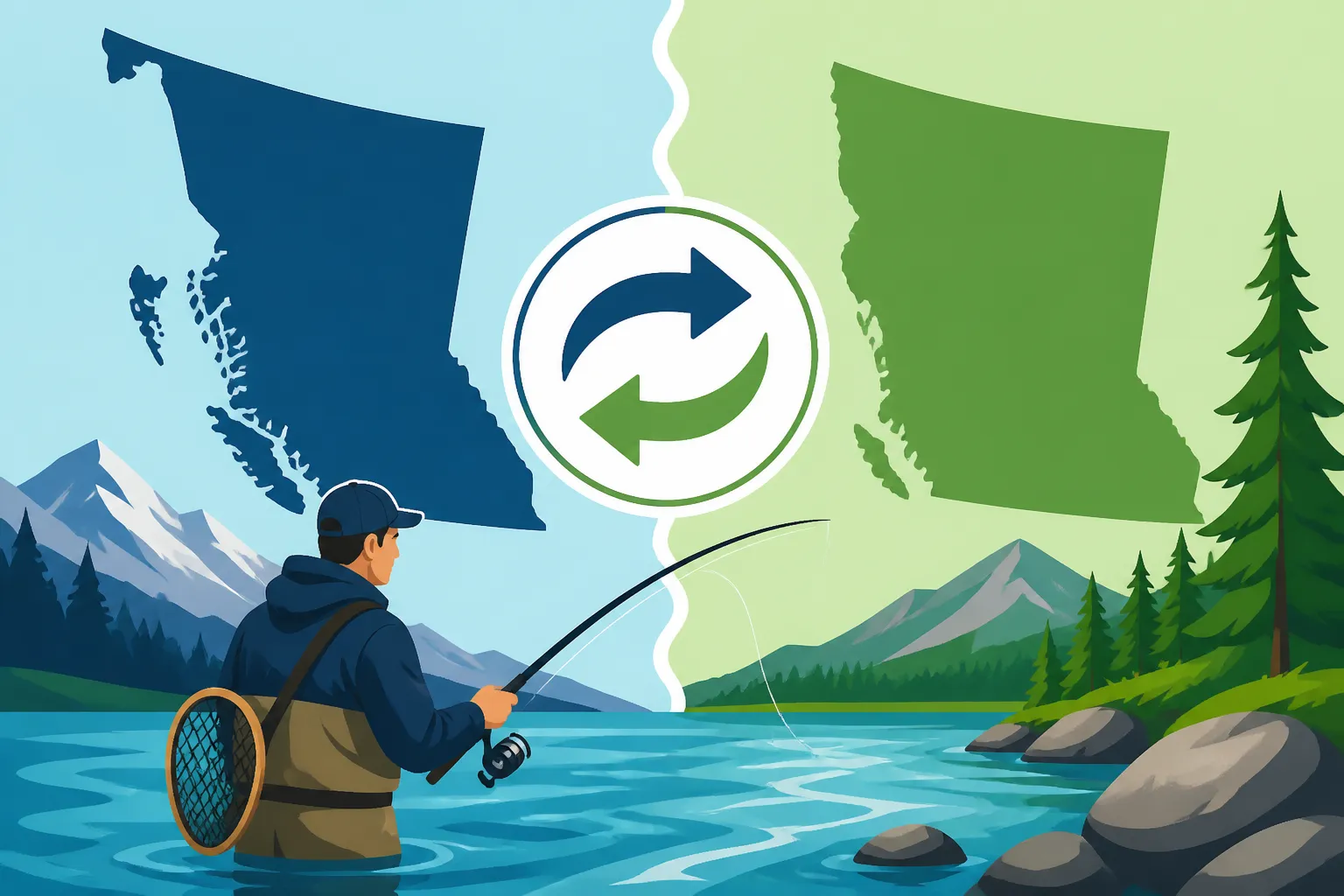
Let's cut right to the chase: for general recreational fishing, there is no blanket reciprocity agreement where a single BC fishing license automatically allows you to fish in Alberta waters, or vice-versa. Each province maintains its own independent licensing system, regulations, and enforcement. When you purchase a British Columbia Fishing License Guide for 2026, you are buying the right to fish according to BC's rules within its geographical boundaries. The same applies when you purchase an Alberta fishing license – it grants you access to Alberta's waters under their specific regulatory framework. This is a crucial distinction to understand, as the lack of reciprocity is often the source of angler confusion and accidental non-compliance. You are always responsible for knowing which province's waters you are in and holding the appropriate license for that jurisdiction.
Identifying Shared Waterways and Their Jurisdictions
While a true license reciprocity might be absent, British Columbia and Alberta do share numerous waterways along their extensive border. These include significant river systems and their tributaries that flow through both provinces, creating popular fishing opportunities. For instance, the mighty Columbia River system, the Kootenay River, and the Elk River all have sections that traverse or originate in the Rockies on either side of the provincial divide. On the northern reaches, other river systems and lakes might also fall close to the border. The key here isn't that one license works for both, but rather that anglers need to be acutely aware of which side of the invisible provincial line they are actually fishing on. Even if a fish swims freely between jurisdictions, you as the angler are governed by the rules of your physical location. This can be tricky when a river winds back and forth across the border, or a lake's center line marks the boundary. Anglers often rely on detailed maps, GPS devices available on platforms like Amazon, or local knowledge to precisely determine their position.
What License Do You Actually Need?
Understanding the fundamental lack of direct license reciprocity means you need to be strategic about how you approach fishing on boundary waters. It's not about which license is "better" or "covers more," but about having the correct authorization for your precise location.
Fishing in British Columbia Waters
If your intended fishing spot, or even the trajectory of your cast, falls within the geographical boundaries of British Columbia, then a valid BC fishing license is absolutely mandatory. This applies whether you're a BC resident, a non-resident Canadian, or a non-resident of Canada. For example, if you're fishing the headwaters of the Elk River in BC, even if the river eventually flows into Alberta, you need that BC license. You'll also need to be aware of other BC-specific requirements, such as purchasing a BC Salmon Conservation Stamp Rules if you plan to retain salmon in freshwater, or understanding specific regional closures.
Determining if you're in BC waters requires a bit of diligence. You can use official provincial maps, GPS units, or even dedicated fishing apps that often overlay provincial boundaries. If you're unsure, err on the side of caution. Remember that BC's freshwater and tidal water licenses are separate entities, so make sure you have the correct type for the environment you're fishing in, as explained in our guide on BC Freshwater vs Tidal Waters License, Explained. It's always best to check the latest BC Fishing Regulations Explained before heading out, as rules can change seasonally or due to conservation concerns.
Fishing in Alberta Waters
Conversely, if you find yourself fishing on the Alberta side of the provincial border, an Alberta fishing license is required. Alberta also has its own system of general licenses, as well as specific endorsements or "tags" for certain species. For instance, Alberta requires a Wildlife Identification Number (WIN) before you can purchase any fishing license, which is a key difference from BC's system. Like BC, Alberta distinguishes between resident and non-resident licenses, and there might be different costs depending on your residency status, similar to the considerations for Resident vs Non-Resident Fishing License Costs in BC.
It's crucial to understand that even if you're targeting the same species that exist in BC, Alberta's regulations for those species might be entirely different. Bag limits, size restrictions, and season dates could vary significantly. Just as with BC waters, precise location awareness is key. If you're exploring the upper reaches of a river that originates in BC but then crosses into Alberta, the moment you cross that invisible line, Alberta's rules apply. Local sporting goods stores in border towns often sell licenses for both provinces, and it's a good idea to pick up the relevant Alberta regulations synopsis as well, just like you would for Reading the BC Freshwater Fishing Regulations Synopsis.
The Double-Check Dilemma
Given the lack of direct reciprocity, the most prudent approach when fishing waters that are close to or straddle the BC-Alberta border is to do a "double-check" and, if necessary, carry both licenses. This might seem like an extra hassle and expense, but it's far better than facing a fine or the unpleasant experience of having your fishing trip cut short by a conservation officer.
Imagine you're fishing a tributary that winds through a canyon, and without realizing it, you cross an unmarked provincial boundary line that a detailed map would have shown. If you only have a BC license and you're caught fishing in Alberta waters, you are technically fishing without a license in that province. The reverse is also true. Many experienced anglers who frequent these border areas invest in both provincial licenses for the season, especially if they plan to explore extensively. This foresight eliminates doubt and allows for a more relaxed and lawful fishing experience. Always verify your location against a reliable map or GPS device, which you can easily find on Amazon, to ensure you are operating within the bounds of your purchased license.
Navigating the Nuances of Border Water Regulations
Beyond just the license itself, the actual fishing rules – bag limits, gear restrictions, season dates – can also differ significantly between British Columbia and Alberta, even for the same fish species in connected waterways. This adds another layer of complexity that diligent anglers must navigate.
Discrepancies in Bag Limits and Size Restrictions
One of the most common differences you'll encounter when moving between provincial jurisdictions are the varied bag and possession limits, as well as minimum or maximum size restrictions for fish. For example, a species like rainbow trout or bull trout might have a daily bag limit of three fish in one province, but only one or even catch-and-release-only regulations in the other. Consider a scenario where you're fishing a lake whose shore is split by the border. You might catch a fish on the BC side and legally retain it under BC's BC Bag and Possession Limits by Species. However, if you then move your boat into the Alberta portion of the lake and continue to fish with that same fish in your livewell, you could be in violation of Alberta's possession limits if their rules are stricter or if that species is managed differently there. These discrepancies underscore the importance of not only having the right license but also understanding the specific regulations for the province you are actively fishing in at any given moment.
Variances in Gear, Bait, and Method Restrictions
Another significant area of divergence lies in the allowed fishing gear, bait, and methods. British Columbia and Alberta each have their own philosophies on conservation and management, which often translate into different rules regarding what you can use. For instance, one province might permit the use of barbed hooks in certain areas, while the other might enforce single, barbless hooks universally. Live bait, or even certain types of dead bait (like roe), might be perfectly legal in one province but strictly prohibited in the other to prevent the spread of disease or invasive species.
Consider fly-fishing-only waters or sections that are designated for artificial lures only. It's not uncommon for a river to transition from a bait-friendly zone in one province to a strict artificial-only zone as it crosses into the other. For example, some special regulation waters in BC might restrict gear type, which could differ from a connecting waterway in Alberta. If you're drift fishing a river that crosses the border, you might need to change your entire setup – removing bait, crimping barbs, or even switching lures – the moment you enter a new jurisdiction. Failure to do so could result in fines, regardless of your intention. Always consult the respective provincial regulations to ensure your gear and methods are compliant.
Crucial Information from Fishery Notices and Synopses
The regulations printed in annual synopses are a great starting point, but they are not always the final word. Both BC and Alberta regularly issue in-season fishery notices to announce changes to regulations, often due to conservation concerns, unusual weather patterns, or specific stock assessments. These notices can include sudden closures, changes to bag limits, or alterations to permitted gear, and they supersede the printed synopsis.
For anglers fishing boundary waters, this means a double dose of vigilance is required. You can't just check BC's BC Fishery Notices and In-Season Closures, Explained and assume you're covered. You must also check Alberta's equivalent notices for the specific region you plan to fish. This real-time information is critical because a section of river might be open in one province but closed immediately across the border. Ignorance of these notices is not a defense, and conservation officers on both sides of the border are well-versed in their respective regulations and highly active in ensuring compliance. Make it a routine part of your pre-trip planning to check both provincial websites for the most up-to-date information.
Here’s a simplified comparison of general licensing approaches between BC and Alberta:
| Feature | British Columbia | Alberta |
|---|---|---|
| General Requirement | Freshwater or Tidal Waters Basic License | Wildlife Identification Number (WIN) + Basic Fishing License |
| Resident Licenses | Available (lower cost) | Available (lower cost) |
| Non-Resident Licenses | Available for Canadian & Non-Canadian (higher cost) | Available for Canadian & Non-Canadian (higher cost) |
| Salmon Conservation Stamp | Required for salmon retention in freshwater | Not applicable (differs) |
| Annual Expiration | March 31st annually | March 31st annually |
| Youth Licenses | Under 16 may not need one, but check specifics | Under 16 do not need a WIN or license |
| Online Purchase | Yes, via official government portal or vendors | Yes, via official government portal or vendors |
Avoiding Costly Mistakes: Enforcement and Prevention
Nobody wants their peaceful day on the water ruined by an unexpected encounter with a conservation officer that ends in a ticket. Understanding the rules, carrying the right documentation, and exercising caution are your best defenses against costly mistakes when fishing near the BC-Alberta border.
The Consequences of Fishing Without the Correct License
Fishing without the proper license in either British Columbia or Alberta is a serious offense, and the penalties can be substantial. Conservation officers have the authority to issue significant fines, confiscate gear, and even seize vehicles or boats in more egregious cases. Beyond the financial implications, a violation can result in a permanent record, and repeated offenses could lead to a suspension of your fishing privileges in that province.
Imagine setting up your gear on the BC side of a small stream that meanders through the mountains. You catch a few beautiful trout, feeling great about your day. Then, a conservation officer approaches. Upon checking your license, they notice you've unknowingly waded a few steps across the provincial boundary into Alberta waters without an Alberta license. Even if you argue ignorance, it won't typically hold up. The fine could easily be hundreds of dollars, overshadowing any enjoyment you got from your catch. Our guide on Fishing Without a License in BC: Penalties provides more details on the potential repercussions, which are mirrored by Alberta's robust enforcement system. It's a risk simply not worth taking.
Tools and Strategies for Border Anglers
To avoid these stressful situations, preparedness is key. Modern technology offers some fantastic tools for anglers traversing provincial boundaries. A reliable GPS device, like those readily available on Amazon, can be invaluable. Many handheld GPS units or smartphone apps (with downloaded maps for offline use, as cell service can be spotty in remote border areas) can display precise provincial boundaries, allowing you to know exactly where you stand. Investing in detailed topographical maps of the border region is also highly recommended. You can often find specialized maps that highlight jurisdictional lines, and these are often sold through outdoor retailers or on Amazon.
Beyond location tools, it's wise to carry both your BC and Alberta fishing licenses with you if you plan to fish waters close to the border. This might mean having physical paper copies in a waterproof bag, or ensuring digital versions are easily accessible on your phone, provided your device is waterproof and charged. It’s also prudent to carry copies of the relevant regulation synopses for both provinces. A quick glance at the rules can often avert a potential issue.
Local Expertise and Resources
Perhaps one of the most underutilized resources for border anglers is local knowledge. Before heading out, make a point of visiting local tackle shops or sporting goods stores in towns situated near the BC-Alberta border. These businesses often cater to anglers from both provinces and are usually a treasure trove of information. The staff frequently know the local quirks of the waterways, where the provincial lines are less clear, and what current in-season closures or regulation changes might affect specific areas. They can also advise on where to legally purchase licenses for both provinces.
Many local guides who operate in these boundary regions are also excellent sources of information. They make it their business to understand the intricate regulations of both provinces and can offer invaluable advice on specific fishing spots, permitted gear, and how to stay compliant. Even a brief conversation can save you a lot of hassle and ensure a more enjoyable, stress-free fishing experience. Don't be shy about asking questions; local experts are usually keen to help fellow anglers stay safe and legal on the water.
Disclaimer
The information provided in this guide is for general informational purposes only and does not constitute legal advice. Fishing regulations in British Columbia and Alberta are subject to change without notice. It is the sole responsibility of every angler to consult the most current official fishing regulations and fishery notices issued by the relevant provincial authorities (e.g., BC Ministry of Water, Land and Resource Stewardship and Alberta Environment and Protected Areas) before engaging in any fishing activity. Always verify your licensing requirements and understand local rules for the specific waters you intend to fish.