How deep white sturgeon go in the Fraser
One of the most thrilling aspects of chasing British Columbia's magnificent white sturgeon on the Fraser River is the sheer mystery and challenge they present. Anglers often ponder, "Just how deep do these ancient giants actually go?" It’s a question that gets at the heart of understanding their elusive habits, and it's a frustration many feel when trying to pinpoint these incredible fish. This guide aims to demystify the depths white sturgeon inhabit in the Fraser, helping you better understand their preferences and, hopefully, increase your chances of a successful encounter.
Understanding White Sturgeon Habitat in the Fraser River
The Fraser River is an incredibly complex and ever-changing ecosystem, not a static bathtub with uniform depths. Understanding where white sturgeon choose to hang out means understanding the river itself – its currents, its depths, and its seasonal transformations. These fish are masters of adaptation, moving within this dynamic environment to find the most comfortable and productive spots.
The Fraser River's Dynamic Depths and Sturgeon Preferences
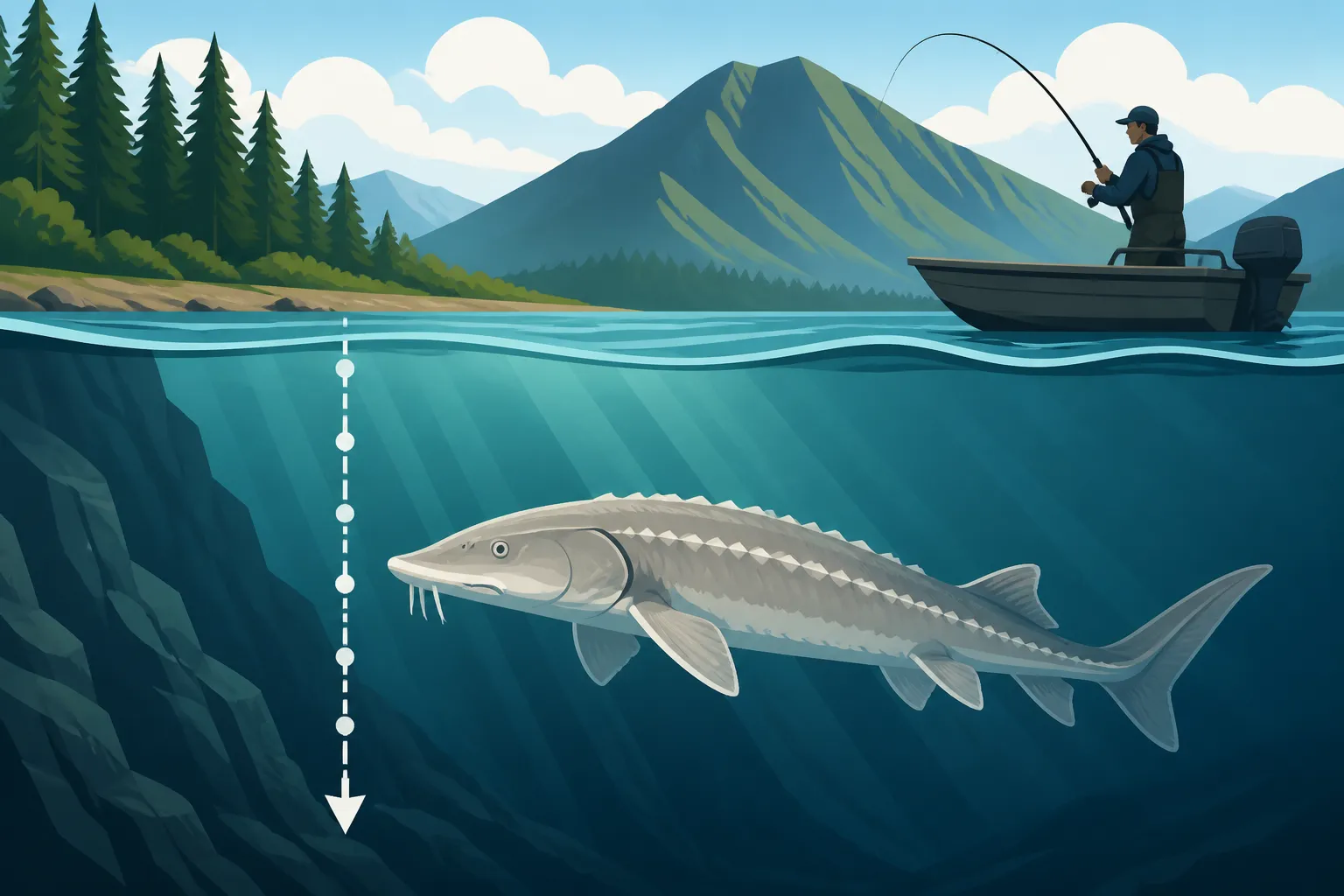
The Fraser River is renowned for its vast size and formidable currents, but it's also famous for its incredible depth variations. You'll find stretches that are surprisingly shallow, barely covering a sandbar, and then, without much warning, the river plunges into profound depressions. White sturgeon aren't typically found cruising the shallow flats like trout; they are bottom-dwellers, and they gravitate towards the deeper, more stable environments. This includes significant "scour holes" carved out by the powerful current, and long, deep pools that can extend for hundreds of meters. These areas offer respite from the strongest currents and provide a sense of security, especially for the truly enormous, record-breaking individuals. It's not uncommon for these fish to be found in waters ranging from 20 to 60 feet deep, and sometimes even deeper in the most pronounced holes, especially in the Lower Fraser where the river is at its most expansive and powerful.
Seasonal Movements and Depth Changes
The depth at which white sturgeon choose to reside isn't fixed; it's a dynamic variable influenced heavily by the seasons. During the spring freshet, when the Fraser swells with snowmelt, water levels rise dramatically, and the river becomes a turbulent, silty beast. In these conditions, sturgeon might seek out slightly shallower, less turbulent areas adjacent to deep channels, or tuck into slower-moving eddies where they can escape the full force of the current without expending too much energy. As water levels recede in late summer and fall, and the clarity improves, they might redistribute into those classic deep pools and channels more readily. Water temperature also plays a significant role; in the scorching heat of summer, they might seek deeper, cooler pockets of water, while in the colder months, they might congregate in slightly more thermally stable deeper sections. Understanding these seasonal shifts is key to knowing BC Fishing Season Dates and Closures for sturgeon.
The Role of Structure and Current
Sturgeon are masters of using the river's underwater topography to their advantage. It's not just about the absolute deepest spot, but where that depth occurs in relation to structure and current. They love to lie in wait behind large submerged boulders, massive log jams, or significant drop-offs. These features create current breaks, allowing the sturgeon to hold their position with minimal effort while waiting for food to drift by. Imagine a huge, ancient tree trunk snagged on the riverbed, creating a calm "pocket" just downstream in 40 feet of water. That's a prime sturgeon lie. Similarly, they'll often position themselves at the edge of a fast current seam, where the deeper, slower water meets the main flow, creating a conveyor belt of potential food. These structural elements, even in deep water, are magnets for sturgeon.
Key Factors Influencing Sturgeon Depth
The white sturgeon's decision to occupy a particular depth is rarely arbitrary. It's a complex interplay of environmental factors that dictate comfort, safety, and feeding opportunities. Being able to mentally "map" these factors onto the river's contours can give you a significant advantage in predicting where these fish might be.
Water Temperature and Oxygen Levels
Like all fish, sturgeon are ectothermic, meaning their body temperature is regulated by their environment. They have preferred temperature ranges for optimal metabolic function. In the heat of summer, the surface layers of the Fraser can warm considerably. While the Fraser is a large, cold river, localized areas can heat up. Sturgeon will often retreat to deeper water where the temperature is more stable and cooler. Conversely, in the depths of winter, deeper water can sometimes offer a slightly more stable, albeit cold, temperature compared to shallow areas that might experience more dramatic swings.
Oxygen levels are another critical, though often overlooked, factor. The Fraser is generally well-oxygenated, but in certain conditions or specific deep, stagnant holes (which are rare in a river system as dynamic as the Fraser), oxygen levels can vary. Sturgeon will naturally avoid areas with insufficient oxygen. While not as common a concern in the main stem of the Fraser as it might be in some lakes or slower river systems, it's still a biological driver for their movements and depth preferences.
Food Availability and Foraging Behavior
This is perhaps the most significant factor influencing sturgeon depth. White sturgeon are opportunistic bottom feeders. Their diet heavily relies on various prey items, many of which are associated with the riverbed or drift along it. During the massive salmon runs – Chinook, sockeye, coho, pink, and chum – adult salmon carcasses are a primary food source. These carcasses often settle into deeper pockets and along the bottom, making these depths prime feeding grounds. You can learn more about What white sturgeon eat in the Fraser River to understand their foraging habits.
Similarly, other prey fish, like eulachon (when available) or other baitfish, might hug the bottom or get swept into deeper areas by the current. If the main food source is concentrated at a certain depth, you can bet the sturgeon will be there, too. Their barbels, highly sensitive to touch and chemical cues, are perfectly adapted for rooting around in the substrate, meaning they are intrinsically tied to the riverbed for their sustenance. You'll often find anglers discussing Best bait for sturgeon on the Fraser River, and that bait often needs to be presented right on the bottom.
Spawning Habits and Nesting Sites
While adult white sturgeon spend much of their lives in deeper areas, their spawning habits require specific conditions. Sturgeon typically spawn in relatively shallower, turbulent water, often downstream from rapids or riffles, where there's a strong current and a clean, gravelly bottom. These areas, though shallower than their typical feeding lies, provide the necessary conditions for their adhesive eggs to attach to rocks and gravel and for oxygenated water to flow over them. After spawning, which usually occurs in late spring to early summer, the adults will typically retreat back to their deeper holding lies to recover and resume feeding. These distinct movements for reproduction illustrate how their depth preferences shift dramatically for specific life cycle events.
How Anglers Locate Sturgeon at Different Depths
Finding white sturgeon in the vast expanse of the Fraser River requires a blend of traditional river knowledge and modern technology. It's a bit like detective work, piecing together clues to figure out where these behemoths might be hiding in the deeper channels.
Sonar and Fish Finder Technology
Modern sonar and fish finder technology have revolutionized sturgeon fishing. Gone are the days of purely guessing and relying solely on historical knowledge. Today's anglers use advanced units that can paint a detailed picture of the river bottom, revealing depths, contours, structure, and even the fish themselves. Technologies like CHIRP sonar and side imaging can show you not only how deep the water is directly beneath your boat but also the submerged obstacles and potential sturgeon lies to the sides.
When you're out on the Fraser, looking for a promising spot, your fish finder is your best friend for understanding the depth profile. You'll be scanning for those deep depressions, underwater shelves, and significant drop-offs where sturgeon often congregate. High-quality units available on platforms like Amazon can help you mark these features with precision, allowing you to return to productive spots time and again. However, seeing a "fish arch" on your screen in deep water doesn't guarantee it's a sturgeon, but it certainly increases your confidence that you're in the right depth and area.
Reading the River and Identifying Prime Spots
While technology is great, nothing beats the wisdom gained from years of "reading the river." Experienced sturgeon anglers develop an intuitive understanding of how the Fraser flows and where fish might hold. This involves observing surface currents – swirling eddies, slack water behind islands, or subtle changes in the water's texture that indicate a drop-off or submerged structure.
For example, a sudden calm patch in an otherwise fast-flowing section might signal a deep hole or a significant current break below. Confluence points, where smaller tributaries meet the main Fraser, often create deep scour holes that are prime sturgeon habitat. Even the erosion patterns on the riverbanks can hint at the deeper channels and cuts below. This skill is honed over time, combining visual cues with knowledge of typical sturgeon behavior and their preferred depths, often learned by spending countless hours on the water. Many guides specialize in this nuanced knowledge, helping anglers understand How to Catch Sturgeon on the Fraser River.
Bait Presentation and Weight Selection
Once you've identified a promising deep spot, the challenge is getting your bait down to where the sturgeon are. This is where strategic bait presentation and weight selection come into play. White sturgeon are bottom feeders, so your bait absolutely must be resting on the riverbed, or very close to it, to be effective.
In the strong currents of the Fraser, this often requires substantial weight. Anglers commonly use pyramid or round cannonball sinkers, sometimes weighing 8 ounces, 12 ounces, or even up to 2 pounds or more, depending on the current speed and depth. The goal is to use just enough weight to hold your bait firmly on the bottom without it being swept away by the current. If your line is dragging too much, you'll know you need more weight. Finding the right balance is crucial; too much weight and you risk your line getting snagged, too little and your bait won't stay in the strike zone. This precise approach is a key part of the Best rig for bottom fishing for sturgeon. You'll find a wide array of lead weights and specialized gear for this type of fishing readily available on sites like Amazon.
Common Depths Where Sturgeon are Encountered
While white sturgeon can be found at various depths depending on the conditions, there are certain common ranges and types of locations where anglers most frequently encounter them. These are the "sweet spots" that experienced guides and keen anglers target.
Deep Pools and Scour Holes
These are the classic sturgeon haunts, and for good reason. Deep pools, often formed by natural meanders or the convergence of currents, can hold vast numbers of fish. Scour holes, particularly those downstream of constricted areas or major obstacles, are deep pockets where the current has eroded the riverbed, creating perfect holding areas. These can range anywhere from 30 to 80 feet deep in some of the more significant spots on the Lower Fraser.
For example, sections of the Fraser near Mission or Chilliwack have well-known deep pools where sturgeon have been caught for generations. These deep zones provide sanctuary from the current, stable temperatures, and often act as natural traps for drifting food. It's in these consistent, deeper environments that you'll often find the largest, most sedentary sturgeon. Knowing Best sturgeon spots on the Lower Fraser River often means knowing where these deep features are.
Transition Zones and Current Edges
While sturgeon love deep water, they aren't always found squarely in the deepest part of the deepest hole. Often, they prefer the "transition zones" – the edges where deep water meets shallower water, or where a fast current seam meets slower water. These areas, typically ranging from 20 to 50 feet deep, are highly productive because they offer the best of both worlds: relatively deep water for security and cooler temperatures, combined with proximity to current that brings food.
Imagine a large, flat shelf at 25 feet that suddenly drops into a 60-foot channel. Sturgeon will often position themselves right on that edge, or just at the lip of the drop-off, where they can ambush prey drifting into the deeper water. These current edges are energetic zones, constantly delivering food, making them prime ambush points for these large predators. This is particularly relevant when considering Best technique for sturgeon in cold water, as they may shift positions slightly to conserve energy.
Variability Across the Fraser System
It's important to remember that "how deep" is highly relative to where you are on the Fraser River. The depths in the Lower Fraser, from Vancouver up to Hope, are generally more profound and extensive, with large, wide channels and massive scour holes. As you move upstream into the Fraser Canyon, the river becomes narrower, faster, and often shallower in many stretches, though it can still carve out incredibly deep, swift-moving pockets.
For instance, a "deep hole" in the Fraser Canyon might be 40 feet, whereas in the Lower Fraser, that might be considered a shallower edge. The sturgeon adapt to these localized conditions. Therefore, local knowledge and a good depth sounder are invaluable resources. A good guide will tell you that while the average holding depth might be, say, 30-50 feet in a particular section, they could be found shallower or deeper based on water levels, clarity, and feeding activity on any given day.
To give you a clearer picture, here's a table summarizing the factors influencing sturgeon depth and common locations:
| Factor Influencing Depth | Typical Depth Range (Approx.) | Common Location Characteristics | Angler Strategy |
|---|---|---|---|
| River Structure | 20-80+ feet | Deep scour holes, defined channels, drop-offs, large submerged logs/boulders | Target major depth changes, use sonar to identify structure. |
| Seasonal Changes | Varies with water levels/temp | Deeper in summer heat/winter cold; shallower eddies during freshet. | Adjust based on current river conditions and time of year. |
| Food Availability | Bottom-oriented, often 20-60 feet | Areas where salmon carcasses or baitfish collect, current seams. | Focus on presenting bait directly on the bottom in known feeding lanes. |
| Current Strength | 20-60 feet, often on edges | Behind obstacles, in current breaks, on the edge of main flow. | Locate areas of reduced current where fish can hold easily. |
| Spawning | Shallower, turbulent water (not typical holding) | Upstream of riffles/rapids with clean gravel (seasonal movement). | Avoid these areas during spawning to prevent disturbance. |
Knowing when Steelhead Runs on BC's North Coast Rivers are happening, for example, might not directly affect sturgeon depth but highlights how different species interact with river conditions.
Conclusion
The question of "how deep white sturgeon go in the Fraser" doesn't have a single, static answer. It's a dynamic puzzle, influenced by the river's ever-changing characteristics, the seasons, and the sturgeon's fundamental needs for shelter and food. These magnificent fish are predominantly bottom-dwellers, and you'll typically find them in depths ranging from 20 to 80+ feet in the Fraser's myriad pools, scour holes, and along productive current edges.
Ultimately, successfully locating these incredible creatures comes down to a blend of understanding their habits, skillfully interpreting the river's subtle clues, and wisely employing modern sonar technology to confirm your suspicions. It's about respecting their ancient ways and appreciating the sheer power and mystery of British Columbia's largest freshwater fish. So, gear up, keep your eyes on the water and your sonar humming, and get ready for an unforgettable encounter with a true Fraser River giant! You can explore more about these fish, including Sturgeon Growth Rate to Trophy Size and White Sturgeon Habits on the Fraser River, to deepen your understanding.
Disclaimer
This article is for general informational purposes only and does not constitute professional advice. Laws, prices and regulations vary by location and change over time. Consult a qualified professional for guidance on your specific situation.