Best trolling spread for chinook salmon
There’s nothing quite like the thrill of a Chinook salmon strike, that sudden, explosive pull that signals you’ve hooked into one of British Columbia’s most prized fish. But let's be honest, trolling for these magnificent creatures can sometimes feel like a game of chance, with hours passing without so much as a nibble. You’ve got your boat, your gear, and your hopes high, only to be met with silence on the lines. This guide is here to demystify the art of the trolling spread, helping you understand how to arrange your gear to maximize your chances of enticing those elusive Chinook in BC’s diverse waters.
The Foundation: Why a Strategic Trolling Spread is Crucial for Chinook
Trolling for Chinook isn't just about dragging a lure behind your boat; it's a sophisticated dance with multiple lines, depths, and presentations, all working in harmony to cover as much water as possible and mimic natural baitfish schools. Ignoring the subtleties of a proper spread can lead to frustratingly empty fish boxes, and frankly, wasted time on the water.
The Elusive Nature of Chinook and Their Feeding Habits
Chinook salmon, also known as King salmon, are apex predators, powerful and often finicky. They are typically found in deeper, cooler waters, often congregating around baitfish schools like herring, pilchards, or anchovies, or near underwater structure where baitfish hide. Their feeding patterns can change dramatically with the tide, time of day, water temperature, and even barometric pressure. This means that a static, one-size-fits-all approach to trolling rarely pays off. You need a dynamic strategy that can adapt. Understanding What Chinook Salmon Eat in the Ocean is paramount to selecting the right lures and baits, and knowing their preferred environment will help you place those offerings effectively within your spread. Without a carefully planned spread, you're essentially putting all your eggs in one basket, hoping a lone lure stumbles into a feeding fish rather than actively presenting multiple irresistible options.
Essential Gear for Building Your Spread
Before we even talk about placement, let’s quickly touch on the core equipment you’ll need for a successful Chinook trolling spread. First, reliable downriggers are non-negotiable for precisely controlling depth. You'll want at least two, but ideally, three or four, to really build out a comprehensive spread. These allow you to send lures down to specific depths, which is crucial when Chinook are holding deep. You can find a wide array of durable downriggers and accessories on Amazon, perfect for outfitting your vessel.
Beyond downriggers, consider lead core lines or diving planers for lines without downriggers, which help get lures to intermediate depths. Rods and reels should be robust enough to handle the powerful runs of a large Chinook, typically medium-heavy to heavy trolling rods paired with level-wind reels spooled with strong braided or monofilament line. Finally, don't forget your terminal tackle: a variety of flashers, dodgers, and leaders will be key players in attracting and presenting your chosen lures.
Building Your Spread: Depth, Distance, and Diversity
The magic of a trolling spread lies in its ability to present multiple baits at different depths and distances from the boat, mimicking a scattered school of baitfish or covering various strata of the water column where Chinook might be lurking. It’s about creating an enticing buffet.
Mastering the Water Column: Downriggers, Divers, and Weights
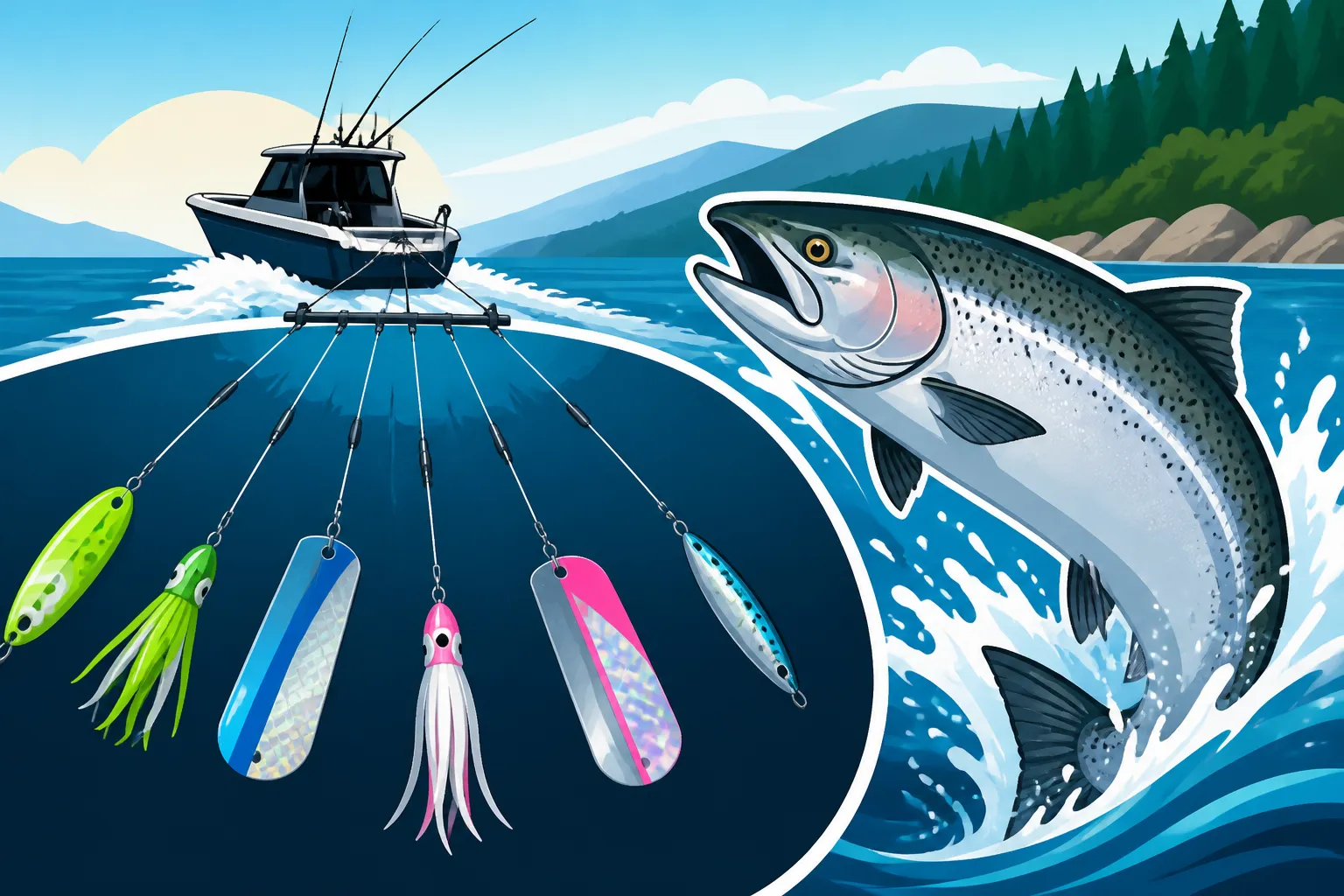
Chinook salmon can be found anywhere from just below the surface to over 100 feet deep, depending on the time of year, location, and presence of bait. Your trolling spread needs to effectively cover this entire water column. Downriggers are your primary tool for this. Typically, you'll run your deepest lines directly off the stern, sending them down to where you're marking fish or bait. If you have four downriggers, you might run two deep (e.g., 60 and 80 feet) and two shallower (e.g., 30 and 45 feet) to test different depths simultaneously. Remember to check out Best Downrigger Settings for Summer Chinook for detailed guidance on optimizing your setup for those warmer months.
For lines without downriggers, diving planers or lead core line can be incredibly effective. Diving planers, like the popular Dipsy Diver, allow you to deploy lures horizontally away from the boat while also taking them down to a preset depth. These are fantastic for extending your spread wider, helping to avoid tangles and cover more ground. Lead core line, on the other hand, sinks at a consistent rate per colour (usually 10 yards), allowing you to estimate depth based on how many colours you have out. Both methods are great for targeting those middle depths that Chinook often patrol.
Lure Selection and Placement: Attracting That Strike
Once you've got your depths covered, the next critical element is lure selection and how you position them within your spread. Diversity is key here. Chinook can be picky, and what works one day might not work the next. A good spread incorporates a variety of lures, colours, and actions. For instance, you might run a large flasher-and-hoochie combination deep on a downrigger, mimicking a squid or larger baitfish. On another downrigger, perhaps a shallower one, you might deploy a whole or cut-plug herring, presented naturally to entice a wary fish. Many anglers find the classic green or chartreuse flashers with a white or green hoochie combo to be incredibly effective in BC waters. You can find excellent quality flashers and hoochies, often in multi-packs, on Amazon to keep your tackle box well-stocked.
Consider the action of each lure as well. Some lures, like spoons, have their own inherent wobble and flash, while others, like hootchies, rely heavily on the action imparted by a flasher or dodger. How to Rig Herring for Chinook Trolling is a skill every BC angler should master, as herring are a natural and highly effective bait. Don't be afraid to mix and match. Perhaps a spoon on your shallowest downrigger, a flasher/hoochie combo on a mid-depth downrigger, and a cut-plug herring on your deepest one. Varying your lure choices and their positions can help you identify what the Chinook are keying in on that particular day.
Optimizing for BC Conditions: Currents, Structure, and Bait
British Columbia’s coastal waters are incredibly dynamic, offering a vast array of conditions that can influence your trolling strategy. What works wonders in the calm, deep waters off Tofino might not be as effective in the swift currents of Discovery Passage near Campbell River.
Reading the Water: Current, Structure, and Bait Balls
Currents are a huge factor when trolling in BC. Strong currents can make maintaining your depth and lure action a challenge. When fishing in areas with significant tidal flow, like many of the Best Salmon Fishing Spots in BC, you often want to troll with or against the current, not directly across it, to ensure your lures are presenting naturally. If you're going with the current, you might need to increase your boat speed slightly to achieve the desired lure action. Against the current, you can often slow down and still get great action. Always observe how your lines are behaving and adjust your boat speed accordingly. You can learn more about general salmon fishing tactics in Salmon Fishing Techniques for BC Rivers.
Underwater structure, such as reefs, ledges, and drop-offs, are magnets for baitfish, and consequently, for Chinook. Your fish finder is your best friend here. Look for bait balls, arches (indicating individual fish), and changes in bottom contour. When you mark bait or fish near structure, that's your cue to work that area thoroughly. Often, Chinook will hold just off the structure, ambushing baitfish. Your spread should be designed to target these areas, perhaps with deeper lines probing the base of a drop-off and shallower lines sweeping the top.
Common and Effective BC Chinook Trolling Setups
While there's no single "best" setup, several configurations are tried and true for Chinook in BC. A popular spread often involves a mix of depths and lure types.
The "Standard" Three-Downrigger Spread:
- Deep Line (Port or Starboard Stern): Often 60-100 feet deep. A large flasher (e.g., Hot Spot, Oki) paired with a long leader (4-6 feet) to a large hoochie or a whole/cut-plug herring. This is your "meat" line, targeting fish holding deep.
- Mid-Depth Line (Opposite Stern): Often 30-50 feet deep. A smaller flasher with a spoon (e.g., Silver Horde, Coyote) or a plastic plug (e.g., Tomic, Apex). This covers the middle of the water column.
- Shallow Line (Any Downrigger, or Surface with Planer Board/Lead Core): 15-30 feet deep. This might be another spoon, a bucktail fly, or even just a natural bait like a small herring if conditions allow. Often run further out to the side of the boat to avoid tangles.
Table: Common Chinook Trolling Lures and Their Typical Deployment
| Lure Type | Description | Typical Depth Range (with Downrigger/Diver) | Best Presentation | Notes |
|---|---|---|---|---|
| Flasher & Hoochie | Large plastic attractor with squid imitation | Deep (50-100+ ft) | Slow troll, constant action | Excellent for attracting fish, wide variety of colours. |
| Flasher & Herring | Large plastic attractor with natural bait | Deep to Mid (30-80 ft) | Slow troll, natural scent trail | Irresistible to Chinook; How to Rig Herring for Chinook Trolling is key. |
| Spoon | Metal or plastic, wobbles and flashes | Shallow to Mid (15-50 ft) | Varied troll speeds, erratic action can be effective | Versatile, great for searching, many sizes and patterns. |
| Plug/Hard Bait | Solid body lure, dives and wobbles | Shallow to Mid (10-40 ft) | Consistent troll speed, specific diving depths | Good for mimicking larger baitfish, strong vibration. |
| Diving Planer (e.g., Dipsy) | Lead-weighted disc, dives and tracks sideways | Mid (20-60 ft without downrigger) | Varying speeds, tracks lines away from boat | Great for extending spread width and hitting specific depths. |
When deciding on your Best Trolling Speed for Chinook Salmon, remember that slower speeds often work better for natural baits and larger flashers, while spoons and plugs can sometimes be effective at slightly faster speeds. Experimentation is always your best friend!
Advanced Tips and Troubleshooting Your Spread
Even with the perfect spread, conditions can change, and fish can be finicky. The best anglers are constantly observing, adapting, and troubleshooting to keep those lines tight.
Monitoring Your Electronics and Adjusting on the Fly
Your boat's electronics, particularly your fishfinder/sonar and GPS, are invaluable tools for optimizing your trolling spread. Don't just set your depth and forget it. Actively watch your screen for bait balls, individual fish, and changes in the bottom structure. If you start seeing a lot of activity at 60 feet, adjust your shallower lines deeper, or deploy another deep line. If you're not seeing anything, consider moving to a different depth altogether or changing locations. A good sonar/fishfinder, often available on Amazon, can make all the difference in locating those elusive feeding Chinook.
GPS allows you to mark successful trolling passes and return to them. If you get a bite at a specific depth and location, mark it and try to replicate that pass. Often, Chinook will stack up in specific areas, and repeating a successful pass can lead to multiple hook-ups. Pay attention to the speed over ground versus your speed through the water – current can drastically alter your lure's presentation.
Troubleshooting a Slow Bite
The dreaded slow bite is something every angler experiences. When your meticulously deployed spread isn't getting any love, it's time to troubleshoot. Here are a few things to consider:
- Change Depths: Are you fishing too deep or too shallow? Try moving your lines up or down 10-20 feet, or bringing a shallower line deeper.
- Vary Lure Colours/Types: Sometimes a slight change in colour or lure action can make all the difference. If you're running all green flashers, try switching one to a blue or purple. If you're using hootchies, try a spoon or a plug.
- Adjust Speed: Even a half-knot change in boat speed can alter the action of your lures significantly. Slow down, speed up, or try a subtle S-turn to make your lures dart and dive more erratically. This erratic motion can often trigger a reaction strike from a hesitant Chinook.
- Check Leader Lengths: Sometimes, Chinook want the lure right behind the flasher; other times, a longer leader (5-7 feet) gives the lure more natural movement. Experiment!
- Fresh Bait: If you’re using natural bait like herring, ensure it's fresh and presenting well. Old, washed-out bait simply won't cut it for discerning Chinook.
- Move On: If you've tried everything in an area and still nothing, don't be afraid to pull your gear and move to a new spot. Sometimes, the fish just aren't there, or they've moved on. British Columbia has an abundance of incredible fishing spots, many of them detailed in guides like Best Fishing Rivers in British Columbia, so don't be afraid to explore.
Developing an effective trolling spread for Chinook salmon in BC is a blend of art and science. It requires an understanding of the fish, your gear, and the dynamic environment you're fishing in. By focusing on depth control, lure diversity, and constant adaptation, you'll significantly increase your chances of hearing that rod bend and experiencing the unparalleled fight of a British Columbia Chinook.
Disclaimer
This article is for general informational purposes only and does not constitute professional advice. Laws, prices and regulations vary by location and change over time. Consult a qualified professional for guidance on your specific situation.