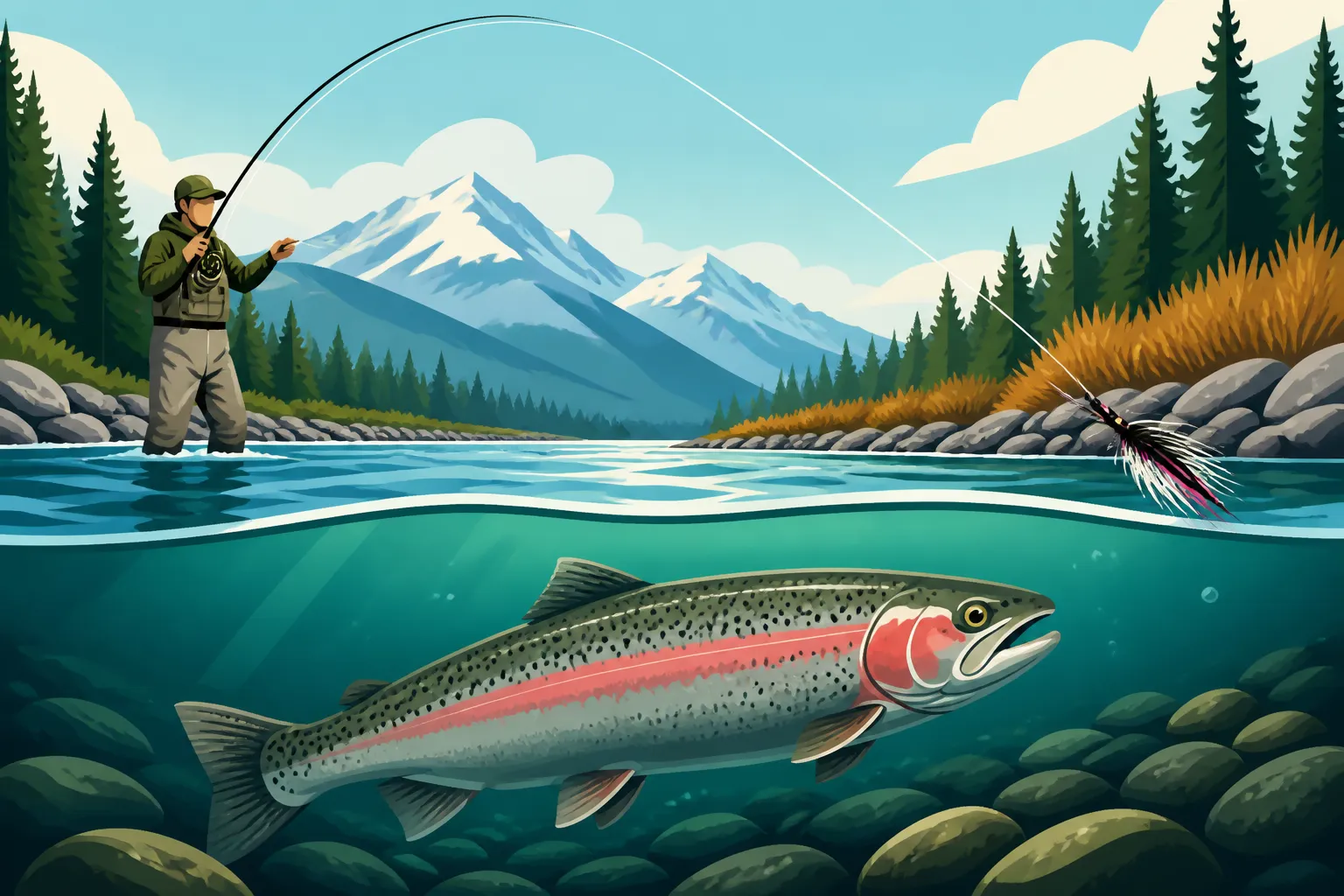
How to fish a fly for steelhead in a tailout
For many anglers, the tailout of a run can be one of the most frustrating yet rewarding places to target steelhead with a fly. It often looks so promising, with that lovely seam and slower current, but getting your fly to present naturally and enticingly can feel like cracking a secret code. This guide is here to unravel the mysteries of fishing a tailout, offering practical advice and techniques to help you consistently hook into those elusive chrome beauties in British Columbia's incredible rivers.
Understanding the Tailout: A Steelhead's Sanctuary
Before we even think about casting, let's get a handle on what a tailout actually is and why it's such an important feature for steelhead. A tailout isn't just the end of a run; it's a dynamic zone with specific characteristics that draw fish in, whether they're resting, holding, or even feeding. Many anglers rush through this section, focusing on the faster, choppier water upstream, but that's a mistake.
What Defines a Tailout?
Think of a tailout as the transition zone where a faster, more defined run or riffle slows down and typically gets shallower before deepening again into a pool or a slower, wider section of the river. You’ll notice the current speed decreasing, often creating distinct seams and soft eddies along the edges. The bottom contour might change too, from gravel and rocks in the faster water to finer gravel or sand as it flattens out. This slowing of water is key, as it provides steelhead with a break from the relentless current without completely isolating them from the main flow.
One of the defining features is the 'seam line' where the faster water from the main run meets the slower, often calmer water of the tailout. This seam is a highway for nutrients and smaller organisms, but also offers a comfortable holding position for fish. It’s a crucial zone to pay attention to, as steelhead will often sit right on the edge of this transition, conserving energy while waiting for an easy meal to drift by. The depth can vary wildly, from knee-deep wading areas to sudden drops, so always be mindful of your footing.
Why Steelhead Hold in Tailouts
Steelhead are incredible athletes, but even they need a break. Tailouts offer them that perfect balance of energy conservation and opportunity. Unlike the tumultuous head of a run where they expend a lot of energy just holding their position, the slower current in a tailout allows them to rest comfortably. This is especially true for fish that have travelled a long way upstream, or those preparing for the next leg of their journey. A tired steelhead isn't necessarily a non-biting steelhead; it's often a fish looking for an easy meal without having to work too hard.
Beyond resting, tailouts can be prime feeding lies. The slower current concentrates drifting insects, dislodged eggs, or even smaller baitfish that might struggle in the slower flow. If there's a strong salmon run upstream, tailouts below spawning grounds can become absolute buffets of loose eggs. Furthermore, the slightly shallower, often clearer water in a tailout means they can feel more secure if there's overhead cover from trees or even just the riverbanks. It provides a sense of safety, even if it's an illusion to a keen angler. This combination of resting potential and feeding opportunity makes them irresistible to steelhead, and thus, to us anglers.
Essential Gear for Tailout Success
Getting your fly into the right zone in a tailout, and presenting it naturally, requires a thoughtful approach to your gear. It's not just about having a fly rod; it's about having the right fly rod, line, and leader system to manage the nuanced currents and often lighter takes of steelhead in these softer waters. How to Catch Steelhead in BC is a great overall resource, but let's dive into the specifics for tailouts.
Rod and Reel Selection
For most BC steelhead rivers and their tailouts, a two-handed spey rod is often the king. A 12-foot to 14-foot rod in a 7 or 8-weight will give you the casting power to cover wide runs without excessive wading, and the backbone to handle big steelhead. Brands like Sage, Scott, and Orvis offer excellent options, but there are many reputable manufacturers out there. A spey rod allows you to make long, controlled casts with minimal backcasting room, which is often a blessing on brushy BC riverbanks. You can find a good selection of spey rods and reels on Amazon, often with reviews from fellow anglers.
If you prefer a single-handed rod, a 9 or 10-foot rod in an 8 or 9-weight can certainly get the job done, especially in smaller rivers or when nymphing. However, managing line and making long casts can be more physically demanding. Your reel should be a reliable large-arbor model with a smooth drag system and ample backing capacity. Steelhead are powerful, and you don't want to be caught short when that fish decides to make a run for it downstream.
Fly Lines and Leaders for Controlled Presentation
This is where things get a bit technical, but mastering your line system is paramount for fishing tailouts effectively. You need versatility to switch between swinging flies and nymphing, and often the ability to present a fly slowly and deep without snagging.
- Skagit Lines: These heavy, short shooting heads are fantastic for throwing heavy flies (like Intruders or weighted tubes) and sinking tips in larger rivers or when you need to get deep quickly. Pair them with various lengths and densities of T-series sinking tips (T-11, T-14) to adjust your depth. This setup excels at getting a fly down and across the current, allowing for a slow, controlled swing.
- Scandi Lines: Lighter and longer than Skagits, Scandi lines are excellent for delicate presentations with smaller, unweighted or lightly weighted flies. They are great for situations where you want a smooth, elegant cast and a softer landing, often when fish are more sensitive to splashy presentations in clearer, shallower tailouts. You can use poly leaders or VersiLeaders with different sink rates to fine-tune your depth.
- Integrated Spey Lines: Some lines offer an integrated shooting head and running line, which can simplify rigging and casting. These are often a good middle ground between Skagit and Scandi, offering decent power and good presentation.
- Nymphing Lines: For indicator nymphing with a single-handed rod, a weight-forward floating line with a long leader is standard. For Euro nymphing, a specialized thin, level line or a Euro-specific tapered line allows for maximum sensitivity and direct contact with your flies.
Your leader and tippet selection are equally important. For swinging flies, a stout leader (often 10-15 lb test fluorocarbon) is typically attached to your sinking tip, ending with 2-4 feet of tippet (8-12 lb test). When nymphing, leaders can be much longer, sometimes up to 12-15 feet, tapering down to 6-10 lb test fluorocarbon tippet. Fluorocarbon is less visible in the water and sinks, which is beneficial for both swinging and nymphing presentations. Remember to regularly inspect your tippet for nicks and abrasions, as steelhead will test every knot and weak point.
The Right Fly for the Moment
Tailouts can hold a variety of steelhead moods, so having a diverse fly box is essential. The general rule of thumb is to start with a less intrusive fly and size up or down based on fish activity and water conditions. Fly Patterns for BC Steelhead Rivers can give you an even broader overview.
- Intruders and Leeches: These are classic steelhead swinging flies. Intruders, with their bulky profile and often vibrant colors, are designed to trigger an aggressive strike. Leech patterns, from simple black string leeches to more elaborate articulated designs, imitate a natural food source that steelhead are accustomed to. Tie them on shank hooks or tubes.
- Spey Flies: Traditional spey flies, often tied with soft hackles and sparse materials, are fantastic for more subtle presentations. They breathe beautifully in the water and are perfect for clearer water or when fish are being finicky. These are usually fished on a lighter sink tip or intermediate line for a gentler swing.
- Nymphs: When fish are actively feeding on the bottom or holding tight to structure, nymphs can be deadly. Stonefly nymphs (Pat's Rubber Legs, Kaufmann's Stone), caddis larva, and even general attractor nymphs work well. During salmon spawning seasons, egg patterns (Glo Bugs, Otter's Soft Eggs) are absolutely essential, especially if you see salmon activity upstream.
- Dry Flies: While less common for steelhead, in very specific conditions, especially during warmer months or on certain rivers, a skater pattern or a large dry fly can elicit explosive strikes from aggressive fish. Always have a few in your box, just in case.
When choosing flies, consider water clarity, temperature, and light conditions. In murky water, larger, darker, or brighter flies with more profile are often better. In clear water, smaller, more natural patterns often shine. Having a variety on hand, perhaps purchased from a local fly shop or even a convenient online source like Amazon, will ensure you're prepared for whatever the river throws at you.
Reading the Water and Approaching Tailouts
Successfully fishing a tailout starts long before your fly hits the water. It’s about careful observation, understanding the flow, and making a stealthy approach. Steelhead in tailouts can be more sensitive to disturbance, so a quiet, calculated strategy is your best friend.
Identifying Prime Lies in a Tailout
A tailout isn't uniform; it has sweet spots. Your goal is to identify these "prime lies" where a steelhead is most likely to hold. Look for:
- The Seam: This is often the most obvious place. As mentioned, where the faster main current meets the slower tailout water, a distinct seam forms. Fish will sit just inside the slower water, facing upstream, allowing food to be delivered right to them.
- Depressions and Boulders: Any irregularities on the riverbed that break the current can create a holding lie. A slight depression, a cluster of rocks, or a large submerged boulder will provide a current break for a steelhead.
- Back Eddies and Soft Pockets: Along the banks of the tailout, you'll often find small back eddies or softer pockets of water. While not always prime holding lies for actively migrating fish, these can be excellent spots for resting steelhead, especially after a long journey or during periods of high water.
- Depth Changes: As the water shallows out from the main run, look for any sudden drop-offs or subtle changes in depth. Steelhead will often sit just on the deeper side of a shelf, again, using the current break and access to depth for security.
- Overhead Cover: Overhanging branches, downed trees, or even just high banks can provide a sense of security from aerial predators. Steelhead will often position themselves near such cover.
Don't just cast blindly. Take a few minutes to walk the bank (if possible and safe), observe the water, and visualize how the current is flowing and where a fish might logically hold. Imagine you are a steelhead; where would you rest and feed?
Stealthy Approach and Wading Strategies
Steelhead in tailouts, especially in clearer or shallower water, can be spooky. A heavy footfall on the bank, a careless splash, or even your shadow cast over the water can send them scattering. Your approach needs to be as subtle as possible.
- Start Downstream: Whenever possible, approach a tailout from downstream. This keeps you out of the fish's immediate line of sight and lessens the chance of spooking them. Work your way upstream slowly, fishing each likely spot as you go.
- Walk Softly: If you're on the bank, walk gently. Avoid stomping or running. If you're wading, shuffle your feet and move deliberately. Wading Techniques for BC Steelhead Rivers emphasizes safety, but also stealth.
- Stay Low and Concealed: Use natural cover like trees, bushes, or high banks to break up your silhouette. Wear drab, natural colors that blend with the environment. Avoid bright clothing.
- Wade Smart: Only wade as much as necessary. Often, you can reach prime lies with a good cast from the bank or by wading just to the edge of the slower water. If you must wade into the current, do so slowly and methodically, allowing the water to settle around you before casting. Avoid kicking up silt, which can alarm fish and obscure their vision.
Remember, the goal is to make your presence as unnoticeable as possible. The more relaxed and unaware the steelhead are, the more likely they are to respond to your fly.
Mastering Fly Fishing Techniques for Tailouts
Now for the fun part: getting that fly in front of a steelhead. Whether you prefer the graceful swing of a spey rod or the precise presentation of nymphing, there are specific strategies that shine in the unique currents of a tailout.
Swinging Flies: The Dance of the Intruder
Swinging flies is perhaps the most iconic way to target steelhead, and tailouts can offer fantastic opportunities for this method. The goal is to present your fly so it drifts downstream and across the current, then "swings" into the likely holding lie of a steelhead.
- Cast Down and Across: Start by casting your fly line at a downstream angle, typically between 45 and 60 degrees from straight across the river. The exact angle depends on the current speed and how quickly you want your fly to sink and swing.
- The Immediate Mend: As soon as your line lands, make an upstream mend with your fly line. This isn't always a huge, dramatic mend; it's often a subtle repositioning of the line closer to you, allowing your fly to sink without being immediately pulled downstream by the faster surface current. This is crucial for getting depth and a clean swing.
- The Controlled Swing: Allow your fly to swing naturally with the current. The slower water of the tailout often means you'll want to slow down your swing even further. You can achieve this by making small, stack mends downstream or by slowing your retrieve if you're stripping. The idea is for the fly to move across the current at roughly the same speed as the natural food items in that specific current layer.
- Tension and Connection: Maintain a subtle tension with your fly line throughout the swing. This allows you to feel the subtle tug of a steelhead taking the fly. Don't strip the line in too quickly unless you're trying to add movement to a specific pattern. Many steelhead strikes occur at the very end of the swing, as the fly hangs in the current or begins to rise.
- The Step-Down: After each cast and swing, take one or two small steps downstream. This ensures you're covering new water with each subsequent cast and presenting your fly to fresh fish. Continue this systematic approach until you've fished through the entire tailout.
Vary your sinking tip density and length to adjust the depth of your swing. In shallower tailouts, a lighter tip or even an intermediate poly leader might be perfect. For deeper slots, a T-14 or T-17 tip might be necessary. Experiment with different angles and presentations until you find what the fish are responding to. Remember, a slow, enticing swing is often more effective than a fast, aggressive one in the softer flows of a tailout.
Nymphing: Precise Depth and Drift
When steelhead are holding tight to the bottom, refusing to chase a swinging fly, or when the water is particularly shallow and clear, nymphing can be incredibly effective. It's all about getting your fly (or flies) to drift naturally at the fish's level.
Indicator Nymphing
This technique uses a strike indicator to detect bites and helps you control the depth of your flies.
- Set Your Depth: Attach your indicator to your leader. The distance from the indicator to your bottom fly should be about 1.5 to 2 times the depth of the water you're fishing. This ensures your flies are tumbling along the bottom or just above it.
- Add Weight (If Needed): If your flies aren't getting down quickly enough, add a few small split shot weights (often called "pencil lead" or "tin shot") above your leader knot or on the tippet, a foot or so above your top fly.
- Cast Upstream and Across: Make an upstream cast, quartering up and across the current. The goal is to land your flies and indicator gently, allowing them to begin their drift naturally.
- Mend for a Dead Drift: As your flies drift downstream, make constant, subtle mends with your fly line to eliminate drag. The indicator should drift at the same speed as the surface current, without being pulled ahead or lagging behind. Any unnatural drag will make your flies look suspicious to a steelhead.
- Watch the Indicator: This is crucial. Any hesitation, dip, or sudden movement of the indicator, or if it stops entirely, could be a bite. Set the hook firmly with an upstream sweep of your rod. Don't wait for a huge tug; steelhead takes can be incredibly subtle.
- Cover the Water: Work your way downstream, casting into different current seams and covering the entire width of the tailout. Pay close attention to the prime lies you identified earlier.
Euro Nymphing
For those who prefer a more direct, contact-nymphing approach, Euro nymphing can be deadly in tailouts, especially those with complex currents or varying depths.
- Specialized Leader/Line: This technique uses a long, thin leader (often 20+ feet) that is typically much lighter than a standard leader, sometimes with a sighter section of multi-colored line to help detect strikes. The specialized lines are typically level or very thinly tapered.
- Direct Contact: Instead of an indicator, you rely on direct contact with your flies and visual cues from your sighter or line tip. The rod tip is held high, keeping almost all the fly line off the water, minimizing drag entirely.
- Weight from Flies: Most of the weight comes from your specially weighted nymphs, often tungsten-beaded patterns. You might fish two or three flies in a "point-dropper" or "tag-dropper" setup.
- Feel the Take: You detect strikes by feeling subtle taps, watching your sighter for pauses or twitches, or even seeing the line jump. It's a very active form of fishing that provides incredible sensitivity.
- Targeted Drifts: Because you have such direct control and minimal drag, you can guide your flies through very specific current lanes and around structure, perfectly mimicking a natural drift. This is excellent for picking apart small pockets and seams in a tailout.
Regardless of your chosen nymphing technique, fluorocarbon tippet is almost always preferred due to its density (it sinks) and invisibility underwater. Best Techniques for High Water Spring Conditions might offer some relevant insights if the tailout is particularly deep or swift due to runoff.
Key Considerations for Tailout Tactics
- Go Slow: Whether swinging or nymphing, slowing down your presentation is often the key in a tailout. The fish aren't usually in super-aggressive chase mode; they're looking for an easy, unhurried meal.
- Vary Your Retrieve/Drift: Don't be afraid to experiment. If a dead drift isn't working, try imparting a slight twitch or slow retrieve to your nymphs. If your swing isn't getting hits, try slowing it down even more, or adding a small "slip" to the line at the end of the swing to make the fly hang tantalizingly.
- Fish Through: Don't just make a couple of casts and move on. Steelhead can be reluctant to move, and it often takes multiple, well-presented drifts or swings to entice a strike. Fish each section thoroughly, adjusting your angle and depth slightly with each pass.
- Look for Multiple Fish: Tailouts can sometimes hold several steelhead. If you hook one, there's a good chance another is nearby. After releasing a fish, give the water a few minutes to settle, then fish the same area again.
- Consider Water Temperature: This dramatically impacts steelhead activity. In colder water (like during Best Techniques for Winter Steelhead), fish are often lethargic and prefer slower, deeper presentations. In warmer water, they might be more willing to move for a fly.
Remember, every tailout is a little different, and what works one day might not work the next. Pay attention to the subtle cues the river gives you, and don't be afraid to experiment with your approach. The reward of a chrome steelhead from a challenging tailout is truly something special.
| Technique Category | Primary Presentation | Typical Fly Types | Ideal Water Conditions | Advantages in Tailouts |
|---|---|---|---|---|
| Swinging | Down-and-across, controlled drift | Intruders, Spey Flies, Leeches | Moderate current, varied depths | Covers wide water, triggers aggressive strikes, active fishing |
| Indicator Nymphing | Upstream dead drift, bottom bounce | Egg patterns, Stonefly Nymphs, Caddis Larva | Varied current, moderate depth, feeding fish | Precise depth control, detects subtle bites, targets bottom-holders |
| Euro Nymphing | Upstream dead drift, direct contact | Weighted Nymphs (Tungsten), Small Attractors | Complex currents, varying depths, technical waters | Maximum sensitivity, pinpoint accuracy, minimal drag |
Final Thoughts on Tailout Fishing
Fishing a tailout for steelhead is a fantastic way to engage with these magnificent fish. It requires patience, keen observation, and a willingness to adapt your techniques. While the head of a run might hold the fresh, aggressive fish, the tailout often holds the "thinking man's" steelhead – fish that are settled, resting, and often more discerning. Learning to decipher the subtle currents and present your fly with finesse will not only increase your success rate but also deepen your understanding and appreciation for the intricate world of steelhead fishing in British Columbia.
This article is for general informational purposes only and does not constitute professional advice. Laws, prices and regulations vary by location and change over time. Consult a qualified professional for guidance on your specific situation.