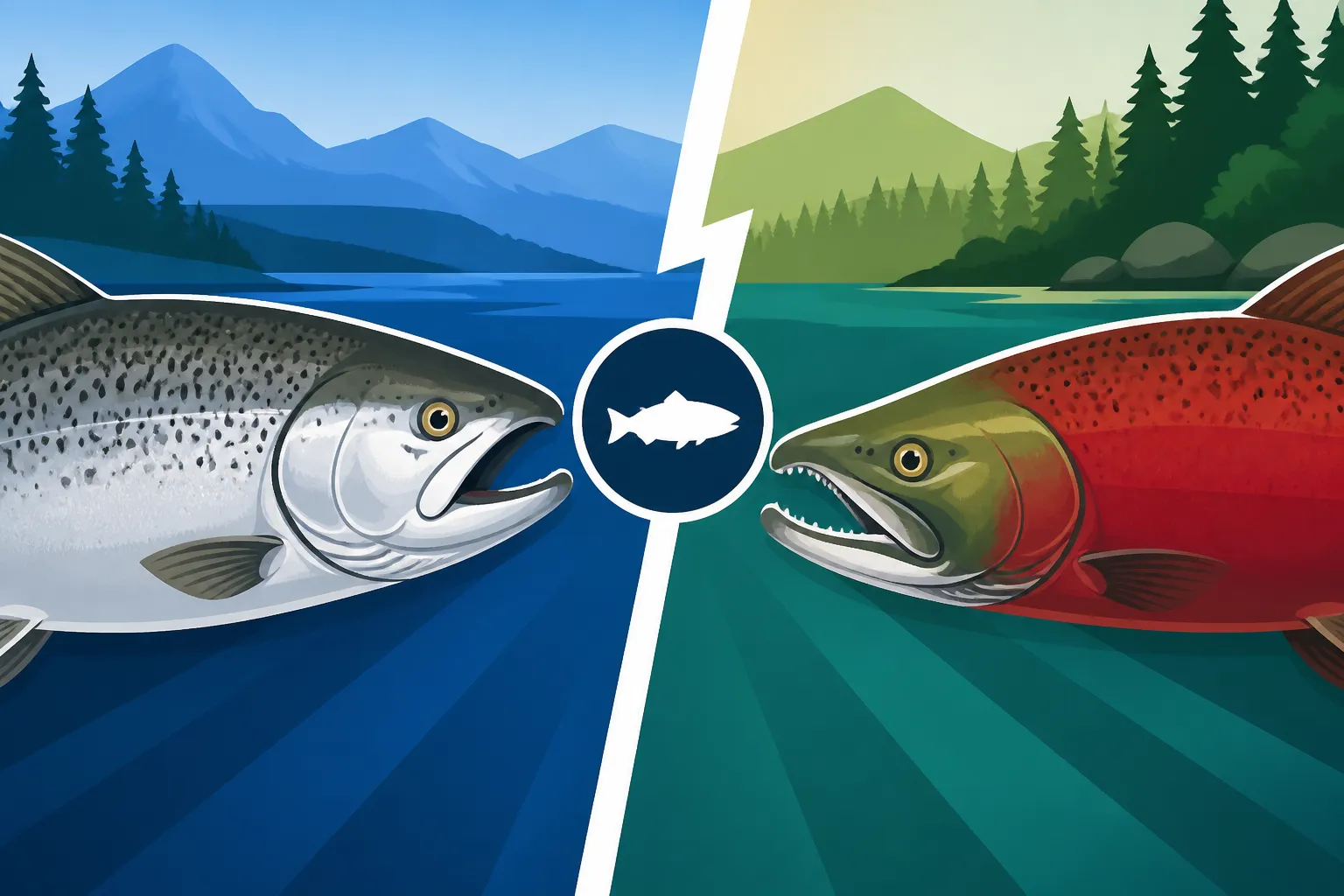
How to tell a chinook from a coho salmon
One of the trickiest parts of fishing in British Columbia, especially when you're just starting out or exploring new waters, is figuring out exactly what kind of salmon you've just hooked. It's a common frustration, particularly with the Pacific salmon species, because they can look quite similar, especially in the water or when they're fresh out. But knowing the difference between a Chinook and a Coho salmon isn't just a matter of bragging rights; it's crucial for adhering to regulations, using the right techniques, and ultimately, contributing to sustainable fishing practices. This guide will walk you through the key distinctions, making you a more confident and responsible angler.
The Basics: Why Identification Matters
You've got a beautiful, strong-fighting salmon on the line, and your heart is pounding. Maybe it's a silvery torpedo, leaping and thrashing, making it impossible to get a good look. Once you land it, the excitement is palpable. But then the questions start: Is it a Chinook? Or a Coho? Why does it even matter? Well, beyond satisfying your own curiosity, accurate identification is absolutely vital for several practical and ethical reasons in BC's diverse fisheries.
Regulatory Implications
Let's face it, fishing regulations in British Columbia can be a bit of a labyrinth. They vary by species, by area, by season, and even by time of day. This is particularly true for Chinook and Coho salmon, which often have different daily bag limits, size restrictions, and sometimes even retention bans depending on where and when you're fishing. Imagine the scenario: you're out on the Fraser River, excited about your catch, only to realize later you've mistakenly kept a Chinook when the regulations for that particular zone and day only permitted Coho retention, or vice versa. That's a surefire way to turn a fantastic day on the water into a costly and regrettable experience with a fisheries officer. Understanding these differences beforehand helps you stay within the law and avoid penalties for fishing without a license in BC. It's not just about avoiding fines; it's about respecting the hard work that goes into managing these precious fish stocks.
Misidentification can also have broader conservation impacts. Fisheries managers set specific limits based on scientific assessments of each species' population health. If anglers are consistently misidentifying fish and over-retaining a species that's under stress, it can undermine conservation efforts. For example, some areas might have BC Chinook Salmon Non-Retention Areas at certain times to protect vulnerable stocks. Knowing your fish helps protect these populations for future generations of anglers.
Tailoring Your Approach
Beyond regulations, knowing your species helps you become a more effective angler. Chinook and Coho, while both salmon, often have different habits, preferred habitats, and feeding behaviours. This means the techniques, lures, or baits that work wonders for a Chinook might be completely ineffective for a Coho, and vice-versa. Think about it: a massive Chinook, often found in deeper, stronger currents, might be smashing large spoons or hootchies trolled at specific depths, or inhaling large bait presentations on the bottom. On the other hand, a Coho might prefer faster, more aggressive retrieves closer to the surface, or chase after smaller, flashier lures.
If you're targeting a specific species, precise identification skills allow you to fine-tune your presentation and location. For instance, if you're out in the Georgia Strait and hear reports of a strong Coho bite, you'll want to adjust your trolling speed and lure size accordingly, perhaps opting for smaller spoons or hoochies than you would for a large Chinook. Conversely, if you're after a trophy Chinook, you'll focus on different gear and tactics. This knowledge also extends to choosing the right tackle. A heavy-duty setup designed to fight a powerful, deep-diving Chinook might be overkill for a nimble Coho, making the fight less enjoyable and potentially harder to land the fish without excessive stress. Knowing the species you're likely to encounter helps you pack the right rods, reels, and terminal tackle.
Key Visual Differences Between Chinook and Coho
Now, let's get down to the nitty-gritty: how do you actually tell these two magnificent species apart? While they can both be silvery and salmon-shaped, there are some very distinct visual cues that, once you know what to look for, make identification much easier. It often comes down to looking at a few key features that serve as their "fingerprints."
Tail Caudal Fin and Tail Spotting
This is often your best friend when it comes to quick identification, especially when the fish is still in the water or freshly landed. Take a good, close look at the tail fin itself and the area around it.
- Chinook Salmon (Oncorhynchus tshawytscha): The tail of a Chinook is typically fully spotted on both the upper and lower lobes. You'll see distinct, often darker, spots peppered across the entire fan of the tail fin. Furthermore, the base of the tail (the caudal peduncle) on a Chinook is quite thick, giving it a powerful, muscular appearance. They also tend to have a slightly forked or squared-off tail.
- Coho Salmon (Oncorhynchus kisutch): Coho tails, in contrast, usually have spots only on the upper lobe of the tail. The lower lobe will generally be clear or have very few, faint spots. Their tails are also typically more distinctly forked than a Chinook's. The caudal peduncle on a Coho is generally more slender and graceful compared to the powerful build of a Chinook.
Imagine holding up the tail of a freshly caught salmon. If it looks like someone sprinkled pepper evenly over the whole thing, you're likely holding a Chinook. If the pepper shaker was only aimed at the top half, it's probably a Coho.
Mouth and Gum Colour
This is perhaps the most definitive and easiest visual identifier, assuming you can get a clear look inside the fish's mouth. This characteristic is so reliable that it's often the first thing fisheries officers check.
- Chinook Salmon: Open up that mouth! A Chinook salmon will have a black mouth and, crucially, black gums along the base of the teeth. This distinctive feature is why they're often affectionately, or sometimes frustratingly, called "blackmouth" salmon by anglers. The roof of the mouth and the tongue will also be dark.
- Coho Salmon: Now, for the Coho, while its mouth will also be dark or black, it will have white or very pale gums along the base of the teeth. This striking contrast with the dark mouth interior makes it a clear "whitemouth." The tongue might be dark, but the gums are the key.
So, if you've got a fish that otherwise looks like a salmon and you're unsure, a quick peek inside the mouth for gum colour will usually clear up any confusion instantly. This is a critical ID point, especially if you’re concerned about BC Salmon Conservation Stamp Rules or specific bag limits.
Body Shape and Colouration
While not as foolproof as the tail spotting or gum colour, general body shape and overall colouration can also provide strong clues, especially as you gain more experience. However, these can be more variable depending on the individual fish, its stage in the life cycle, and where it was caught.
- Chinook Salmon: These are often the "kings" of the Pacific salmon, and their body shape reflects that power. They tend to be deeper-bodied and more robust, with a broader shoulders and a thicker appearance overall. Their scales are relatively large. In terms of colour, they typically have a very silvery body, often with a subtle bluish or purplish sheen on the back, fading to white on the belly. As they get closer to spawning, their colour can darken considerably, often taking on a reddish-brown or olive tone. They also tend to have irregular, often larger, spots on their back and dorsal fin.
- Coho Salmon: Coho are generally more slender and streamlined than Chinook. Their scales are noticeably smaller, giving them a smoother appearance. Their overall colour is often a vibrant, iridescent blue-green along the back, transitioning to bright silver on the sides and white on the belly. Like Chinook, their colour deepens as they approach spawning, often becoming a reddish-maroon hue. The spotting on a Coho's back and dorsal fin tends to be smaller and more regular than that of a Chinook.
It's important to remember that ocean-bright fish will look very different from those that have spent time in freshwater rivers. A Chrome bright Coho fresh from the ocean, like those found during coastal Coho Salmon Fishing in BC, will be much more iridescent than one that has been staging in the river for weeks.
Size and Weight Expectations
While you shouldn't rely solely on size for identification (there are small Chinook and large Coho!), there are general expectations that can help.
- Chinook Salmon: The largest of the Pacific salmon, Chinook can grow to impressive sizes. A typical mature Chinook caught in BC might range from 10 to 30 pounds, with many exceeding that, sometimes reaching well over 50 pounds, earning them the moniker "tyees." BC record chinook salmon weight can be truly astounding! When you hook into a Chinook, you'll often feel an incredible, deep-diving power.
- Coho Salmon: Coho salmon are generally smaller than Chinook, though they are still a strong, exciting fish to catch. A common Coho will typically weigh in at 5 to 15 pounds, with larger ones reaching into the high teens or even occasionally over 20 pounds. When fighting a Coho, you'll often notice more acrobatic jumps and quick, darting runs compared to the brute force of a Chinook.
Again, use size as a secondary indicator. A small Chinook might be mistaken for a large Coho if you're not paying attention to the primary identifiers.
Practical Identification Tips on the Water
Okay, so you know the key differences in theory. But how do you actually apply this when you're out there, maybe in low light, with a fish flopping in the net? Here are some practical tips to make on-the-spot identification easier and more reliable.
Looking for Gums and Tail Spots
These are your go-to checks. As soon as you've got the fish safely in the net or alongside the boat, try to get a quick, clear look at these two features.
- Gently lift the head: If the fish is subdued, gently support its head and try to get a look at the inside of its mouth. A quick glance at the gums will be very telling. You're looking for that stark contrast: black gums for a Chinook, white gums for a Coho. Many experienced anglers can even tell from a quick glance as the fish opens its mouth while thrashing.
- Examine the tail: Even if the fish is still in the water, you can often get a good enough view of the tail to see the spotting pattern. If it's completely covered in spots, it's likely a Chinook. If the spots are concentrated on the upper half, it's a Coho. If you're fishing catch and release, minimizing the time the fish is out of water is paramount, so practice getting these quick visual cues down. Tools like a headlamp can be invaluable for early morning or late evening fishing to get a good look at fish features. You can find reliable options for fishing headlamps on Amazon to help with this.
Remember, when in doubt, it's always best to err on the side of caution. If you're unsure, assume it's the species with the stricter regulations (e.g., lower bag limit, non-retention) or simply release it unharmed.
Considering Location and Season
While not direct identification methods, understanding the typical whereabouts and timings of these fish can help you make an educated guess, which you then confirm with visual cues.
- Location: Certain areas are renowned for specific species. For instance, the Campbell River on Vancouver Island is often called the "Salmon Capital of the World" due to its incredible Chinook runs, while many smaller coastal rivers might see more prominent Coho runs later in the year. The Fraser River Fishing Guide highlights the presence of both species, but their peak times can differ.
- Season: Chinook tend to have earlier runs in many systems, with strong pulses in late spring and summer, particularly for larger "spring" or "summer" Chinook. Coho typically peak later, often in late summer and fall, as they move into rivers and coastal streams. Knowing the Best Time of Year to Fish in BC for each species can give you a strong initial hunch about what you've caught before even inspecting it. For example, if you're fishing a river in October, there's a higher probability you'll encounter a Coho than a fresh run of ocean-bright Chinook.
Keep an eye on BC Fishery Notices and In-Season Closures, Explained, as these will often specify which species are open or closed in particular areas during certain times, further informing your expectations.
Gear for Better Identification
Sometimes, a little help from your equipment can go a long way in making those tricky identifications clearer.
- Polarized Sunglasses: These are a game-changer for any angler, not just for seeing fish but also for reducing glare on the water's surface, allowing you to see features of a fish more clearly even before it's in the net. You might spot those tail spots or even a flash of a gum line in clearer water. Investing in a good pair of polarized sunglasses (there are many great options on Amazon) is a must for serious anglers.
- Headlamp/Flashlight: As mentioned, if you're fishing at dawn, dusk, or even at night (where permitted, like for some salmon runs in tidal waters), a reliable headlamp is essential. It provides hands-free illumination right where you need it to examine the fish's mouth and tail without struggling in low light.
- Reference Materials: Keep a waterproof identification card or a digital guide on your phone (if signal permits) handy. Many anglers carry a laminated card from a local tackle shop or print one out. Having a quick visual reference for Pacific Salmon Species Identification Guide can be incredibly helpful for confirming what you're seeing.
Common Misconceptions and Tricky Situations
Even with all this knowledge, fishing isn't always black and white. There are situations where identification can be particularly challenging, and some common myths persist.
Hatchery Fish vs. Wild Fish
British Columbia has a mix of wild and hatchery-enhanced salmon populations. Hatchery fish, especially Coho and Chinook, are often marked with an adipose fin clip (a small fin on their back near the tail is removed). While this clip doesn't change the primary identification features (gums and tail spots), it can sometimes slightly alter their overall appearance or give anglers a false sense of security that all clipped fish are one species or another.
Remember:
- Fin clips are for hatchery origin, not species ID. A clipped fish could be a Chinook or a Coho. You still need to use the traditional methods to identify the species itself.
- Wild fish do not have fin clips. If you catch an unclipped fish, it's wild, and in some areas, there might be specific regulations or even non-retention rules for wild salmon to protect natural spawning stocks. Always check the current regulations carefully, as BC Freshwater Salmon Retention Rules often differ based on whether a fish is wild or hatchery-marked.
Lighting and Water Conditions
The environment you're fishing in plays a huge role in how clearly you can see a fish.
- Murky Water: If you're fishing in turbid or cloudy water, getting a good look at a fish, even after it's in the net, can be tough. The subtle differences in colouration or spotting might be obscured by the water's quality. This is where polarized sunglasses and a good headlamp become even more critical.
- Low Light: Early morning or late evening often offers fantastic fishing, but it severely limits visibility. A fish that looks bright silver in full daylight might just appear dark and featureless in dim conditions. Always rely on tactile examination of the mouth or bring a light source if you're unsure.
- Reflective Surfaces: The reflections off wet scales or a shiny net can make discerning patterns or subtle colours challenging. Try to move the fish slightly to get different angles of light, or use your hand to shield it from harsh glare if you're taking a quick look for identification.
Juvenile Salmon
Sometimes, especially in freshwater rivers or estuaries, you might hook into very small salmon. Distinguishing between juvenile Chinook and Coho (often called "smolts" or "parr" at this stage) can be extremely difficult for even experienced anglers. They often share similar parr marks (vertical bars on their sides) and general body shapes.
- When in doubt, release. If you're catching very small salmon and can't confidently identify them using the mouth and tail markers, the safest and most responsible course of action is to release them gently and unharmed. They are the future of the fishery.
- Look for distinct fin ray counts: While difficult for the average angler on the water, experts sometimes use fin ray counts (e.g., number of rays in the anal fin) to distinguish very small salmon. However, for practical fishing purposes, this isn't usually feasible. For most anglers, if it's small and hard to tell, treat it with care and let it go.
Chinook vs. Coho Salmon: Quick Reference Guide
Here's a handy table summarizing the key differences to help you quickly identify your catch on the water:
| Feature | Chinook Salmon (King/Spring Salmon) | Coho Salmon (Silver Salmon) |
|---|---|---|
| Mouth/Gums | Black mouth, black gums along teeth. | Dark mouth, white or pale gums along teeth. |
| Tail Spots | Spots on both upper and lower lobes of the caudal fin. | Spots primarily on the upper lobe only. |
| Tail Shape | Slightly forked or squared-off, often thicker caudal peduncle. | More distinctly forked, often more slender caudal peduncle. |
| Body Shape | Deep-bodied, robust, powerful build. Larger scales. | More slender, streamlined, graceful. Smaller scales. |
| Colouration | Silvery with bluish/purplish back, often irregular dark spots. | Iridescent blue-green back, bright silver sides, smaller spots. |
| Average Size | Larger, typically 10-30+ lbs (can exceed 50 lbs). | Smaller, typically 5-15 lbs (can reach low 20s). |
| Fight Style | Powerful, deep runs, heavy head shakes. | Acrobatic jumps, fast, darting runs. |
Being able to confidently distinguish between Chinook and Coho salmon isn't just a skill that comes with years of experience; it's something you can actively learn and practice on every fishing trip. It boils down to paying close attention to a few key identifiers: the colour of the gums, the spotting pattern on the tail, and to a lesser extent, body shape and size. Mastering these distinctions will not only make you a more knowledgeable angler but also a more responsible one, ensuring you adhere to vital regulations and contribute to the conservation of these magnificent fish for everyone to enjoy for years to come. So next time you're out on the water, take that extra second to really look at your catch—it'll make all the difference!
Disclaimer
This article is for general informational purposes only and does not constitute professional advice. Laws, prices and regulations vary by location and change over time. Consult a qualified professional for guidance on your specific situation.