Best line for sturgeon fishing in heavy current
One of the most thrilling and challenging pursuits in British Columbia is targeting the mighty white sturgeon, especially when you're battling them in the powerful currents of rivers like the Fraser. It's an unforgettable experience, but many anglers quickly discover that standard fishing line just won't cut it. The sheer power of these ancient fish combined with the relentless pull of moving water can lead to heartbreaking break-offs and lost tackle. This guide will walk you through choosing the best fishing line to confidently tackle sturgeon in heavy current, ensuring your gear is up to the monumental task.
The Unique Challenges of Sturgeon Fishing in Heavy Currents
Sturgeon fishing in British Columbia's powerful rivers isn't just about finding the fish; it's about having gear that can withstand an incredible amount of stress. The environment itself presents as many challenges as the fish do, and your line is truly your first and last point of contact. If your line fails, the fight is over.
The Sheer Power of Fraser River Sturgeon
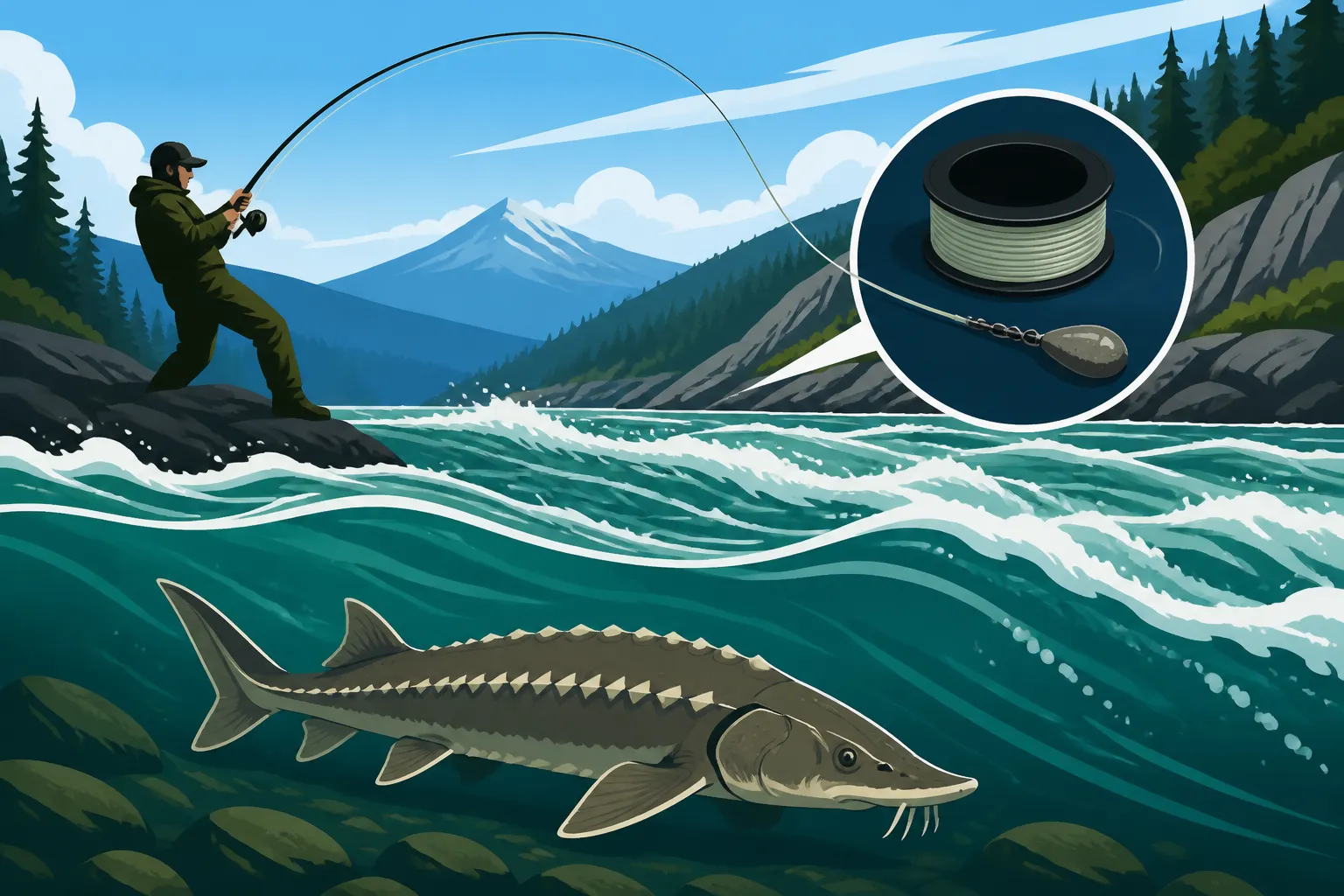
Let's be real, a Fraser River sturgeon isn't your average trout. These are ancient, massive fish that can grow to truly enormous sizes. We're talking about fish that can easily top hundreds of pounds and often measure many feet in length. When you hook one of these magnificent creatures in a strong current, it’s like hooking a freight train. They don't just swim away; they use the full force of the river to their advantage, leveraging the water flow to create an almost unstoppable pull. This means your line needs to absorb immense shock and withstand continuous, relentless pressure. A line that might be perfectly fine for salmon or steelhead in similar currents will likely snap under the pressure of a big sturgeon. White Sturgeon Fishing on the Fraser River is an entirely different ballgame, demanding specialized tactics and, most importantly, specialized tackle.
Understanding Current Dynamics
The currents in rivers like the Fraser can be incredibly dynamic. They aren't just a steady flow; they feature eddies, seams, boils, and sudden bursts of speed. Your line is constantly exposed to this moving water, which creates drag. The thicker your line, the more resistance it creates, making it harder to hold bottom, feel bites, and even retrieve your bait effectively. Beyond the sheer force, these currents often carry debris—branches, leaves, and even larger snags that can rub against your line. Imagine a hundred-pound sturgeon making a run directly into a submerged log while your line is stretched taught across a boulder field. This isn't just a hypothetical; it's a common scenario. Without exceptional abrasion resistance, your line can fray and snap in an instant, turning a potential trophy catch into a painful memory.
Essential Line Properties for Heavy Current Sturgeon
When you’re preparing for a day of targeting sturgeon in heavy current, every component of your tackle matters, but none more so than your fishing line. It’s the invisible tether connecting you to a potential monster, and it needs to possess specific characteristics to stand a chance.
Breaking Strength and Abrasion Resistance
These two properties are paramount. When a massive sturgeon decides to head downstream into a powerful current, your line is under incredible strain. You need a line with a high breaking strength, measured in pound test, that can handle not just the weight of the fish but the added resistance of the current. This isn't the time to skimp. Think of the analogy of a tow rope; you wouldn't use a thin string to pull a car, and you shouldn't use a light line to pull a sturgeon.
Equally important is abrasion resistance. As discussed, river bottoms are often rocky, littered with submerged logs, and generally unforgiving. Your line will inevitably come into contact with these abrasive surfaces during a long fight. A line that nicks easily will quickly become compromised, leading to a break-off right when you least expect it. This is where the composition and construction of the line really come into play. Some materials inherently stand up better to rubbing and scraping than others. You want a line that can take a beating and keep on fighting.
Low Stretch for Hooksets and Sensitivity
In heavy current, feeling a subtle bite can be challenging, and setting a hook effectively is critical. Many anglers find themselves surprised by how gently a huge sturgeon can pick up bait. With a lot of line out and the current creating a belly in it, a stretchy line can make it almost impossible to detect those delicate taps. You might miss half the bites! More critically, once you do get a bite, a stretchy line absorbs much of the force of your hookset, making it harder to drive the hook firmly into the sturgeon's tough, cartilaginous mouth. You need a direct, instantaneous connection from your rod tip to your bait. Low-stretch line transmits every bump, every nibble, and ensures that when you rear back to set the hook, that energy goes directly to the fish, not into stretching the line itself. This can be the difference between a solid hookup and a frustrating miss.
Diameter and Visibility Considerations
When choosing line for heavy currents, diameter is a crucial trade-off. A thicker line, while potentially stronger and more abrasion resistant, creates more drag in the water. This increased drag makes it harder for your bait to sink and stay on the bottom, can pull your rig out of the strike zone, and makes it feel like you're fighting the current more than the fish. Conversely, a thinner line cuts through the water more efficiently, reducing drag and allowing your bait to present more naturally. However, a thinner line might sacrifice some breaking strength or abrasion resistance.
For sturgeon, visibility is less of a concern for the main line, as they are primarily bottom feeders relying on scent. However, your leader material might benefit from being less visible. The key is to find that sweet spot: the thinnest line possible that still offers the immense strength and abrasion resistance needed for these powerful fish in challenging conditions. Sometimes, a high-quality line with a smaller diameter can outperform a cheaper, thicker line of the same pound test due to superior manufacturing and material science.
Braided Line: The Uncontested Champion for Sturgeon
When it comes to tackling the giants of the Fraser in their turbulent home, braided fishing line stands head and shoulders above the rest. It’s become the go-to choice for serious sturgeon anglers, and for very good reason.
Why Braid Excels
Braided line is constructed from multiple strands of synthetic fiber woven together, which gives it a set of properties perfectly suited for heavy current sturgeon fishing. Firstly, and perhaps most importantly, is its incredible strength-to-diameter ratio. You can get a much stronger line at a significantly thinner diameter compared to monofilament. This means less drag in the current, allowing your bait to get down and stay down more easily, and giving you better control over your presentation.
Secondly, braid has virtually zero stretch. This is a game-changer for detecting those subtle sturgeon bites, even with hundreds of feet of line out in a fast current. Every bump and tap is transmitted directly to your rod tip, giving you the best chance to react. Furthermore, that lack of stretch ensures a powerful, immediate hookset, crucial for penetrating the sturgeon's bony mouth. Finally, modern braided lines, especially those with tighter weaves (like 8-carrier braids), offer surprisingly good abrasion resistance. While no line is completely impervious to sharp rocks, braid generally holds up much better against constant rubbing than monofilament would in similar conditions. Brands like PowerPro and Spiderwire are popular choices, and you can easily find a wide selection of these high-quality braided lines on platforms like Amazon.
Choosing the Right Pound Test and Diameter
For sturgeon fishing in heavy currents, you absolutely do not want to go light on your main line. A good starting point for your braided line would be anywhere from 80 lb to 150 lb test. Yes, that sounds heavy, but remember the size of these fish and the environment they live in. In extremely heavy currents or areas known for particularly large fish or snaggy bottoms, some anglers even opt for 200 lb test.
The key is to select the highest breaking strength that still offers a manageable diameter for your reel and casting needs. A common choice is 100 lb test braid, as it provides immense strength while still being relatively thin. However, if you are fishing in an area like the Fraser Canyon where snags are rampant and the current is brutal, going to 130 lb or even 150 lb braid can save you a lot of heartache (and lost tackle). Always err on the side of caution. Consider what kind of rod and reel setup you have for Best rod setup for Fraser River sturgeon and ensure the line you choose is compatible. You can find robust options for different pound tests and spool sizes readily available on Amazon.
The Importance of a Quality Leader
Even with the best braided main line, a leader is an absolute must for sturgeon fishing. The leader serves several vital functions. It acts as a shock absorber, taking the brunt of sudden runs and head shakes, preventing the braid from cutting into your knots prematurely. It also provides an extra layer of abrasion resistance right at the business end, where your line is most likely to encounter teeth, gill plates, or sharp rocks on the riverbed.
For sturgeon, a heavy monofilament or fluorocarbon leader is typically used. Many anglers opt for 100 lb to 250 lb test leader material, depending on the size of fish expected and the severity of the riverbed. Monofilament offers good knot strength and some stretch for shock absorption, while fluorocarbon offers excellent abrasion resistance and is virtually invisible underwater, which might be a minor advantage though sturgeon aren't typically line shy. The leader length can vary, but generally, 3-6 feet is a good starting point. You'll attach your main braided line to your leader with a strong knot like a uni-to-uni or a blood knot, and then your hook setup, often a heavy-duty circle hook, is tied directly to the leader. Best rig for bottom fishing for sturgeon will often incorporate such a leader.
Monofilament and Fluorocarbon: Role and Limitations
While braided line dominates as the primary choice for heavy current sturgeon fishing, both monofilament and fluorocarbon still have important roles to play, primarily as leader material or in specific less extreme scenarios.
Monofilament as a Leader or for Less Extreme Conditions
Traditional monofilament line, made from a single strand of nylon, has been a staple in fishing for decades. Its primary advantages are its stretch, which acts as a great shock absorber, and its ease of knot tying. For sturgeon, this stretch can be a double-edged sword. While it’s beneficial for absorbing the initial violent surge of a hooked fish, it also severely hampers bite detection and hook-setting power when used as a main line in heavy current. With a lot of stretchy mono out in a strong current, you'll be fighting the current and the line's elasticity before you even get to the fish.
However, monofilament shines as a leader material. Its shock-absorbing qualities complement the zero-stretch of braid, providing a buffer against powerful runs. Heavy-test monofilament leaders (100 lb to 250 lb) are a common and effective choice for sturgeon, offering good abrasion resistance and allowing for solid knots to your hook. For scenarios where the current isn't exceptionally strong, or if you're targeting smaller sturgeon, some anglers might still use heavy mono as a main line (e.g., 60-80 lb test), but for true heavy current conditions, it's generally outclassed by braid for the main spool.
Fluorocarbon for Leaders and Specific Situations
Fluorocarbon is another excellent material, best utilized in sturgeon fishing as a leader. It shares many characteristics with monofilament but has some distinct advantages. Fluorocarbon is less visible underwater than mono due to its light-refractive properties, making it practically invisible to fish. While sturgeon aren't typically considered line-shy, this can't hurt. More importantly for sturgeon, fluorocarbon boasts superior abrasion resistance compared to monofilament. This means it can withstand more rubbing against rocks, logs, and even the sturgeon's rough body during the fight, significantly reducing the chance of fraying and breaking.
However, fluorocarbon can be stiffer and more expensive than monofilament, and tying secure knots with very heavy fluorocarbon can be more challenging. Its low-stretch properties are fantastic for sensitivity, but as a main line, it might still have too much "memory" and be less supple than braid for long casts or managing in current. Thus, heavy fluorocarbon is almost exclusively used as a leader for sturgeon, typically in similar pound tests to mono leaders (100 lb to 250 lb). Many top-tier fluorocarbon leader materials are available on Amazon and are definitely worth the investment for that crucial connection to the fish. Remember to always consult BC Fishing Regulations Explained before heading out, as specific rules for gear might apply.
Here’s a quick comparison of line types for heavy current sturgeon fishing:
| Line Type | Pros | Cons | Best Use for Sturgeon in Heavy Current |
|---|---|---|---|
| Braided | – Extremely high strength-to-diameter ratio – Virtually no stretch (excellent sensitivity & hooksets) – Good abrasion resistance (especially 8-carrier) – Less current drag |
– Can be more expensive – Requires good knot-tying technique – Can "dig in" on spools if not spooled correctly – Highly visible (can be addressed with leader) |
Main Line: 80-200 lb test |
| Monofilament | – Excellent shock absorption (stretch) – Easy to tie knots – Generally less expensive – More forgiving for beginners |
– High stretch (poor sensitivity & hooksets in current) – Higher diameter for given strength (more current drag) – Lower abrasion resistance than braid/fluoro as main line |
Leader Material: 100-250 lb test |
| Fluorocarbon | – Very low visibility – Excellent abrasion resistance – Low stretch (good sensitivity) |
– Can be stiff and have memory – More expensive than mono – More difficult to tie knots in heavy tests – Less shock absorption than mono |
Leader Material: 100-250 lb test |
Ultimately, for the main line on your reel when targeting sturgeon in heavy current, braided line is the clear winner due to its strength, low stretch, and reduced diameter. However, pairing it with a robust monofilament or fluorocarbon leader is the ultimate combination for success. This setup provides the sensitivity and power of braid while adding the shock absorption and superior abrasion resistance where it matters most, right near the fish. You’ll be prepared for the incredible fight of these magnificent creatures in their powerful river homes, making for a truly memorable angling adventure. Don't forget to check BC Fraser River Sockeye Closure Windows and other fishery notices before any trip, as regulations can change. For a deeper dive, consider guides like How to Catch Sturgeon on the Fraser River or explore options for a guided experience with Best Sturgeon Guides on the Fraser River.
Disclaimer
This article is for general informational purposes only and does not constitute professional advice. Laws, prices and regulations vary by location and change over time. Consult a qualified professional for guidance on your specific situation.