Best trolling speed for kokanee on Okanagan Lake
It’s a common scenario: you’re out on the shimmering waters of Okanagan Lake, the sun is shining, and your gear is perfectly set up. You’ve heard the kokanee are biting, but after hours of trolling, your cooler is still looking mighty empty. Many anglers find themselves scratching their heads, wondering what they’re doing wrong, and often, the answer lies in one critical, yet frequently overlooked, detail: your trolling speed. This guide is dedicated to helping you unlock the secret to consistent kokanee success by mastering the art of dialing in the perfect trolling speed for these finicky, silver-sided beauties.
The Elusive Dance: Why Trolling Speed is Crucial for Okanagan Kokanee
Kokanee salmon, the landlocked sockeye, are renowned for their delicate bites and their particular preferences. They don't just bite any lure moving at any speed; they respond to a specific presentation that mimics their natural prey. Unlike their ocean-dwelling relatives, Okanagan Lake kokanee feed primarily on zooplankton, tiny invertebrates that drift in the water column. Your trolling speed directly impacts how your lure behaves, how it imitates these food sources, and ultimately, whether a kokanee decides to strike.
Mimicking Natural Prey Movements
Think about it from the kokanee's perspective. They’re accustomed to feeding on microscopic organisms that don't dart around at breakneck speeds. When you're trolling too fast, your lure might appear erratic, unnatural, or simply too quick for them to track and intercept comfortably. Conversely, if you're trolling too slowly, your lure might lack the necessary action to entice a strike, appearing lifeless and unappealing. The sweet spot is a speed that gives your lure a subtle, lifelike quiver, wobble, or dart that mimics a struggling zooplankton or a small baitfish. This nuanced movement is what triggers their predatory instincts, especially in clear, often calm, Okanagan waters.
Understanding Lure Action and Speed Synergy
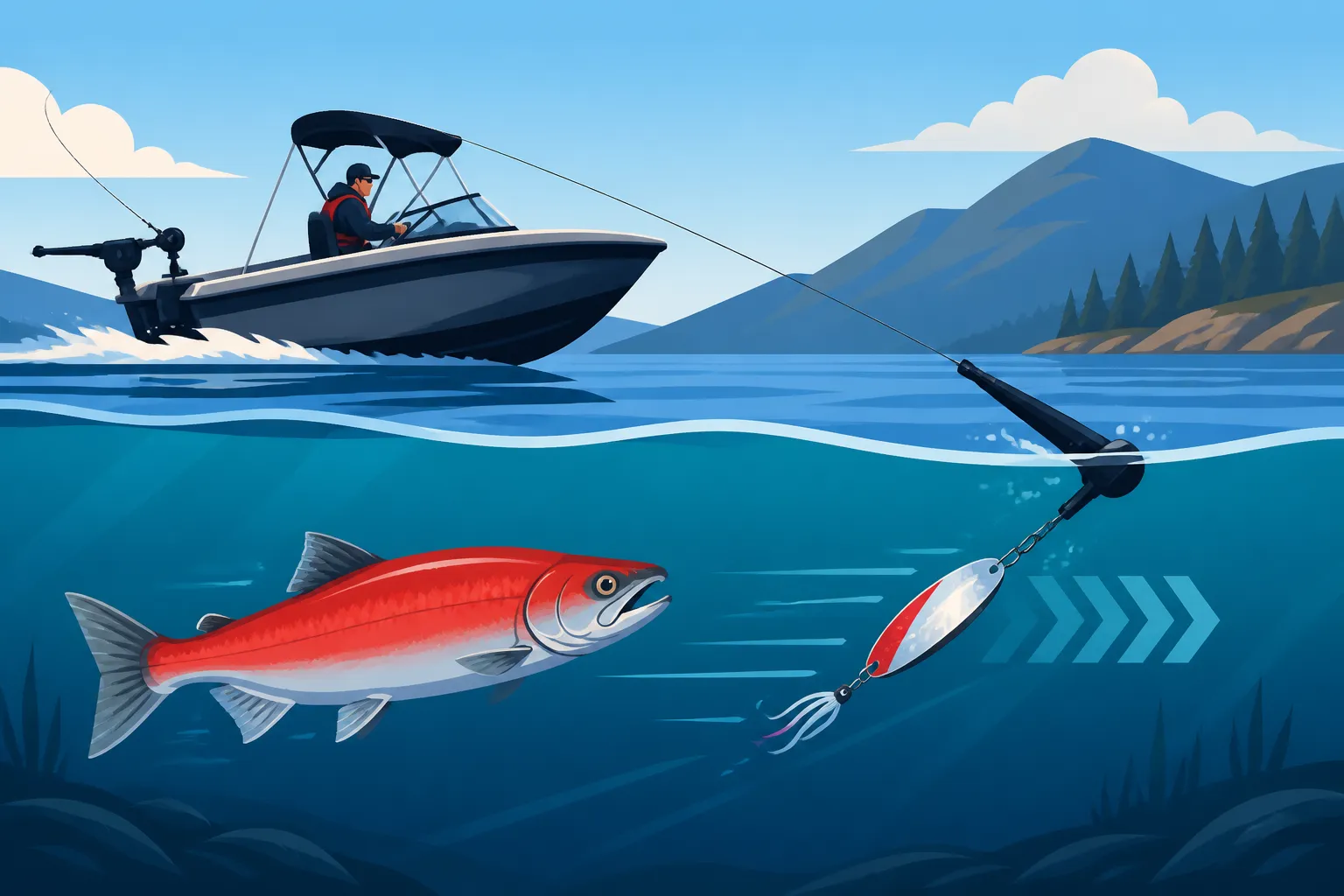
Every lure is designed to perform optimally within a certain speed range. Dodgers and flashers, which are essential for kokanee, rely on water resistance to create their signature oscillating or rotating action. If you troll too fast, a dodger might "blow out," meaning it loses its rhythmic wobble and just drags stiffly through the water, or a flasher might spin too rapidly, twisting your line. Too slow, and they won't impart enough action to the trailing hoochie, wedding band, or spoon. The trick is to find the speed that makes your dodger or flasher work its magic, transferring that irresistible action to the small lure behind it. This synergy between speed and lure action is the cornerstone of effective kokanee trolling.
Dialing It In: Factors That Dictate Your Optimal Trolling Speed
There isn't a single, magic trolling speed for kokanee that works every day, everywhere on Okanagan Lake. If only it were that simple! Instead, it's a dynamic puzzle influenced by several environmental and gear-related factors. Learning to read these variables will make you a much more adaptable and successful angler.
Water Temperature and Kokanee Metabolism
Water temperature plays a monumental role in kokanee activity levels. Like all cold-blooded creatures, their metabolism is directly tied to the water temperature around them. In colder water, their metabolism slows down. This means they're generally less active, less inclined to chase fast-moving prey, and will prefer a slower, more deliberate presentation. You might find yourself needing to drop your speed to as low as 0.8-1.2 mph. Conversely, during warmer periods, especially in the spring and fall when the water is in their preferred temperature range (typically 50-60°F or 10-15°C), kokanee are more active and aggressive. They’ll be more willing to chase, and a slightly faster troll, perhaps 1.5-2.0 mph, can often trigger strikes. Keeping an eye on your fish finder's temperature gauge is crucial for this.
Time of Day and Light Conditions
The time of day directly correlates with light penetration in the water, which in turn influences how visible your lure is and how actively kokanee feed. In low light conditions, such as early morning or late evening, or on overcast days, kokanee tend to be higher in the water column and more actively feeding. During these times, a slightly faster troll can help cover more water and present your lure to more fish before they retreat to deeper, darker waters. However, when the sun is high and bright, kokanee often drop deeper and become more cautious. You might need to slow your troll down to give them more time to inspect and commit to your lure. This is also when subtle lure action becomes even more critical. You can learn more about this by checking out the Best time to fish for kokanee at first light.
Lure Type, Size, and Color
Different lures demand different speeds. A small, lightweight hootchie or wedding band will have a different action profile than a heavier spoon or plug. For instance, a classic wedding band behind a dodger usually performs best at slower speeds (1.0-1.6 mph) to allow its blades to spin enticingly without being overpowered. An Apex lure, on the other hand, might have its best side-to-side wobble at a slightly higher speed (1.4-2.2 mph).
Moreover, the size of your lure can influence the ideal speed. Smaller lures often require a bit more speed to generate action, while larger lures might be more effective at slower speeds, allowing their inherent action to shine. Color also plays a role in visibility; brighter, more reflective colors might be more visible at higher speeds, while subtler, natural colors might require a slower troll for the kokanee to get a good look. Many anglers have their favorite go-to kokanee jig colors for deep trolling, but don't be afraid to experiment. When you're stocking up on these specialized lures, a quick browse on Amazon can reveal a vast selection from various brands, ensuring you're ready for any condition.
Depth and Downrigger Presentation
The depth at which you're fishing is intrinsically linked to your trolling speed. Kokanee are notorious for suspending in specific thermoclines or feeding layers. Using downriggers or weighted lines to get your lures down to the fish is key. If you're running multiple lines at different depths, varying your speed can help prevent tangles and ensure each lure is presented effectively.
When your downrigger ball is deep, say 80-100 feet, the drag on your line is significant. Trolling too fast can cause your line to bow excessively, making it harder to maintain your desired depth and detect subtle bites. A slower, more controlled troll is usually better when fishing deep. Conversely, if kokanee are feeding shallower, you might have more flexibility with speed. Fine-tuning your sonar settings for finding structure on Kootenay Lake (or Okanagan Lake in this case) can help you identify these specific depth zones where the fish are holding, which then informs your speed choice.
Water Clarity and Current
While Okanagan Lake is generally quite clear, periods of heavy rain or spring runoff can introduce turbidity, affecting visibility. In murkier water, fish rely more on lateral line vibrations than sight. A slightly faster troll with a lure that produces more vibration might be advantageous to help kokanee locate your offering. However, too much speed can also put them off.
Current, though less pronounced in a lake than a river, can still exist, especially near inflows or outflows, or with strong winds creating subsurface movements. Trolling with or against a subtle current will affect your true lure speed through the water. Always monitor your GPS speed over ground but also consider the water's movement relative to your boat. Sometimes, trolling against a slight current at a slightly higher GPS speed will result in the ideal water speed for your lure.
Practical Approaches to Fine-Tuning Your Kokanee Trolling Speed
Now that we understand the variables, let's talk about the practical side of getting that speed just right. It’s a process of observation, adjustment, and continuous learning.
Monitoring Your Speed Accurately
Gone are the days of guessing your speed. Modern electronics are your best friend. A reliable GPS unit (many fish finders come with integrated GPS) will give you your speed over ground (SOG). This is your primary metric. Aim to keep your speed as consistent as possible. Fluctuations, even minor ones, can change your lure's action and might put off a following kokanee.
Many anglers also use a dedicated "paddlewheel" speed sensor, especially useful for understanding your speed through the water if there's current. However, for most Okanagan kokanee fishing, a consistent GPS speed is usually sufficient.
The "S-Curve" Technique
One of the most effective ways to find the sweet spot for kokanee is the "S-curve" or "zigzag" trolling pattern. Instead of trolling in a straight line, steer your boat in a gentle S-shape.
Here’s why it works:
- Varying Speed: As your boat turns, the lures on the inside of the turn will slow down, while the lures on the outside will speed up. This momentary change in speed often triggers bites.
- Covering Water: It also allows you to cover a wider swath of water, increasing your chances of crossing paths with a kokanee school.
- Identifying the Speed: Pay close attention to which side of the boat gets bites. If you get hits on the inside turn, it suggests kokanee prefer a slower presentation. If bites come on the outside, a faster speed is preferred. This immediate feedback tells you where to adjust your straight-line trolling speed.
Visualizing Lure Action
While you can't see your lure 80 feet down, you can observe its action near the surface. Before deploying your full spread, drop one of your chosen dodger/lure combinations alongside the boat at varying speeds. Watch how the dodger wobbles, how the hootchie dances, or how the wedding band spins. Take note of the speed at which it looks most appealing and lively, but not over-the-top. This visual check can give you a baseline for what to aim for down deep. Remember, you're trying to achieve a natural, almost subtle, motion.
Experimentation and Adjustment
Kokanee fishing is rarely a "set it and forget it" endeavor. Start with a commonly recommended speed for Okanagan Lake (around 1.2-1.8 mph is a good starting range). If you're not getting bites after 15-20 minutes, make a small adjustment—increase or decrease by 0.2-0.3 mph. Repeat this process until you start getting hits.
It's also beneficial to vary depths and lure colors simultaneously with speed adjustments. If you've been consistent at 1.5 mph for a while with no success, try slowing to 1.2 mph for a bit. If still no luck, try bumping it up to 1.8 mph. The fish will tell you what they want. Many successful anglers have a process for how to locate kokanee in BC lakes and then quickly identify their preferences.
Here's a handy table to get you started with common kokanee setups and their typical speed ranges:
| Lure/Setup | Primary Action | Suggested Trolling Speed Range (mph) | Notes |
|---|---|---|---|
| Dodger + Wedding Band | Dodger wobbles, wedding band spins | 1.0 – 1.6 | Classic combo, very effective at slower speeds for maximum spin |
| Dodger + Hootchie | Dodger wobbles, hootchie jiggles | 1.2 – 1.8 | Versatile, slightly faster can add more darting action to the hootchie |
| Small Spoon (e.g., Apex, Kitimat) | Wobbles, darts, flutters | 1.4 – 2.2 | Good for covering water, often better at slightly higher speeds for action |
| Fomula/Small Plug | Tight wiggle, subtle roll | 1.5 – 2.5 | Can be effective when kokanee are more aggressive, or for imitating larger prey |
| Mini-Hooches (no dodger, weighted) | Erratic dart, subtle wobble | 0.8 – 1.4 | Good for finicky fish, or when a very subtle presentation is needed |
Note: These are general guidelines. Always observe your lure action and let the fish tell you the preferred speed.
Beyond the Basics: Advanced Tips for Consistent Kokanee Success
Once you've got the fundamentals down, there are always ways to refine your approach and gain an edge, especially on a lake as popular and productive as Okanagan Lake.
Understanding Boat Control and Consistency
Maintaining a consistent trolling speed isn't just about setting your throttle; it's about boat control. Wind and waves can drastically affect your true speed and line presentation. Invest in a good trolling motor, either bow-mounted or transom-mounted, with GPS-enabled spot-lock or speed control. Brands like Minn Kota and Motorguide offer models that can hold your boat at a precise speed, regardless of external conditions. This frees you up to focus on your rods and electronics. Without a dedicated trolling motor, you'll need to constantly adjust your main engine throttle to counteract wind and waves, which can be exhausting and lead to inconsistent speeds. A little extra spent on reliable gear, which you can easily research and purchase on Amazon, can make a huge difference in your catch rate.
Incorporating Scent Attractants
Kokanee have a highly developed sense of smell, and scent can be a game-changer, especially when they're not aggressively feeding. Applying a quality kokanee scent, like those from Pro-Cure or Mike's, to your lures and dodgers can significantly increase your strike rate. The scent disperses in the water, creating a "smell trail" that can draw in kokanee from a distance. The beauty of scent is that it works in conjunction with your trolling speed. A perfectly trolled lure with an irresistible scent becomes even more potent. Reapply scent every 15-30 minutes, or after every fish. This can also compensate slightly if your speed isn't perfectly dialed in, giving the fish another reason to bite.
Reading Your Electronics for Clues
Your fish finder isn't just for locating fish; it's a window into the underwater world that can help you fine-tune your speed. Pay attention to how baitfish schools are behaving. Are they tightly balled up, suggesting a predator nearby or calmer conditions? Or are they spread out and darting, indicating a more active feeding environment? Observing the activity of these smaller fish can give you clues about the kokanee's mood and whether a faster or slower presentation might be more effective.
Also, watch for marks of kokanee following your lures. If you see fish come up to your lure on the screen but not commit, it's often a sign that your speed or lure presentation is close but not quite right. This is your cue to make a subtle speed adjustment (e.g., 0.1 mph up or down) or try a gentle S-curve to see if that triggers a strike. Sometimes, even the faintest change in depth or water temperature shown on your electronics can prompt a necessary speed alteration. If you're looking for more general information on these beautiful fish, our guide on Kokanee Fishing in BC offers a broader perspective.
The Role of Leader Length
While not directly a speed factor, leader length plays a critical role in how your lure interacts with the dodger/flasher and therefore how effective your trolling speed is. Generally, for dodgers, shorter leaders (6-14 inches) are used for maximum lure action transfer. For flashers, longer leaders (18-36 inches) allow the lure more independent movement behind the aggressive flash and thump. If you’re consistently getting short strikes or fish are just batting at your lure, consider adjusting your leader length in small increments. This subtle tweak, combined with the right trolling speed, can make all the difference. For a deep dive into successful strategies, consider reading up on Best Kokanee Trolling Techniques for Okanagan Lake.
Don't Forget the Details: Rod Holders and Line Counters
Having quality rod holders that keep your rods secure and properly positioned is crucial for consistent trolling. Angle your rods so that your lines are spread out and don't tangle. Line counter reels are almost a necessity for kokanee. They allow you to precisely replicate the depth and distance of your successful presentations. If you catch a fish at 85 feet with 120 feet of line out, you can accurately repeat that setup. You can find excellent line counter reels and sturdy rod holders on Amazon, making your setup more efficient and enjoyable. Remember to always be aware of the BC Bag and Possession Limits by Species to ensure sustainable fishing.
Mastering the best trolling speed for kokanee on Okanagan Lake is an ongoing journey, not a destination. It requires patience, keen observation, and a willingness to experiment. By paying attention to water conditions, understanding your gear, and consistently fine-tuning your approach, you’ll start seeing more of those spirited kokanee leaping at the end of your line.
Disclaimer
The information provided in this guide is for general informational purposes only and is based on typical angling practices and general knowledge of British Columbia fishing. Fishing conditions, regulations, and fish behavior can change rapidly. Always consult the most current British Columbia Freshwater Fishing Regulations Synopsis and local fishery notices before heading out. Safety should always be your top priority on the water.