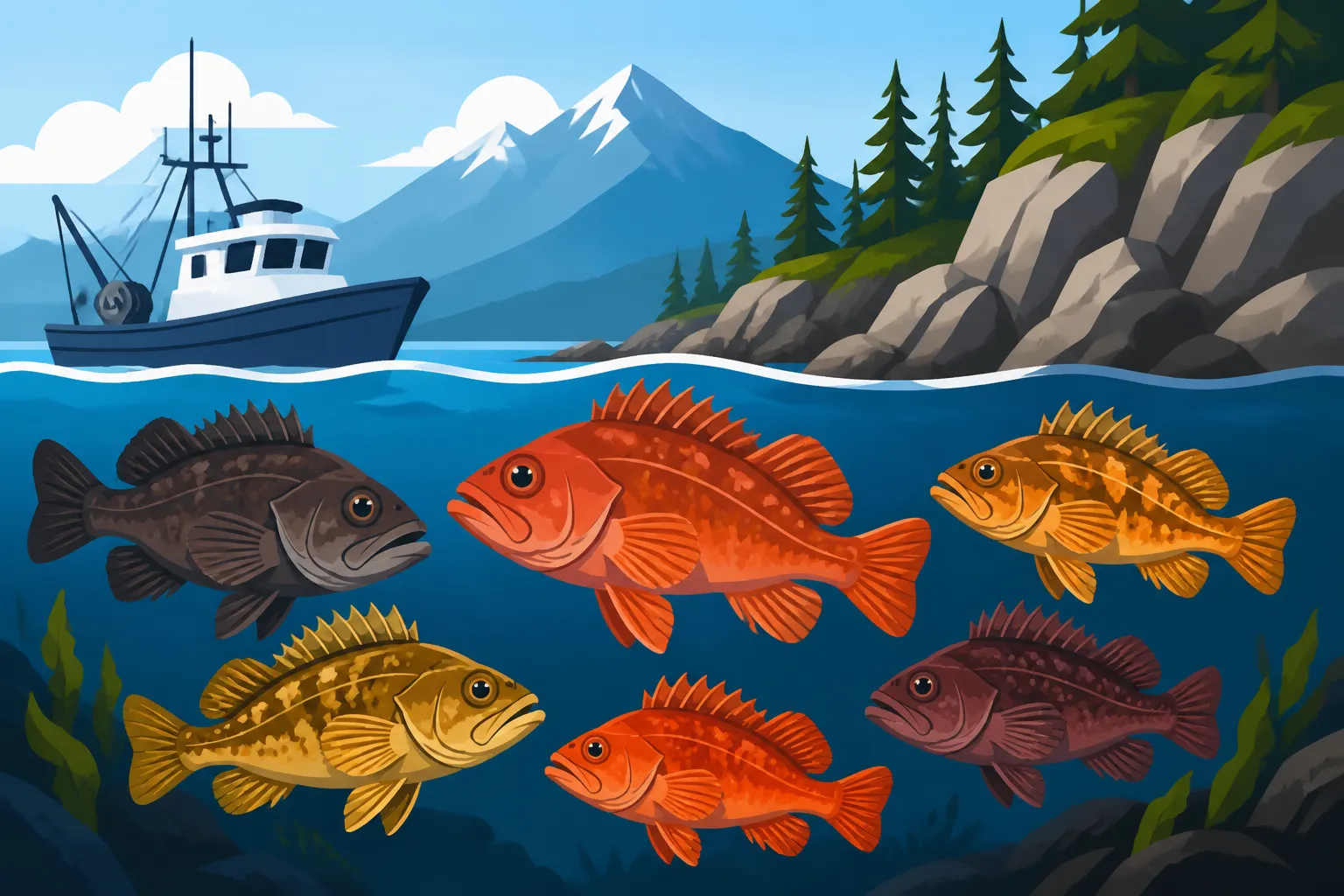
What rockfish species live off the BC coast
It can be incredibly challenging to tell one rockfish from another when you're out on the vast waters of the BC coast. Many anglers get confused by their similar appearances and diverse colour patterns, leading to uncertainty about bag limits and conservation. This guide is here to untangle that confusion, helping you confidently identify the various rockfish species you might encounter while fishing off British Columbia's stunning shores.
The Crucial Importance of Rockfish Identification for BC Anglers
Anglers often feel a rush of excitement when a fish comes over the rail, especially something as striking as a rockfish. But that excitement can quickly turn into confusion or even anxiety if you're not sure exactly what species you've just landed. Is it legal to keep? How many can I keep? Is it a species that needs extra care? These aren't just academic questions; they have real-world implications for the health of our marine ecosystems and for your own fishing experience.
Conservation and Management: Why Knowing Your Catch Matters
Rockfish are a fascinating and incredibly diverse group of fish, with over 30 species found in British Columbia waters. Many of these species are long-lived, slow-growing, and mature late in life, making them particularly vulnerable to overfishing. Take the iconic Yelloweye Rockfish, often mistakenly called "Red Snapper" (a completely different species found in warmer waters). These magnificent fish can live to be over 100 years old, meaning it takes a very long time for populations to recover once they've been depleted. Because of this, certain rockfish species, like the Yelloweye, have very strict regulations in place to protect them.
When you correctly identify your catch, you're not just following a rule; you're actively participating in conservation efforts. You're ensuring that future generations of anglers will also have the chance to experience the thrill of catching these beautiful fish. It’s about being a responsible steward of our precious marine resources, recognizing that every fish we interact with plays a role in the intricate balance of the ocean. Without accurate identification, well-intentioned anglers could inadvertently contribute to the decline of vulnerable species, which is something none of us want. This commitment to responsible angling is a huge part of the BC fishing culture.
Avoiding Penalties: Navigating BC's Fishing Regulations
Let's be honest, nobody wants to get a ticket or face a fine, especially when you're out trying to relax and enjoy the water. BC's fishing regulations, particularly for rockfish, can be quite complex. There are specific bag limits, possession limits, and even prohibitions on certain species. For example, some rockfish might have a daily limit of two, while others, like the Yelloweye, might be completely off-limits for retention, or have very specific, low limits in certain areas. Misidentifying a fish could mean accidentally keeping an over-limit, retaining a prohibited species, or even failing to record it properly on your tidal waters fishing license.
Enforcement officers are out there, and they're diligent about ensuring compliance. The penalties for violating fishing regulations can range from hefty fines to the confiscation of your gear and even your boat in serious cases. It's a truly frustrating situation to find yourself in, all because a Copper Rockfish looked a little too much like a Canary Rockfish in the low light of a cloudy afternoon. This is why having a reliable identification guide or a good app on your phone, and taking the time to learn the key features, is so incredibly important. Knowing the rules, like those outlined in BC Fishing Regulations Explained and BC Bag and Possession Limits by Species, is your best defense against inadvertently breaking them.
Health and Safety Considerations
While less common, some rockfish species have spines that can deliver a nasty poke if you're not careful. Beyond that, the depth at which rockfish live can also pose a unique challenge. Many rockfish reside in deeper waters, and when brought to the surface quickly, they can suffer from barotrauma – essentially "the bends" for fish. Their swim bladders expand, pushing their internal organs out or causing severe damage. This can make a catch-and-release attempt futile if not handled properly. Knowing the species and its typical depth preference can help you prepare. If you're targeting deeper-dwelling rockfish that you intend to release, having a descending device on board is crucial to safely return them to depth. This not only increases their survival rate but also aligns with the conservation ethic we all strive for.
Furthermore, being able to identify a fish also relates to understanding potential consumption advisories. While most rockfish are excellent eating, certain larger, longer-lived species can accumulate higher levels of mercury or other contaminants over their lifespan. Staying informed through local fishery notices about species-specific consumption guidelines, even if those are general across many species, is another layer of knowing your catch.
Common Rockfish Species You're Most Likely to Encounter
British Columbia's diverse coastline, with its rocky reefs, kelp forests, and deep channels, is prime habitat for a remarkable array of rockfish. While there are many species, a handful are far more commonly encountered by recreational anglers. Understanding these key players will give you a solid foundation for identifying almost any rockfish that ends up on your line.
The Iconic Yelloweye Rockfish "Red Snapper"
Ah, the Yelloweye Rockfish! This is arguably the most recognized (and often misidentified) rockfish on the BC coast. Many anglers affectionately, but incorrectly, refer to them as "Red Snapper." True Red Snappers are a distinct species found predominantly in the Atlantic and Gulf of Mexico. Our BC Yelloweye are a different, albeit equally stunning, fish.
Appearance: Yelloweyes are truly a sight to behold. They typically boast a brilliant orange to reddish-orange body, often mottled with patches of yellow or white. What makes them unmistakable are their bright, intense yellow eyes, which truly pop against their colourful scales. Smaller Yelloweyes can sometimes be a bit more uniformly orange, making identification slightly trickier, but the yellow eye is almost always present. They also have a rough, spiny dorsal fin and a prominent ridge along their cheek.
Habitat and Behaviour: These are deep-water dwellers, often found lurking around rocky reefs, pinnacles, and ledges from 60 to 600 feet, sometimes even deeper. They are ambush predators, lying in wait for crustaceans and smaller fish to pass by. Their slow growth and long lifespan make them particularly susceptible to fishing pressure, hence the very strict conservation measures. Catching one is a special event, but be prepared to release it carefully, as retention limits are extremely tight or often prohibited. Always double-check current regulations for specific areas.
Black Rockfish and Canary Rockfish
These two are often caught in similar habitats and can sometimes cause confusion due to some overlapping characteristics, though they have distinct differences once you know what to look for.
Black Rockfish: These are a fantastic sport fish and a favourite among many anglers.
- Appearance: As their name suggests, Black Rockfish tend to be dark, ranging from charcoal grey to solid black on their backs, fading to a lighter, sometimes mottled, grey on their bellies. A key identifying feature is the presence of faint, dark blotches or streaks along their sides. They also have a distinct lower jaw that protrudes slightly beyond the upper jaw. Their fins can sometimes have a brownish or slightly reddish tint, especially on larger specimens.
- Habitat and Behaviour: Black Rockfish are often found in shallower, more nearshore waters compared to Yelloweye, typically from the surface down to about 200 feet, often around kelp beds, jetties, and rocky shorelines. They are more active hunters and will often hit jigs, flies, and bait readily. They're a schooling fish, so where you find one, you'll often find more. Their propensity to cruise near the surface makes them a prime target for light tackle.
Canary Rockfish: These are another beautiful and commonly caught species.
- Appearance: Canary Rockfish are aptly named, typically displaying a vibrant orange to yellow-orange colouration, often with three distinct, diffuse orange stripes or blotches running from their eyes across their gill plates. Unlike the Yelloweye, their eyes are usually a duller orange or brown, not bright yellow. They also have a whitish belly. A key differentiator from Yelloweye is that Canary Rockfish lack the prominent ridge on their cheek.
- Habitat and Behaviour: Canary Rockfish prefer rocky reefs and broken bottom from 60 to 800 feet, generally a bit deeper than Black Rockfish but overlapping with Yelloweye habitats. They are also schooling fish and can be quite aggressive biters.
Copper and Quillback Rockfish
These two can also be found in similar rocky habitats and are frequently caught by anglers targeting groundfish.
Copper Rockfish: These fish are masters of camouflage, blending beautifully with their rocky surroundings.
- Appearance: Copper Rockfish are quite variable in colour, from coppery brown to olive green, often with distinct white or pale blotches along their sides and back, particularly below the dorsal fin. Their bellies are usually a lighter cream or white. A reliable distinguishing feature is a prominent white or pale stripe running from their lateral line up towards the tip of their pectoral fin. Their fins also often have a coppery or orangish tint.
- Habitat and Behaviour: You'll find Copper Rockfish in relatively shallower waters, often from the intertidal zone down to around 600 feet, preferring kelp beds, rock piles, and artificial reefs. They are less schooling than Black or Canary Rockfish, often found singly or in small groups. They're opportunistic feeders, taking a variety of bait and lures.
Quillback Rockfish: Named for their distinctive dorsal fin, these are another common sight in BC.
- Appearance: Quillbacks typically have a mottled brown, orange, and yellow pattern, allowing them to blend seamlessly with the rocky seafloor. Their most defining characteristic is their extremely tall, spiny dorsal fin, with deeply incised membranes between the spines, giving it a ragged or "quill-like" appearance. They also have a very dark, almost black, blotch on their spinous dorsal fin, and their belly is usually pale.
- Habitat and Behaviour: Similar to Copper Rockfish, Quillbacks prefer rocky crevices, boulders, and overhangs in shallower to moderately deep waters, usually from 30 to 900 feet. They are quite sedentary, often holding tight to structure, making them a challenge to spot with sonar but a rewarding catch when you find them.
China and Tiger Rockfish
These two rockfish species are truly unique in their appearance, making them relatively easier to identify once you've seen them.
China Rockfish: These are among the most strikingly marked rockfish.
- Appearance: China Rockfish have a dark, almost black body, sharply contrasted by bright yellow or white blotches and stripes. The most prominent feature is a broad, irregular yellow stripe that runs along their lateral line, starting from the gill plate and extending almost to the tail. They also often have bright yellow or white spots on their head and dorsal fin.
- Habitat and Behaviour: They are typically found in shallow, inshore rocky areas, often in kelp beds or around rock walls, from the intertidal zone down to about 400 feet. They are not usually caught in great numbers but are a prized catch due to their distinctive beauty.
Tiger Rockfish: The name says it all!
- Appearance: Tiger Rockfish are unmistakable with their bold, vertical reddish-orange and white bands that resemble a tiger's stripes. Their heads are large and spiny, and they often have a slightly flattened appearance. These stripes are typically very distinct and run across their entire body.
- Habitat and Behaviour: These are deeper water rockfish, typically found from 100 to 900 feet, often inhabiting crevices and caves on rocky bottom structures. They are ambush predators and can be quite aggressive when hooked.
Less Common But Still Present Rockfish Species in BC Waters
While the previously mentioned species form the bulk of recreational rockfish catches, BC's waters are home to an even wider array of rockfish. You might not encounter these as frequently, but knowing a few more can broaden your identification skills and help you appreciate the incredible diversity lurking beneath the waves.
Vermilion and Widow Rockfish
These two species, while not as prevalent in every angler's catch, are definitely present and worth knowing about.
Vermilion Rockfish: These are another beautiful, reddish rockfish, sometimes confused with younger Yelloweye, but with clear differences.
- Appearance: Vermilion Rockfish have a bright red to orange-red body, often with faint darker blotches. Their key distinguishing features are their relatively smooth body profile (less spiny than some other rockfish) and, most importantly, the presence of vermilion (bright red) mottling on their lower jaw. Their eyes are usually red as well, but not the intense yellow of a Yelloweye.
- Habitat and Behaviour: You'll find Vermilion Rockfish over rocky bottoms, typically in moderate depths from 100 to 600 feet. They can be found singly or in small groups and are known for their firm, white flesh, making them a desirable table fish when regulations allow.
Widow Rockfish: These are typically found in deeper, more open water and can be quite numerous when encountered.
- Appearance: Widow Rockfish generally have a dark, mottled brownish-orange to reddish-brown body, often with a paler belly. Their distinguishing characteristic is their relatively large eye and a fairly streamlined body shape. They lack prominent stripes or blotches, giving them a more uniform appearance compared to many other rockfish. Their fins can sometimes have a darker margin.
- Habitat and Behaviour: Unlike many other rockfish that hug the bottom, Widow Rockfish are often semi-pelagic, meaning they can be found suspended in the water column above rocky reefs, sometimes forming large schools. They inhabit depths from the surface down to over 1,000 feet. They feed on plankton and small invertebrates and can be caught jigging in mid-water.
Yellowtail and Greenstriped Rockfish
Rounding out our list of less common encounters, these two add to the rich tapestry of BC's rockfish population.
Yellowtail Rockfish: These are another schooling rockfish that can be quite fun to catch.
- Appearance: Yellowtail Rockfish have a generally olive-green to brownish-yellow body, often with a paler belly. Their most distinctive feature, and how they get their name, is their yellowish tail fin (caudal fin), which can range from a subtle yellow hue to a more vibrant yellow. They also have a somewhat compressed body shape and a relatively small mouth.
- Habitat and Behaviour: Similar to Widow Rockfish, Yellowtail are often semi-pelagic and can be found schooling above rocky reefs, kelp beds, and even open sand flats, typically from 50 to 1,800 feet. They feed on zooplankton and small schooling baitfish.
Greenstriped Rockfish: These are smaller, often overlooked rockfish, but their markings are quite unique.
- Appearance: Greenstriped Rockfish are characterized by a pale, often pinkish or reddish, body adorned with five distinct horizontal green stripes along their sides. These stripes are usually continuous and well-defined. They have relatively large eyes for their body size.
- Habitat and Behaviour: These are generally smaller rockfish found over sand, mud, or gravel bottoms, often near rocky areas, in depths ranging from 150 to over 1,200 feet. They are not typically targeted by recreational anglers but might show up as bycatch when targeting other bottom fish.
Practical Tips for Identifying Rockfish on the Water
Identifying rockfish can feel like a daunting task, especially when you're out on the rocking deck of a boat, trying to get a good look at a fish before it goes back in the water or into the cooler. But with a few simple techniques and some helpful resources, you can become much more confident in your rockfish identification skills.
Key Distinguishing Features to Look For
When you bring a rockfish aboard, don't just glance at its overall colour and assume. Rockfish can vary in colour quite a bit even within the same species, depending on their diet, habitat, and depth. Instead, focus on these critical features:
- Eye Colour: This is often the most important clue! Is it bright yellow (Yelloweye), dull orange (Canary), or red (Vermilion)?
- Body Colour and Pattern: Look for distinct stripes (China, Tiger, Greenstriped), blotches (Copper, Yelloweye), or uniform tones (Black, Widow).
- Fin Characteristics: Check the dorsal fin (Quillback's tall spiny dorsal) and tail fin (Yellowtail's yellow tail). Are there any specific colourations on the pectoral or pelvic fins?
- Jaw and Head Shape: Does the lower jaw protrude (Black Rockfish)? Are there prominent ridges or spines on the head (Yelloweye, Tiger)? Some rockfish have very spiny heads, while others are smoother.
- Lateral Line: Is there a prominent stripe along the lateral line (China Rockfish)? Is it straight, or does it curve?
Keep a mental checklist or even a printed guide handy. You might even consider taking a quick, clear photo with your phone for later identification, especially if you're practicing catch and release. Remember, the goal isn't just to say "it's a rockfish," but to confidently name the species.
Depth and Habitat Clues
The depth at which you catch a rockfish and the type of bottom structure you're fishing over can provide significant clues to its identity. For example, if you're jigging in 400 feet over a sharp rocky pinnacle, a Yelloweye or Canary Rockfish is much more likely than a Black Rockfish, which prefers shallower water. Conversely, if you're casting jigs into a kelp bed in 50 feet of water, a Copper or Black Rockfish is a strong possibility.
- Shallow Waters (Surface to ~100 ft): Think kelp beds, jetties, shallow reefs. Common species here include Black Rockfish, Copper Rockfish, China Rockfish, and Quillback Rockfish.
- Moderate Depths (100-400 ft): This range sees a lot of overlap. Yelloweye, Canary, Vermilion, and Tiger Rockfish are frequently found here, often hugging complex rocky structures.
- Deep Waters (400+ ft): Yelloweye, Canary, Tiger, and Greenstriped Rockfish can extend into these depths. Widow and Yellowtail Rockfish are often found suspended in the water column in deeper areas.
Understanding these general preferences can help you narrow down the possibilities before you even get the fish to the boat. Combining depth and habitat knowledge with visual identification features makes for a much more accurate assessment. For more on local hotspots, check out resources like Best Halibut Fishing Spots in BC or Best Salmon Fishing Spots in BC, as rockfish are often bycatch in these areas.
Utilizing Identification Guides and Resources
You don't need to be a marine biologist to identify rockfish. There are fantastic resources available to help every angler.
- Printed Guides: A waterproof, laminated field guide specifically for BC marine fish is an invaluable tool. Keep it on your boat or in your tackle box for quick reference.
- Online Resources & Apps: Many government fisheries departments and reputable angling organizations offer excellent online guides, often with clear photos and descriptions. There are also smartphone apps available that can help with identification. A quick search on Amazon for "BC marine fish identification guide" will yield many excellent results that you can keep handy.
- Experienced Anglers and Guides: Don't hesitate to ask for help! If you're out with an experienced friend or a professional guide, pick their brain. They've likely seen hundreds, if not thousands, of rockfish and can offer real-time identification tips.
- Fishery Notices: Regularly check official fishery notices. These updates often include detailed information on specific area regulations, conservation measures, and sometimes even identification tips for species that are of particular concern or interest. Understanding BC Fishery Notices and In-Season Closures, Explained can be vital for rockfish, as regulations can change frequently.
Remember that practice makes perfect. The more rockfish you see and try to identify, the better you'll become. By taking the time to learn these distinct species, you’re not only enriching your own fishing experience but also becoming a better advocate for the health of BC's incredible marine environment. It adds another layer of satisfaction to every fish you catch and release.
Disclaimer
This article is for general informational purposes only and does not constitute professional advice. Laws, prices and regulations vary by location and change over time. Consult a qualified professional for guidance on your specific situation.